What Is on a Leak Detection Van, and What Each Tool Is For
Six or seven instruments, each reading a different symptom. What the acoustic ground microphone, correlator, tracer gas rig, thermal camera, moisture meters, pressure test kit and endoscope each detect, what defeats each one, and when it is the right first choice.
A leak detection van is not one machine that beeps over the leak. It is six or seven separate instruments, and each reads a different symptom: sound, temperature, gas, moisture, pressure. None of them sees the pipe. The pipe is only seen at the end, when a small hole goes in at the point everything else agrees on.
Here is the kit as it comes out of the van. For each item: what it detects, what defeats it, and when it is the right first choice.
Acoustic ground microphone
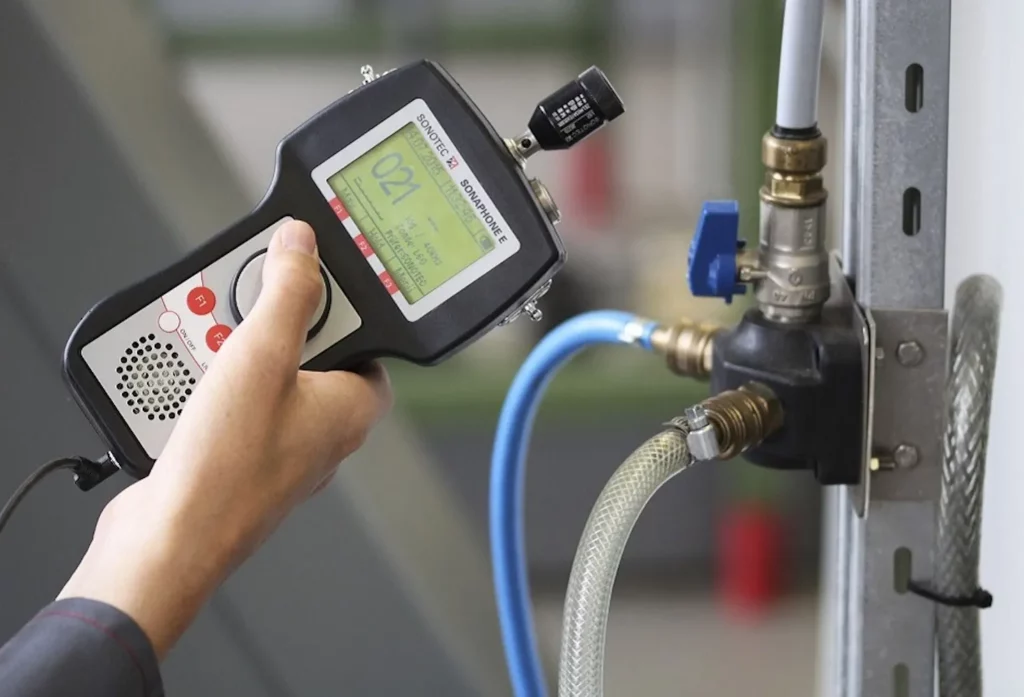
What it detects. The noise a pressurised pipe makes when water forces through a split. There are two parts to it: a higher-frequency hiss at the orifice, and a lower-frequency vibration running along the pipe wall into the ground. A ground microphone is a damped contact sensor with an amplifier and filters. The engineer walks a grid and watches for the intensity peak, which sits directly above the leak.
What defeats it. Pressure, first. A leak that is not under pressure is close to silent, so a waste pipe, an overflow, a shower tray or a roof gives you nothing. Plastic pipe is the second problem: it absorbs the high frequencies that make a leak easy to place and smears what is left over a longer length, so the peak flattens. Then there is everything else in a London building making noise: traffic, a tube line, a lift motor, a communal pump. Carpet, underlay and floating floors all cost you signal.
When it is the right first tool. Copper or steel under a solid floor with the system live. A supply pipe under a drive. A meter that turns with every outlet closed. If the leak is pressurised and the pipe is metal, acoustic detection is the fastest route to a mark on the floor.
Leak noise correlator
What it detects. The same leak noise, measured as a time difference rather than a loudness. Two sensors clamp to contact points on one pipe run, either side of the suspected leak, and the noise reaches each at a different moment. The instrument cross-correlates the two recordings and finds the time offset at which they agree best. Feed in the distance between sensors and the speed sound travels in that pipe, and the offset becomes a distance along the run.
What defeats it. Three things, all about inputs rather than the instrument. You need two accessible contact points on one continuous pipe, and in a flat with the run buried at both ends there is nothing to clamp to. The pipe length has to be right, because a guessed length feeds straight through into the answer. And the propagation speed depends on material and diameter, so where the material is unknown it has to be established on site rather than assumed. Older London streets are full of runs that change from lead to copper to plastic in twenty metres, and there is no single velocity for a run like that.
When it is the right first tool. Long runs where walking a ground microphone over the whole length is impractical: garden and driveway supply pipes, communal risers, commercial mains. It is the tool for underground supply pipe work more than for anything inside a flat.
Tracer gas, and why the bottle says 5% hydrogen
What it detects. A hole, silently. The circuit is drained and isolated, then charged with tracer gas. The gas escapes at the defect, migrates up through screed, soil, plaster or boards, and a hand-held semiconductor sensor detects it at the surface.
Why hydrogen in nitrogen. Hydrogen is the lightest gas there is. Its molecules move faster than anything else, so they find and pass through a small defect faster, and disperse quickly afterwards rather than building a background that ruins the next reading. The natural background level of hydrogen in air is about 0.5 ppm, which is the real reason it works: almost anything the sensor registers above that came out of your pipe, not out of the atmosphere.
The obvious question is whether you want hydrogen inside a flat. Pure hydrogen is flammable in air between roughly 4% and 75%, so nobody uses pure hydrogen. The standard tracer is a ready-mixed cylinder of 5% hydrogen and 95% nitrogen, sold as forming gas. ISO 10156 classifies hydrogen and nitrogen mixtures containing less than 5.7% hydrogen as non-flammable irrespective of how the mixture is subsequently mixed with air. That last clause is the point: the mix cannot be diluted into a flammable band, because it is already below it. It is also non-toxic and odourless.
What defeats it. Gas takes the path of least resistance, not the shortest path. Under a suspended timber floor, or a screed with a service void, it can travel metres sideways and surface confidently above a pipe that is perfectly sound. The opposite failure is a tanked wet room or a sealed vinyl floor, where it has nowhere to go and you get nothing. It also requires draining the circuit, so on a heating system the inhibitor comes out and has to be replaced on refill.
When it is the right first tool. Silent leaks. Underfloor heating, plastic pipework with a weeping push-fit joint, a system losing pressure with no audible noise, and any job where the acoustic kit has come back quiet. Tracer gas is the answer to "there is definitely a leak and nothing can hear it".
Thermal imaging camera
What it detects. Infrared radiated by surfaces, and nothing else. It does not see through walls and it does not see water. FLIR put it plainly. A thermal imaging camera cannot see moisture in walls, but it can detect subtle temperature differences and patterns that reveal the existence of water. A hot water leak warms a patch; a cold water leak cools one, mostly through evaporation.
What makes it work in practice. Span, more than resolution. FLIR's guidance for moisture work is to set the image to roughly a 10 or 20 degree Celsius span so small differences become visible, using a camera with thermal sensitivity around 30 mK. A camera left on automatic scaling in a room with a radiator on will show you the radiator and nothing useful.
What defeats it. Anything that puts a temperature pattern on a surface for a reason other than water: an hour of sun on a south wall, underfloor heating that has been running, a radiator or flue behind, a draught from a floor void. Thick stone, thick tile and deep screed flatten the gradient until there is nothing to see. And, again in FLIR's words, identifying a pattern that looks like moisture does not guarantee the presence of water. Every thermal finding gets confirmed with a moisture meter.
When it is the right first tool. Triage. A thermal survey tells you which third of a floor to concentrate on in a few minutes, and maps the extent of a stain far better than a torch. It narrows; it does not locate.
Moisture meters: pin and pinless are different instruments
Pin meters measure electrical resistance between two pins pushed into the material. Water conducts, so less resistance means more moisture. The reading applies only to the material between the pin tips, which is both the strength and the weakness: a real, local, quantitative measurement that leaves two small holes. In timber it reads moisture content directly. In plaster, brick or screed it reports wood moisture equivalent, or WME, a comparison scale rather than a true percentage.
Pinless meters transmit a low-frequency signal from electrode pads on the base and read the change in the field caused by whatever is underneath. Nothing penetrates the surface, so a whole wall can be swept in a minute. The reading is an average across a volume, and the depth of that volume depends on the model. Tramex quote roughly 10 mm shallow and 30 mm deep for their ME5 and MEX5, about 20 mm for the CME5 and CMEX5, up to 100 mm for their roof and wall scanner and up to 152 mm for their deck scanner. Using a 20 mm instrument to rule out water under a 65 mm screed is not a negative result. It is no result.
What defeats both. Conductive material that is not water. Contact with metal sends a dry area straight to the top of the scale, and there is metal everywhere you cannot see: lath, foil-backed board, conduit, mesh, pipe clips. Salts left by an old, long-repaired damp problem read as moisture that is no longer there. Surface condensation reads high on pins and can read low on a pinless meter, because the water sits above the depth of measurement.
When they are the right first tool. Almost never first, and always in pairs. Pinless to sweep and map, pins to test the map at chosen points, then a second method to explain what the map shows. That is what moisture mapping means as a service: a documented grid of readings rather than one number and an opinion.
Pressure test equipment
What it detects. Whether a circuit holds water at all. The least glamorous kit in the van, a hand pump, a calibrated gauge, isolation caps and stop ends, and the only one that answers with a yes or a no.
The test is not improvised. Schedule 2 of the Water Supply (Water Fittings) Regulations 1999 requires a system to withstand an internal pressure of not less than one and a half times the maximum pressure it is designed to operate at. That is the test pressure, so 7.5 bar for a system operating at 5 bar. With no plastic in the pipework, the system is brought to test pressure by pumping, the test continues for an hour without further pumping, the pressure is maintained for that hour, and there must be no visible leakage. Where plastic is involved there are two permitted tests, because plastic expands under pressure and a straight hold would fail a sound system. In the first, the system is pumped at test pressure for 30 minutes, the pressure is reduced to a third of test pressure, and must not fall below that third over the next 90 minutes. In the second, it is pumped for 30 minutes and the drop must be under 0.6 bar after the next 30 minutes, or under 0.8 bar after 150 minutes.
What defeats it. Trapped air, which is compressible and produces a slow drift that looks exactly like a small leak. Temperature change during the test window, so a heated screed or a sunlit run moves the gauge on its own. A passing valve, which bleeds pressure out of the section you thought was isolated. And a leak small enough not to register inside the test period.
When it is the right first tool. Heating and underfloor work, and any conversation that starts "the boiler keeps losing pressure". Testing circuit by circuit rather than the whole house is what makes it powerful: each section either holds or does not, and the search area halves with every test. It is also the test that clears the pipework entirely and points at the expansion vessel or the pressure relief valve instead.
Endoscope
What it detects. The actual pipe. A camera on a semi-rigid cable a few millimetres across, with LEDs and often an articulating tip, pushed through a small drilled hole into a void, a duct, a boxed riser or the space behind a bath panel.
What defeats it. It only sees where you put it, and it needs a route in. Solid screed with no void offers nowhere to go, steam fogs the lens, and a cable that will not turn a corner will not reach the joint you want.
When it is the right tool. Last, deliberately. Every other instrument produces inference; the endoscope produces evidence. It turns "the readings point here" into a photograph of a wet joint before the tiles come up, and that image carries weight in a trace and access insurance claim.
What none of it can do
Across our last 400 leak detection surveys, the cause of the leak was found in 95% of cases. In 2% the water was arriving from a neighbouring property, which no instrument inside your own flat resolves on its own. In 3% it was not a plumbing leak at all: gutters, roofs and other structural defects letting water in. A van full of calibrated equipment tells you what is true. It does not guarantee that what is true is a pipe.
Booking a survey
We cover London out to the M25, all 32 boroughs. Standard leak detection is charged at a fixed hourly rate of £160, agreed before we travel and never increased on the day. A typical survey takes two to four hours, so £320 to £640 in total. Heating and trace and access work is £200 an hour, mains and supply pipe work £180 an hour, and moisture mapping starts at £175 an hour. Behind the rate sits no find, no fee: if we attend a confirmed live leak and cannot locate it, the detection time is not charged. Full detail is on the pricing page. To book, or to get a view on which of these tools your job actually needs, call 020 7123 8560.
How we help with this
If the article describes a problem you actually have, these are the visits that deal with it.
- leak detection in London
Finding a hidden leak without opening the property up first.
- our full guide to leak detection
How each method works, what it costs and when it is the wrong tool.
Not sure which one applies? Describe the symptom on the phone and you will be told which survey it is, the hourly rate and roughly how long it takes, before anything is booked. 020 7123 8560
Frequently asked questions
Does an engineer really need all of this equipment on one van?
To finish in one visit, yes. Each instrument reads one symptom and each has a failure mode the others cover. Acoustic goes deaf on plastic and on anything unpressurised. Tracer gas needs the circuit drained. Thermal cannot tell water from sunlight. Moisture meters cannot tell water from salt or metal. An engineer who arrives with one damp meter can tell you a wall is wet, which you already knew. What you are paying for is the second and third independent method that turns a wet wall into a marked repair point.
Can a thermal camera see a leak through a wall?
No. A thermal camera reads infrared radiated by the surface in front of it and nothing behind that surface. FLIR, who make a large share of the cameras in use, state that a thermal imaging camera cannot see moisture in walls but can detect temperature differences and patterns that reveal the presence of water. That is a real and useful capability, but it is inference from a surface pattern, not an image of the pipe. Any thermal finding has to be confirmed with a moisture meter before anyone opens anything.
Is tracer gas safe to use in an occupied flat?
The gas used is a ready-mixed cylinder of 5% hydrogen and 95% nitrogen, known as forming gas. ISO 10156 classifies hydrogen and nitrogen mixtures containing under 5.7% hydrogen as non-flammable irrespective of how the mixture is subsequently mixed with air, so it cannot be diluted into a flammable range. It is also non-toxic and has no smell. Pure hydrogen is flammable in air between roughly 4% and 75%, which is exactly why nobody uses pure hydrogen for this. The practical disruption is the drain-down, not the gas.
Why did the engineer not just use the acoustic equipment?
Because acoustic detection needs two conditions that a lot of London jobs do not meet. The pipe has to be under pressure, so a waste pipe, an overflow, a shower tray or a roof will be silent. And the pipe carries the sound better if it is metal. Plastic absorbs the high frequencies that make a leak easy to place and spreads what is left along the run, which flattens the peak the engineer is listening for. On plastic underfloor heating in a screed, tracer gas or per-circuit pressure testing will find the leak while acoustic is still guessing.
Is it worth buying a moisture meter and checking myself?
A cheap pinless meter will tell you whether one patch of wall reads higher than the wall next to it, which is genuinely useful information to have before you call anyone. What it will not do is tell you why. Contact with metal behind the plaster sends a dry area straight to the top of the scale. Salts left by a damp problem repaired years ago read as water that is no longer there. And the depth of measurement is often 20 mm or so, which cannot see under a 65 mm screed at all. Treat a home reading as a reason to investigate, never as a diagnosis.
What happens if none of the equipment finds the leak?
Across our last 400 surveys the cause was found in 95% of cases. In 2% the water was coming from a neighbouring property, and in 3% it was not a plumbing leak at all but gutters, roofs or other structural defects letting water in. Where we attend a confirmed live leak and cannot locate it, the detection time is not charged. That is what no find, no fee means here, and it is the reason the survey works through several methods rather than stopping at the first one that goes quiet.
Does any of this equipment damage the property?
Acoustic, correlation, thermal and pinless moisture readings leave nothing behind at all. Pin moisture readings leave two pinholes. Tracer gas requires the circuit to be drained and refilled, and on a heating system the inhibitor has to be replaced afterwards. An endoscope needs a small drilled hole, usually into a void or behind a panel where it will not be seen. Everything else stays closed until the readings agree on one point, which is the whole reason for using this much equipment instead of lifting the floor.