Pools, spas and plant rooms
Swimming Pool Leak Detection
A pool that needs topping up more than usual is losing water somewhere: through the shell, a fitting, the plant pipework, or simply to evaporation. The first task is telling those apart, because they lead to very different repairs at very different costs.
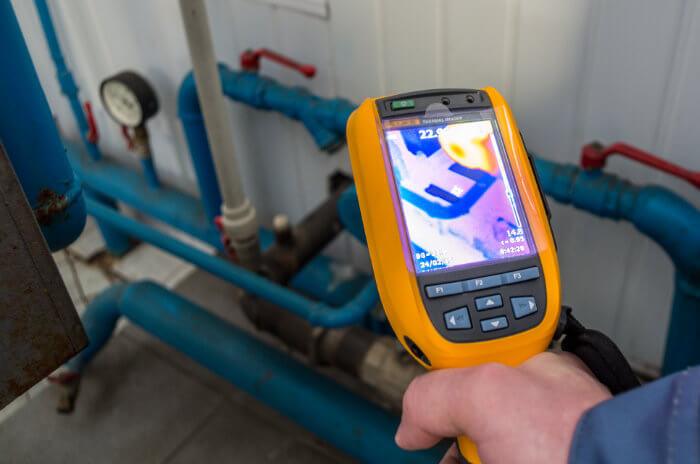
A pool that needs topping up more often than it used to is losing water in one of four places: through the shell, through a fitting, through the buried pipework between pool and plant room, or into the air. Telling those apart is the whole job. They lead to completely different repairs at completely different costs, and you can narrow it down considerably before anyone drives to your house.
First, turn millimetres into litres
Pool owners describe a leak in millimetres and pay for it in cubic metres. The conversion is worth doing before you ring anyone. One millimetre of depth across one square metre of water surface is one litre. Multiply the daily drop in millimetres by the surface area of the pool in square metres and you have the litres you are losing each day.
A 10 m by 5 m pool has a surface area of 50 m². A 10 mm daily drop is 500 litres a day. That is the number to quote when you call, not "it seems a bit low".
Then work out how much of it is normal. SPATA, the UK pool trade association, gives 3 mm in 24 hours as a guide for an uncovered indoor pool losing water to evaporation, and says the figure is significantly higher outdoors. For an outdoor pool it puts normal loss at 25 to 30 mm a week once evaporation, splash, backwashing and water carried out by bathers are added together. It reckons roughly 0.75 of a litre leaves with every person who climbs out.
SPATA's own test is not the American bucket trick. Cover the pool. Stop people swimming. Turn off the automatic top-up. Close the plant room valves and stop backwashing. Mark the level on the front of the skimmer, leave the pool static for up to a week, and mark it again. A covered, isolated pool that still drops has a leak, and you now know its daily rate in millimetres.
Two extra readings are worth taking while you wait. Repeat the measurement with the circulation pump running and again with it off. If the loss speeds up when the pump runs, the pressurised return side is the first place we test. And read your water meter at the start and end of that week, because an isolated pool with the top-up off should barely move it. If the meter is spinning anyway, something upstream of the pool is leaking too.
What the water is actually costing you
Thames Water charges metered households £2.7346 per cubic metre for clean water and £1.4721 per cubic metre for wastewater from 1 April 2026. A cubic metre is 1,000 litres. Top-up water is charged at both rates, because metered volume is assumed to return to the sewer whether it does or not. That is just over £4.20 for every cubic metre your pool loses.
| Pool | Surface area | 10 mm a day | Water and sewerage, 30 days | Over a year |
|---|---|---|---|---|
| 8 m x 4 m | 32 m² | 320 litres a day | about £40 | about £490 |
| 10 m x 5 m | 50 m² | 500 litres a day | about £63 | about £770 |
| 12 m x 6 m | 72 m² | 720 litres a day | about £91 | about £1,100 |
Heated water costs more than that. Lifting 1,000 litres from mains temperature to a pool at 28 degrees takes about 18.6 kWh of heat. At the 7.97p per kWh gas unit rate in Ofgem's price cap for 1 October to 31 December 2026, that is roughly £1.48 of gas before any boiler or heat exchanger losses, on top of the £4.21 of water and sewerage. Call it close to £6 for every cubic metre a heated pool loses.
One thing worth reclaiming while you sort the leak out. Thames Water assumes 90% of your metered water returns to its sewers. If you can show that more than 10% does not, and it lists keeping a swimming pool among the qualifying reasons, you can apply for a wastewater abatement. You need a meter and at least twelve months of readings. That takes the sewerage charge off evaporation you were never going to avoid. It is not the same thing as a leak allowance, and it does not fix anything.
The hosepipe ban turns a slow leak into a legal problem
A hosepipe ban is in force across the Thames Water area and, as of 1 September 2026, it remains in place. Filling or maintaining a domestic swimming or paddling pool with a hosepipe is one of the restricted uses listed in the Water Use (Temporary Bans) Order 2010. Thames Water's own exemptions allow one initial fill after construction or major refurbishment, and topping up from a hand-held container filled at a tap. Nothing else.
Contravening a temporary ban is an offence under section 76 of the Water Industry Act 1991, punishable on summary conviction by a fine up to level 3 on the standard scale, which is £1,000. So a pool losing 500 litres a day cannot lawfully be kept level with a hose this year, and carrying it in by bucket is not a plan. Repairing the leak is the only route back to a full pool.
Liner, concrete and one-piece shells fail in different places
Where we look depends on how the pool was built, because in each type of construction a different component is doing the waterproofing.
Liner pools. The liner is the waterproof layer. The blockwork or steel panel behind it is not. Punctures and seam failures happen, but the usual failure is at a clamped flange, where the liner is squeezed between a faceplate and a gasket at a skimmer, return, light or main drain. Two things give it away: a liner that has gone slack or wrinkled, and a soft or hollow patch underfoot where escaping water has washed out the sand or vermiculite base. Dye testing on a liner pool is done with the circulation off, because a running pump drags the dye away from the point you are trying to find.
Concrete and rendered shells. Reinforced concrete on its own is not watertight in most UK pool construction. The tile bed, the render or marbelite, and the puddle flanges around the fittings do that work. Leaks turn up at movement joints, at the bond beam, along grout lines, and very often in the conduit leaving a light niche. A genuine structural crack through the shell is rare, and when there is one it usually announces itself elsewhere as well, in the surround or on the plant room wall.
One-piece GRP and composite shells. The shell almost never fails. The leak is at the fittings or the pipe tails bonded to them, so the survey goes straight to the pipework.
Any verdict of structural failure reached before every fitting has been dye tested and every circuit pressure tested is a guess. Relining a pool that is leaking at a skimmer gasket is an expensive way of not fixing it.
How the survey runs
The sequence matters more than the kit.
- Isolate the shell from the system. Plug the skimmers, returns and main drain, then measure the level again. If the loss stops, the structure is sound and the problem is in the circulation. If it carries on, the shell or a fitting is at fault.
- Pressure test each circuit on its own. Every suction line, every return, the cleaner line, the plant room manifold, one at a time. A sound line is filled, pressurised and left alone, and the gauge does not move. A needle that creeps down identifies the leaking run, which narrows a whole garden to one pipe.
- Dye test the fittings with the pump off. Skimmer throats, return inlets, light niches and their conduits, steps, main drain, and any grout line or joint that looks suspect. Dye drawn into a gap is the leak. Dye that hangs still is not.
- Trace the buried run. Where a circuit has failed its pressure test, tracer gas and acoustic correlation place the escape point within a spade's width, so any excavation is one targeted hole rather than a trench across your terrace. The same methods we use on buried supply pipes work on pool lines.
Nobody should be digging before step four. Reinstating a lifted patio, deck or lawn is usually the biggest line on the final bill, and it is the one that is avoidable.
Ready to book? Call 020 7123 8560 with three things: the pool size, the daily drop in millimetres, and whether the loss changes when the pump runs. We will tell you how many hours we expect to need and confirm the rate before anyone travels.
Why we do not drain the pool to look
Draining is the quickest way to turn a small problem into a large one, and in London it carries more risk than most places. An empty shell in wet ground has nothing pushing back against the groundwater outside it. Concrete pools can lift. Liners float and wrinkle badly enough that they will not lie flat again. Basement pools sitting in London clay below the water table are the worst case of the three. Then there is the cost of refilling and reheating, which you carry while the pool is out of use and, while a temporary use ban is running, cannot lawfully do with a hose.
Nearly every pool leak can be found with the pool full. We drain only when a test genuinely requires it, and we say why first.
Who actually calls us about a pool
Indoor and basement pools. Most of these are in Kensington and Chelsea, Westminster, Camden and Hammersmith and Fulham, sitting in the same excavated box as the plant room, gym and cinema. The water bill is not the point here. What matters is where the water is going and what it is doing to the structure, which is why these jobs usually need moisture mapping of the surrounding slab and walls. It is worth saying plainly that in a pool hall, not every damp problem is the pool. Across our last 400 leak detection surveys, 3% turned out not to be a plumbing leak at all but roofs, gutters and structural defects letting water in. A humid pool hall under a cold roof will condense, and condensation gets blamed on the pool a great deal.
Garden pools. Richmond, Barnet, Bromley, Kingston and Havering, typically, where the pool sits twenty or thirty metres from the plant room and the pipe runs cross lawn, patio or driveway. These are pressure testing and pinpointing jobs, and the pinpointing is what saves the money.
Small commercial pools. Hotels, gyms, spas and schools, where the binding constraint is that the pool cannot close. These sites have balance tanks, which hide a loss well, and automatic top-up, which hides it completely. If you have an auto-fill, switch it off before you measure anything, or you will be measuring the valve rather than the pool. This work is normally scheduled outside opening hours.
What it costs, and what happens if we cannot find it
Standard leak detection is charged at a fixed hourly rate of £160. Most surveys run two to four hours. A pool with several buried circuits usually sits at the top of that band, so three to four hours, £480 to £640. If the job needs trace and access work, lifting a section of surround or opening a plant room wall to reach the fault, that is £200 an hour. Moisture mapping starts at £175 an hour and emergency attendance at £220. The rate is agreed before anyone travels and it does not rise on the day. The full rate card is published.
Behind the rate sits no find, no fee. If we attend a confirmed live leak and cannot locate it, the detection time is not charged. Across our last 400 leak detection surveys we identified the cause in 95%. In 2% the water was coming from a neighbouring property, and in 3% it was not a plumbing leak at all.
If pool water has already damaged the house, ask to see a sample report before you book rather than after. Escape of water claims turn on cause, origin, method and evidence, and an invoice reading "found leak, repaired" is not evidence.
Pool dropping faster than the weather explains? Call 020 7123 8560. We cover London out to the M25. You will get the hourly rate, the hours we expect to need and an arrival window before you commit to anything, and if we cannot locate a confirmed live leak, the detection time is not charged.
We test London pools methodically: a bucket test separates evaporation from genuine loss, isolation tests split the shell from the circulation system, pressure tests interrogate each buried pipe run, and dye testing pinpoints failures at fittings, lights and skimmers.
From basement spa pools in Kensington to garden pools in Richmond, the goal is the same, a named cause and a marked location before any concrete is touched.
Pool surveys are quoted per site after a short phone assessment of the pool and plant layout.
What you get
- Bucket and isolation testing to confirm real loss
- Pressure testing of suction and return pipework
- Dye testing at fittings, lights, skimmers and grouting
- Acoustic survey of buried plant pipe runs
- Indoor, outdoor, domestic and small commercial pools
- Clear findings before any repair decision
How it works
Finding a pool leak without draining the pool
01
Quantify the loss
A controlled bucket test proves the leak and measures its daily rate.
02
Split shell from system
Isolation testing shows whether water leaves through the structure or the pipework.
03
Test each line
Every suction and return run is pressure-tested individually.
04
Pinpoint the failure
Dye and acoustic methods mark the exact repair point.
Questions
Pool leak detection: cost, method and how long it takes
How do I tell a pool leak from evaporation?
Use SPATA's static test rather than the American bucket test. Cover the pool, stop people swimming, turn off the automatic top-up, close the plant room valves and stop backwashing. Mark the level on the front of the skimmer, leave it static for up to a week, then mark it again and calculate the drop in millimetres. SPATA gives 3 mm in 24 hours as a guide for evaporation from an uncovered indoor pool, and puts normal loss from an outdoor pool at 25 to 30 mm a week once splash, backwashing and water carried out by bathers are included. A covered, isolated pool that still drops has a leak.
How much water is a leaking pool actually losing?
Multiply the daily drop in millimetres by the pool's surface area in square metres. That gives you litres per day, because one millimetre over one square metre is one litre. A 10 m by 5 m pool dropping 10 mm a day is losing 500 litres a day. At Thames Water's 2026/27 metered rates of £2.7346 per cubic metre for water and £1.4721 for wastewater, that is about £63 a month, before you heat any of it.
Can I top up a leaking pool during a hosepipe ban?
Not with a hosepipe. Filling or maintaining a domestic swimming or paddling pool with a hosepipe is a restricted use under the Water Use (Temporary Bans) Order 2010, and a ban is currently in force across the Thames Water area. Thames Water's exemptions cover one initial fill after construction or major refurbishment, and topping up from a hand-held container filled at a tap. Contravening a ban is an offence under section 76 of the Water Industry Act 1991, with a fine of up to £1,000 on summary conviction.
The pool only loses water when the pump is running. What does that mean?
It points to the pressurised return side of the circulation system rather than the shell. Under pressure a fault that seals itself when static will open and lose water. Tell us when you book, because it lets us start the pressure testing on the return circuits instead of working through everything in order.
Do you have to drain the pool to find the leak?
Almost never. An empty shell in wet ground has nothing resisting the groundwater outside it, so concrete pools can lift and liners can float and wrinkle beyond recovery. In London, where basement pools sit in clay and often below the water table, that risk is higher than most places. We isolate, pressure test and dye test with the pool full, and drain only where a test genuinely requires it, having explained why first.
Where do most swimming pool leaks turn out to be?
At fittings and pipework rather than the shell. Skimmer throats, return inlets, light niches and the conduit leaving them, steps, the main drain, and the buried runs between pool and plant room. On a liner pool the commonest single point is the clamped flange where the liner is squeezed between faceplate and gasket. Genuine structural cracks are comparatively rare, which is why a survey should dye test every fitting and pressure test every circuit before anyone proposes relining, re-rendering or excavation.
How much does swimming pool leak detection cost in London?
Standard leak detection is charged at a fixed hourly rate of £160. Most surveys take two to four hours; a pool with several buried circuits usually needs three to four, so £480 to £640. Trace and access work, such as lifting a section of surround, is £200 an hour. Moisture mapping starts at £175 an hour and emergency attendance at £220. The rate is agreed before anyone travels and does not rise on the day, and if we attend a confirmed live leak and cannot locate it, the detection time is not charged.
Does home insurance cover a swimming pool leak?
It depends on the wording. Buildings cover often responds to damage caused by a sudden escape of water, and trace and access cover can pay for locating it, but gradual seepage is commonly excluded and outdoor pools and their pipework are not on every policy. Read the wording first, then make sure the survey produces a report setting out cause, origin, method, moisture readings and photographs. Loss adjusters routinely reject claims supported only by an invoice.
London-wide
Boroughs we bring pool survey kit to
Related services
Underground Leaks
We locate underground water leaks on mains and private supply pipes across London with acoustic correlation and tracer gas, and mark the spot before you dig.
Learn moreTracer Gas
Tracer gas leak detection in London finds the leaks acoustic and thermal methods cannot: deep, small or slow leaks under concrete floors and external grounds.
Learn moreHome Leak Detection
Home leak detection for London flats, houses and supply pipes.
Learn morePool losing more than evaporation?
Tell us the symptoms and your postcode. We’ll confirm the visit, the fixed hourly rate, how long we expect to need and the arrival window before you commit to anything.
Book a detection visit