See through floors and walls
Thermal Imaging Leak Detection
Water changes temperature wherever it goes. A leaking hot-water or heating pipe warms the floor above it; escaping cold water chills plaster as it evaporates. A thermal imaging camera makes those invisible temperature patterns visible instantly, a live map of where water is, and where it should not be.
Quick answer
Thermal imaging finds leaks indirectly: the camera reads surface temperature, not water, so it flags the cool or warm patterns that escaping water leaves on walls, floors and ceilings. Because it only shows temperature difference, a surveyor usually pairs it with acoustic listening or tracer gas to confirm the exact source. Typical UK trade cost-guide ranges run from about £150 to £600.
Thermal imaging leak survey costs in London
| Job | Typical cost | Time |
|---|---|---|
| Basic thermal imaging survey (single room or area) | £150 to £300 | 1 to 2 hours |
| Full-property thermal survey with report | £300 to £600 | 2 to 4 hours |
| Thermal imaging combined with acoustic detection | £250 to £500 | 2 to 3 hours |
| Thermal plus tracer gas confirmation | £350 to £650 | 3 to 4 hours |
| Additional written report or insurance documentation | £50 to £150 | Same day to 2 days |
Typical UK trade cost-guide ranges, not a quote. Our detection is charged at a fixed hourly rate quoted at booking, under no find, no fee.
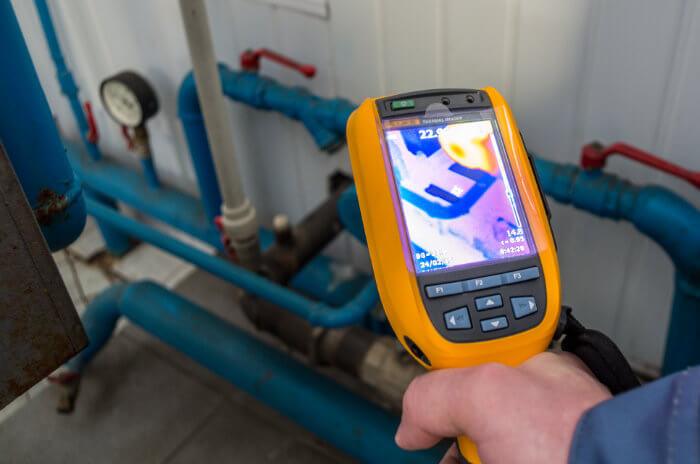
We use professional-grade infrared cameras to scan floors, ceilings and walls, revealing pipe runs, wet patches and heat anomalies in seconds. On underfloor heating systems the camera traces the whole loop and shows the exact point where the pattern breaks.
Thermal imaging is fast, completely non-invasive and produces image evidence that insurers and repair teams can act on immediately.
Included within our standard leak detection visit, no find, no fee applies.
What you get
- Professional infrared cameras on every detection visit
- Traces hot-water, heating and underfloor heating leaks
- Maps moisture spread across ceilings and walls
- Zero disruption, nothing is opened to survey
- Thermal images included in every report
- Cross-verified with acoustic and moisture readings
How it works
What a thermal camera sees, step by step
01
Heat the trail
We run the heating or hot water so the leak paints a clear thermal signature.
02
Scan the structure
Floors, walls and ceilings are surveyed room by room with the infrared camera.
03
Read the anomaly
A leak shows as a bloom that spreads beyond the pipe line, unmistakable against a healthy run.
04
Confirm and mark
Moisture meters and acoustic checks confirm the anomaly is water, not just heat spread.
Before you book anyone
Six things to check before you book thermal imaging leak detection in London
01
A thermal camera shows where water is, not where the leak started
Thermal imaging reads surface temperature differences, not water itself. A cold patch on your kitchen ceiling often marks where water has pooled or tracked along a joist, which can be metres from the actual pipe failure. Sunlight, draughts, underfloor heating and radiator pipes all create similar patterns, so a camera image alone proves very little. Any competent surveyor treats thermal as a screening tool and confirms the finding with acoustic listening, moisture readings or tracer gas before telling you where to open up. If a company's plan is to point a camera, circle a blue blob and leave, you are paying for a photograph, not a diagnosis.
02
A £99 'thermal survey' is a screening visit, not leak detection
UK cost guides put a proper leak tracing survey at roughly £199 to £365 at the entry level, with full multi-method fixed-fee surveys typically £395 to £600 plus VAT, and complex jobs reaching £1,000 or more. Anything advertised well below that is usually a camera-only walkround, or a foot in the door for hourly billing at £95 to £145 per hour with no cap. Two engineers 'still investigating' at hour four costs more than a fixed-fee survey that was priced honestly upfront. Before booking, ask whether the price is capped, what happens if the first method fails, and whether a second visit costs extra.
03
Read the no-find-no-fee small print before you rely on it
No find no fee sounds simple, but many firms qualify it heavily: the full survey fee still applies if the leak is 'inaccessible', outside the tested area, or if you decline destructive access. Some only waive a portion of the bill. Ask directly: if you find nothing, do I pay anything at all, in writing, before the visit. A genuine no-find-no-fee promise is only credible when the fee is fixed in advance, as ours is, because an hourly firm has nothing meaningful to waive and every incentive to keep looking on your clock.
04
Conditions on the day decide whether thermal imaging works
Thermal cameras need a temperature contrast to see anything. A heating circuit leak only shows when the system has been running hot; a cold-feed leak shows best against a warm floor. Surveyors should ask you to run the heating before arrival, or heat the circuit on site, and should isolate and pressure test each circuit separately to prove which pipe is losing water. If nobody mentions preparation when you book, that is a red flag. Homeowners regularly report surveys where the camera 'found nothing' simply because the pipes were at room temperature, and they paid the fee anyway.
05
Check the report will survive your loss adjuster
Most UK buildings policies include trace and access cover, typically capped between £5,000 and £10,000, which reimburses the cost of finding the leak and opening up to reach it. But adjusters reject vague reports. Yours needs the cause and origin of the leak, the detection methods used, a moisture map, and timestamped photos. Notify your insurer before instructing anyone, and confirm the report format in advance. Our trace and access reports are structured for UK loss adjusters and delivered within 48 hours. Also note the cover pays for detection and access, not the pipe repair or redecoration.
06
Budget for all four cost stages, not just the survey
Detection is stage one of four: detection, access (lifting floors, breaking tiles), the repair itself, and reinstatement (re-tiling, screeding, plastering), and reinstatement is often the most expensive. One documented UK case saw a homeowner pay £450 plus VAT for detection, then face access and repair quotes totalling three to five times that figure. That is normal, not a scam, but you should see it coming. Get the detection quote, the access estimate and the repair quote as separate written line items, because that separation is exactly what your insurer needs to assess a trace and access claim.
Compare like for like
Thermal Imaging Leak Detection Done Properly in London
Thermal imaging is a powerful way to find leaks without ripping up floors, but it has real limits. A camera reveals temperature differences, not water itself, so it works best alongside acoustic and tracer-gas methods. This page explains how we use it honestly and what to expect on a London job.
| What to check | A cheap hourly quote | A one-method firm | London Leak Specialist |
|---|---|---|---|
| What thermal actually shows | Sold as a magic camera that sees water, when it only maps surface temperature patterns. | Relies on thermal alone, so a cool damp patch may be read as the leak source. | We treat thermal as a temperature map, not proof of water, and confirm every reading before we commit. |
| Limits of the method | Ignores that warm pipes, drafts and insulation gaps mimic leaks, causing false positives. | Struggles when a leak is cold, deep or masked by underfloor heating already switched on. | We know thermal fails on cold or deep leaks, so we plan around its blind spots from the start. |
| Combining methods | Single quick scan, no acoustic or tracer gas, so ambiguous results are common. | Committed to one technique and will not cross-check, leaving genuine sources missed. | We pair thermal with acoustic listening and tracer gas so findings are confirmed, not guessed. |
| Camera and operator quality | Low-resolution camera in untrained hands produces blurry images anyone can misread. | Decent kit but limited experience reading images across varied London building types. | Good-resolution equipment plus an operator trained to interpret images in context, not just point and shoot. |
| How pricing works | Low headline hourly rate that climbs fast once return visits and extras appear. | Fixed method pricing that does not flex when the leak needs a different approach. | Clear scope against typical UK trade cost-guide ranges, explained before we start, with no surprise add-ons. |
| No-find-no-fee | Rarely offered; you pay for time even when nothing conclusive is found. | May decline the job or charge in full when their single method draws a blank. | Where we agree it upfront, our no-find terms mean you are not billed for an inconclusive search. |
| Insurer-ready report | A verbal answer or a phone photo that insurers will often reject. | Basic notes covering one method, thin on the evidence a claim needs. | A structured report with images and findings across methods, written to support an insurance claim. |
| Access and disruption | Quick look with little care for avoiding needless lifting of floors or tiles. | May open up early because their method cannot narrow the location well enough. | We use thermal to target the area first, keeping unnecessary opening-up to a minimum wherever possible. |
Questions
What thermal imaging can and cannot find
Can a thermal camera see pipes inside walls?
It sees the temperature the pipe creates on the surface, not the pipe itself. A warm pipe a few centimetres deep leaves a clear stripe on the wall or floor; a leak shows as a spreading bloom around that stripe. Deeper or cold pipes need the heating trick or a different method, which is why we carry all of them.
Does thermal imaging find cold water leaks?
Often, yes. Evaporating water cools the surrounding material, so a cold leak appears as a dark, cool patch. Where the contrast is too subtle, we switch to acoustic or tracer gas methods.
Is it accurate enough to dig from?
Thermal imaging narrows the search to a small area almost instantly, and we then confirm the exact point with acoustic or tracer gas before recommending access. No one should break out a floor from a thermal image alone, and with us, no one does.
Is thermal imaging good for underfloor heating leaks?
It is the single best first tool. The camera shows the entire buried loop within minutes of the system running, and the leak point interrupts or blurs the pattern. We then pressure-test the loop to confirm.
How much does thermal imaging leak detection cost in London?
Our rate is a fixed £160 an hour, and a thermal survey alongside acoustic, tracer gas and moisture testing usually takes two to four hours, so £320–£640 in total. Across the trade: entry-level leak tracing surveys start around £199 to £365 nationally, while full multi-method surveys typically run £395 to £600 plus VAT. Beware hourly pricing at £95 to £145 per hour with no cap, which often ends up costing more than a fixed fee for the same result.
Can a thermal imaging camera find a water leak behind a wall?
It can find the temperature signature of moisture, not the leak itself. Wet plaster shows cooler than dry wall, and a hot-water pipe leak shows as a warm plume, but the pattern marks where water has spread, which may be metres from the failed pipe. Professionals use thermal to narrow the search area, then confirm the exact point with acoustic listening, moisture meters or tracer gas before any wall is opened.
Does home insurance cover thermal imaging leak detection?
Usually yes, under the trace and access section of a UK buildings policy, typically capped between £5,000 and £10,000. It covers locating the leak and the making-good of any access holes, but not the pipe repair itself or redecoration. Notify your insurer before booking a survey, and make sure the company provides a written report with cause, origin, methods, moisture map and photos, because loss adjusters reject vague documentation.
How long does a thermal imaging leak detection survey take?
A typical London domestic survey takes two to four hours. Time depends on property size, how many circuits need isolating and pressure testing, and whether the heating must be run to create the temperature contrast thermal imaging needs. Complex cases, such as underfloor heating loops or leaks beneath screed, can take longer. Ask whether your quoted fee covers the whole visit or a capped time window with hourly charges after it.
Can I find a leak myself with a phone thermal camera?
Sometimes, for obvious cases like a hot heating pipe under a floor. Phone attachments and loaned thermal cameras are genuinely useful for draughts and insulation gaps, but leak images are easy to misread: cold subfloors, condensation and draughts all mimic moisture. They also cannot tell you which pipe is leaking or whether it is a leak at all. Use one to gather evidence, then have the finding confirmed before cutting into anything.
Is thermal imaging alone enough to locate a leak?
No. Thermal imaging is a screening method that needs corroboration. It requires a temperature difference to see anything, so cold-water leaks or systems at room temperature can show nothing at all. Reputable surveyors combine it with acoustic ground microphones and correlators, per-circuit pressure testing, tracer gas and calibrated moisture mapping. If a company offers a camera-only survey, treat the result as a starting point, not a location you should open your floor on.
London-wide
Boroughs we bring the camera to
Related services
UFH Leaks
Underfloor heating losing pressure? We locate UFH screed loop leaks in London with thermal imaging and tracer gas, then lift one tile, not the whole floor.
Learn moreHeating Leaks
Boiler losing pressure? Separate a real heating leak from an expansion vessel or relief valve fault before buying parts.
Learn moreHome Leak Detection
Home leak detection for London flats, houses and supply pipes.
Learn moreA damp patch with no obvious source?
Tell us the symptoms and your postcode. We’ll confirm the visit, the fixed hourly rate, how long we expect to need and the arrival window before you commit to anything.
Book a detection visit