Blocks, offices, hotels, schools
Commercial Leak Detection
In a commercial building or residential block, an unlocated leak is more than damage, it is closed floors, unhappy leaseholders, hygiene risk and a service-charge dispute waiting to happen. The economics are simple: precise detection costs a fraction of speculative opening-up in an occupied building.
A leak in an occupied commercial building is a procurement problem before it is a plumbing problem. Someone has to decide who instructs, who pays, whether the survey runs at 3am or during trading, and what evidence the insurer, the leaseholders and the water retailer will still accept in six months. That decision lands on a facilities manager or a managing agent who did not cause the leak and cannot afford to be wrong about it. This page is written for that person.
What a commercial survey costs, and what fixes the price
We charge an hourly rate, agreed before we travel, and it does not move on the day. Standard detection is £160 an hour. Heating circuits and trace and access surveys written up for a loss adjuster are £200 an hour. Mains and supply pipe work is £180 an hour. Moisture mapping starts at £175 an hour. Emergency attendance starts at £220 an hour, and the out of hours figure is stated as a number when you book rather than added afterwards. The only consumable ever charged on top is a tracer gas bottle at £80, and only on jobs that actually need gas. Everything is on the pricing page.
We will not pretend to know a total before we know the building. A single retail unit with one cold and one heating circuit is a different job from a nine storey block with two risers, a plant room and a roof tank. What we fix is the rate, and behind it sits no find, no fee: if we attend a confirmed live leak and cannot locate it, the detection hours are not charged.
Across our last 400 leak detection surveys we found the cause in 95%. In 2% the water was arriving from a neighbouring property. In 3% it was not a plumbing leak at all, but gutters, roofs or other structural defects letting water in. In a multi-let building those last two figures matter more than the first, because they are the findings that stop the wrong party being charged.
The six week clock on a metered commercial leak
If your building is metered, the meter bills you for the water leaving through the leak. That much is obvious. What catches facilities teams out is the sequence running alongside it.
Your water account is not with the water company. Non-household premises in England have chosen their own retailer since the market opened in April 2017. The retailer bills you, handles enquiries and reads the meter; the wholesaler, which most people still call the water company, owns the pipework and supplies the water. Every leak allowance claim is submitted by your retailer to the wholesaler, so phoning the wholesaler direct is how a week gets lost.
Thames Water's leakage code of practice for non-household customers sets the deadlines. You must arrange the repair within six weeks of the leak being confirmed. Miss that and Thames may serve a notice under Section 75 of the Water Industry Act 1991, carry out the repair under its statutory powers and recover reasonable costs from you. The notice is worse than an invoice: under the market-wide leak allowance guidance, where a Section 75 notice was issued and you did not repair in time or agree an extension for mitigating circumstances, no allowance is granted at all. If one has already landed on your desk, our page on Thames Water leak letters covers what to do with it.
Three further conditions catch commercial sites out.
- The claim has to reach the wholesaler within six months of the repair being completed.
- No allowance is granted for increased usage from leaking internal fixtures and fittings, or where the leak was caused by negligence or vandalism. A passing urinal flush or a stuck float valve in a roof tank is a maintenance failure, not a claimable leak.
- The evidence has to exist. Your retailer will want the repair invoice and at least two actual meter reads taken at least two weeks apart after the repair, showing consumption back to normal. Photographs of the leak and of the meter help. If you are claiming the sewerage element as well, the wholesaler needs to be satisfied the water did not reach the sewer, which for a below ground leak means somebody recorded the ground conditions at the time.
None of that can be assembled retrospectively, which is why we photograph and log at the point of location rather than after the repair. The mechanics of the claim itself are in our guide to the Thames Water leak allowance.
One more thing if you hold a portfolio. Not all of it is Thames Water. Thames is the wholesaler for most of Greater London, but Affinity Water supplies the London Boroughs of Harrow and Hillingdon and parts of Barnet, Brent, Ealing and Enfield, and SES Water supplies from Morden and South Croydon southwards. Allowance policy is set by the wholesaler, so two of your buildings eight miles apart can sit under different rules. Thames offers one supply pipe allowance in any 12 months, unless the occupier changed in the last 24; the market-wide guidance is stricter, at one in any 24 month period, and individual wholesalers vary from it. Confirm the wholesaler before you promise a tenant a credit.
If the meter is running now, the clock started when the leak was confirmed. Call 020 7123 8560 and we will give you the hourly rate, how long we expect the building to take, and the earliest slot including tonight. No find, no fee applies to the detection either way.
Surveying a building that cannot close
Non-invasive detection in an occupied building is constrained by three things, and none of them is the equipment.
Noise. Acoustic correlation and ground microphones work by listening for the leak. In an office at two in the afternoon, the plant, the lifts, the air handling units and two hundred people defeat that. The same building at eleven at night, after night setback, is workable. This is the commonest reason a commercial survey is booked out of hours, and it is a physics problem rather than a scheduling preference.
Isolation. Pressure testing tells you which circuit is losing water, but the circuit has to be shut and stay shut long enough to read a decay. In a trading retail unit or a restaurant kitchen that means after close. In a block it means agreeing which risers can come down and warning the flats above before their taps run dry.
Access. Riser cupboards, plant rooms and roof tanks need keys and a person holding them, and a demised unit needs notice under the lease. We ask for drawings, the asbestos register and one named contact before we attend, because a survey that arrives without them becomes two visits and you pay for both.
We work evenings and weekends across London out to the M25. The out of hours rate is quoted as a figure at booking, before anyone is dispatched. Our notes for property managers commissioning leak detection go through how a survey is scoped across a portfolio.
The two compliance regimes that shape a commercial survey
In a house, opening up a ceiling is a decorating decision. In a commercial building it is a controlled activity, and two regimes govern it.
Asbestos. Under regulation 4 of the Control of Asbestos Regulations 2012, the dutyholder for non-domestic premises, and for the common parts of multi-occupancy residential buildings, must know where asbestos containing materials are, keep a record of their location and condition, and give that information to anyone who may work on or disturb them. Materials are presumed to contain asbestos unless there is strong evidence that they do not. In practice this is the strongest argument there is for locating the leak precisely before anything is opened. In a 1970s block, one exploratory hole through the wrong ceiling tile is a licensed removal, a closed corridor and a bill that dwarfs the survey.
Water hygiene. Isolating and draining circuits creates exactly the conditions legionella likes. HSE guidance on hot and cold water systems is specific: keep incoming and stored cold water below 20°C, store hot water at 60°C and get at least 50°C at the outlet within a minute, flush infrequently used outlets weekly, and avoid stagnation and dead legs. A survey that shuts a riser for six hours and hands it back without telling anyone has quietly created a task for whoever holds the water safety plan. We tell the responsible person which circuits were isolated and for how long, so the flushing regime picks it up.
The duty to manage sits with your dutyholder and the water safety plan sits with your responsible person. Our job is to work inside both rather than around them.
Who pays, when the building is multi-let
The argument in a London block is almost never about whether there is a leak. It is about whose leak it is.
The division states easily enough. The wholesaler owns the main and the communication pipe up to the property boundary; from the boundary in, the supply pipe and all internal pipework belong to the property. Inside, the lease decides: communal risers, stacks and distribution mains normally sit with the freeholder or managing agent and are recoverable through the service charge, while pipework serving a single demised unit sits with that leaseholder or tenant.
Easy to state, expensive to argue. Water in a concrete framed building runs along the slab and down service voids and surfaces two floors below and one unit across from where it started. A ceiling stain in flat 12 is routinely a riser fitting on the floor above, or a failed waste connection in flat 14, or in roughly one case in fifty a leak in a neighbouring property altogether. Guessing costs more than measuring.
A report that names the pipe, gives its location and shows the moisture pattern is what ends the argument, and it is far cheaper commissioned jointly than litigated. Where ownership is genuinely unclear we will take instruction from the agent and the leaseholder together and issue one report to both at the same time. The common patterns are in our guides to a leak damaging a neighbour's flat and soil stack and waste pipe leaks in flats.
The report has to satisfy three different readers
A commercial detection report is read by at least three people who each want something different.
The loss adjuster wants cause and origin, the methods used to establish them, moisture readings with locations, dated photographs, and a plain statement of what access work is needed to reach the pipe. Trace and access cover pays for finding the leak and making good the opening up. It does not pay for the pipe repair or the resulting damage, which fall under other sections of the policy. Limits are set per policy rather than by any industry standard, so read your own schedule instead of a figure quoted on somebody's website. Our trace and access page and our notes on insurance leak claims set out how the claim runs.
The term contractor wants a target. "Leak on the hot flow, second floor riser, 1.4m above slab behind the access panel" is a two hour job. "Leak somewhere on the second floor" is a week, and you are paying for the difference.
The leaseholder or tenant about to be charged wants to see that the conclusion was reached by measurement rather than assertion. This is the reader most reports forget, and it is why service charge disputes escalate.
We write one report that serves all three. If your insurer has already appointed an adjuster, tell us at booking and we will address it to them directly.
One asymmetry worth knowing before you plan to argue later. If an insurer declines and you want to escalate, the Financial Ombudsman Service can only take a small business complaint where annual turnover is below £6.5m and the business has either fewer than 50 employees or a balance sheet below £5m, for events since 1 April 2019. A larger commercial policyholder, or a substantial managing agent complaining in its own name, has the courts and nothing else. That is a good reason to get the evidence right on the first visit.
Book a survey for the building
Tell us the address, what you are seeing and who holds the keys. We confirm the hourly rate, how many hours we expect the building to need, the arrival window, and whether the survey has to run out of hours, before you commit to anything. Call 020 7123 8560. If we attend a confirmed live leak and cannot locate it, you are not charged for the detection time.
Terms for block managers and managing agents
Most of our commercial work is repeat work, and the pricing reflects that rather than treating every call as a first one. On an ongoing arrangement with a managing agent, an estate agency or a block management company there is no call-out fee, and the hourly rate comes down with volume. We would rather hold a rate you can budget against across a portfolio than quote each building as a stranger.
The practical benefit is not only the rate. A contractor who already holds your access arrangements, knows which blocks have communal risers and has the drawings on file does not spend the first hour of every visit finding out. On a portfolio that is the difference between a survey and two visits.
One team from the leak to the paint
The engineer who locates the leak can isolate and repair it at the same hourly rate, and we can put the building back afterwards: the making good, the plaster, the decoration. For a managing agent that removes the part of a water escape that actually consumes the week, which is coordinating a detection firm, a plumber, a drying company and a decorator who all blame each other for the delay.
Where the damage is an insurance matter, the same visit produces the report the insurer or loss adjuster needs, so the evidence and the repair come from one instruction rather than three.
We survey commercial and communal systems across London: boosted cold-water risers, heat networks, plant rooms, roof-level tanks and long distribution runs. Correlator-based acoustic work suits large-bore pipework, and out-of-hours surveys keep trading floors and residents undisturbed.
Reporting is built for decision-makers: what is leaking, where, what it affects, and what fixing it involves, in a format managing agents can circulate as-is.
Commercial surveys are quoted per building and system scope; framework rates available for managing agents with recurring requirements.
What you get
- Risers, heat networks, plant rooms and mains distribution
- Out-of-hours and weekend surveys for occupied buildings
- Acoustic correlation for large-bore and long-run pipework
- Flat-to-flat leak origin investigations for managing agents
- Management-ready reports with costed recommendations
- Planned leak-survey programmes for portfolios
How it works
Surveying a working building without closing it
01
Scope with the manager
Drawings, access and symptoms reviewed before we attend, one visit, prepared.
02
Survey the systems
Each circuit is isolated and tested; communal and private supplies distinguished.
03
Pinpoint and prioritise
Leaks located and ranked by risk to fabric, occupants and cost.
04
Report for action
Findings, evidence and next steps circulated to all stakeholders.
Questions
Commercial leak detection: access, hours and reporting
Can you survey the building while it stays open?
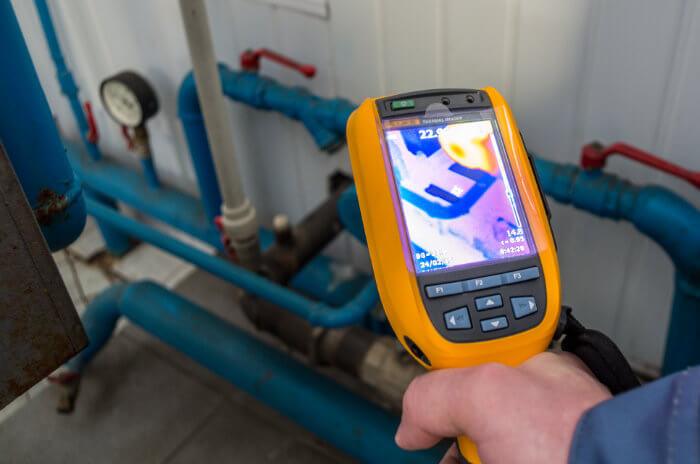
Yes. Non-invasive detection needs access, not demolition, and occupants generally see an engineer with a thermal camera, a moisture meter and headphones. What it does need is somewhere quiet enough to listen and circuits that can be isolated long enough to read a pressure decay. In a busy office or a trading retail unit that pushes the acoustic and pressure work into the evening, while the visual, thermal and moisture work happens during the day.
Why are commercial surveys so often booked out of hours?
Because acoustic detection works by listening. Plant, lifts, air handling units and occupants mask the leak signal during the working day, and the same building after night setback is workable. Isolating a circuit for a pressure test also has to happen when nobody needs the water. It is a physics constraint rather than a scheduling preference. The out of hours rate is stated as a figure at booking, and emergency attendance starts at £220 an hour.
What does a commercial leak detection survey cost?
Standard detection is £160 an hour. Heating and trace and access work is £200 an hour, mains and supply pipe work £180 an hour, moisture mapping from £175 an hour and emergency attendance from £220 an hour. A tracer gas bottle is £80 on the jobs that need gas. The rate is agreed before we travel and does not rise on the day. We do not quote a building total until we know how many water circuits it has, because the hours are what vary, not the rate. No find, no fee covers the detection time if we attend a confirmed live leak and cannot locate it.
Who is responsible for a leak in a multi-let building?
The wholesaler owns the main and the communication pipe up to the property boundary. From the boundary in, the supply pipe and all internal pipework belong to the property. Inside the building the lease decides: communal risers, stacks and distribution mains normally sit with the freeholder or managing agent and are recoverable through the service charge, while pipework serving one demised unit sits with that leaseholder or tenant. Borderline cases turn on lease wording, so read it before you instruct anyone.
Can a business claim a leak allowance on a metered supply?
Often, but through your water retailer rather than direct with the wholesaler. Thames Water's non-household leakage code of practice requires the repair within six weeks of the leak being confirmed and the claim within six months of the repair, and refuses claims where the leak was caused by negligence or where a Section 75 enforcement notice was issued. The market-wide guidance also excludes extra usage from leaking internal fixtures and fittings. Keep the repair invoice and two actual meter reads taken at least two weeks apart after the repair, showing consumption back to normal.
What happens if the leak is not repaired within six weeks?
Thames Water may serve a notice under Section 75 of the Water Industry Act 1991 requiring remedial steps, and if they are not taken it can carry out the work itself and recover reasonable costs from you. Separately, the market-wide leak allowance guidance says no allowance is granted where a Section 75 notice was issued and the leak was not repaired in the required time or an extension agreed for mitigating circumstances. Booking detection promptly is what keeps that door open, because you cannot repair what nobody has located.
Do you need our asbestos register before attending?
Yes, wherever there is any prospect of opening up. Regulation 4 of the Control of Asbestos Regulations 2012 requires the dutyholder for non-domestic premises, and for the common parts of multi-occupancy residential buildings, to record the location and condition of asbestos containing materials and give that information to anyone who may work on or disturb them, with materials presumed to contain asbestos unless there is strong evidence otherwise. Having the register at the scoping stage is also what lets us plan a survey that avoids opening up at all.
Will your report satisfy our loss adjuster?
It is written for one: cause and point of origin, the methods used to establish them, moisture readings with locations, dated photographs, and the access work needed to reach the pipe. Trace and access cover pays for finding the leak and making good the opening up, not the pipe repair or the resulting damage, and the limit is set by your own policy schedule rather than by any industry standard. If an adjuster is already appointed, tell us at booking and we will address the report to them.
Do you work with our existing maintenance contractor?
Yes, and it is the normal arrangement. We locate and document; your term contractor repairs and makes good. The report gives them a named pipe and a location rather than an exploratory brief, which is usually the difference between a two hour repair and a week of opening up on a corridor you have had to close.
Do you offer better rates for a portfolio or a managing agent?
Yes. On an ongoing arrangement there is no call-out fee and the hourly rate reduces with volume. We aim for long-term arrangements rather than one-off jobs, partly because a contractor who already holds your access details and knows which blocks have communal risers is faster on every subsequent visit.
Can you repair the damage as well as find the leak?
Yes. The engineer who finds the leak can isolate and repair it at the same hourly rate, and we have handymen and builders who can make the affected areas good afterwards. For a managing agent that removes the coordination between a detection firm, a plumber and a decorator, which is usually what stretches a water escape into weeks.
London-wide
Boroughs our commercial team covers
Related services
Trace & Access
What trace and access costs in London and what your insurer covers.
Learn moreUnderground Leaks
We locate underground water leaks on mains and private supply pipes across London with acoustic correlation and tracer gas, and mark the spot before you dig.
Learn moreHome Leak Detection
Home leak detection for London flats, houses and supply pipes.
Learn moreWater damage in a working building?
Tell us the symptoms and your postcode. We’ll confirm the visit, the fixed hourly rate, how long we expect to need and the arrival window before you commit to anything.
Book a detection visit