No find, no fee
Home Leak Detection for Flats and Houses
A hidden water leak never fixes itself. It soaks joists, lifts floors, stains ceilings and quietly adds hundreds of pounds to a water bill before anyone sees a drop. Home leak detection, in a London flat or a house, is about finding it fast without tearing the place apart to do it.
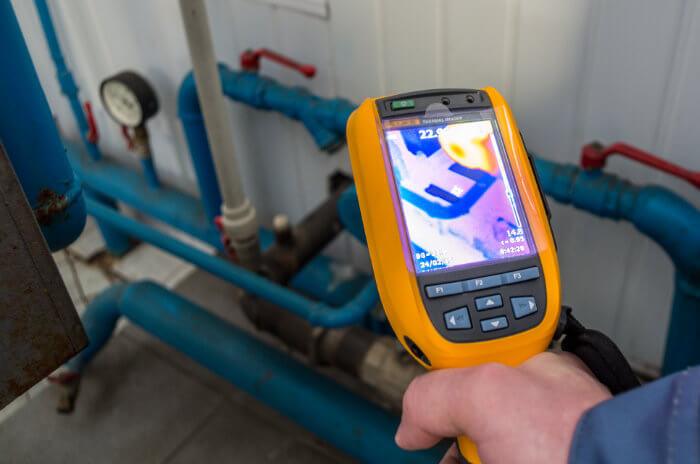
Most people who reach this page already have a symptom and want to know who to ring. The useful thing this page can do is tell you which of six different surveys that symptom points to. They use different equipment, take different amounts of time and are charged at different rates, so booking the wrong one wastes a visit.
London Leak Specialist coordinates specialist leak detection teams across London, out to the M25. The engineers are qualified plumbers, so where a leak is straightforward to reach it is repaired on the same visit. Detection is charged by the hour at a rate agreed before anyone travels, and it sits behind no find, no fee: if we attend a confirmed live leak and cannot locate it, the detection time is not charged.
Domestic and home water leak detection
Most of this work is domestic water leak detection: a flat, a terrace or a semi where water is going somewhere it should not and nobody can see where. Home leak detection is the same discipline as the commercial version, done on a smaller building and usually to a tighter deadline, because the family is still living in it. The equipment is identical, the survey is shorter, and the rate is the standard one rather than a commercial quote.
Domestic leak detection is worth booking as soon as the symptom is consistent rather than waiting for it to get worse. Water tracks along joists and under screed, so the visible stain is rarely above the fault, and every week of delay widens the area that has to dry out afterwards. It also matters for a claim: insurers look at how promptly you acted once you knew.
What a domestic survey does not need is a decision from you about method. Describe the symptom on the phone and the right survey is chosen for you, priced before anyone travels.
Start with the symptom, not the service
A leak survey is a diagnosis, and the diagnosis begins with which system is losing water. That is usually readable from the symptom before an engineer arrives. Find your line below and go to the page for it, because those pages carry the detail this one cannot.
| What you are seeing | What is usually losing water | The survey it needs | Rate |
|---|---|---|---|
| Boiler or sealed system pressure keeps falling and needs topping up, with no water visible anywhere | The heating circuit, or the boiler's own expansion vessel, which mimics a leak without a drop escaping | Central heating leak detection | £200 an hour |
| A warm stripe or patch on the floor, or one underfloor zone that will not hold pressure at the manifold | A pipe cast into the screed, normally one loop out of several | Underfloor heating leak detection | £200 an hour |
| The water meter still creeps with every tap closed and the inside stop valve shut | The buried supply pipe between the meter and the house, which is yours from the boundary inwards | Underground water leak detection | £180 an hour |
| A pool or spa dropping further than evaporation accounts for | The shell, a fitting, or the circulation pipework in and under the plant room | Swimming pool leak detection | Quoted per site after a short phone assessment |
| A damp patch spreading on a wall, ceiling or solid floor while the mains stays under pressure | A pressurised pipe under screed, tiles or plaster | Acoustic leak detection, within a standard survey | £160 an hour |
| A stain that darkens after rain and dries back between downpours | Frequently not plumbing at all: a gutter, a flashing, a failed seal, a bridged cavity | Damp and moisture detection | From £175 an hour |
Those rates are published in full on our pricing page and they do not move once you have been quoted. A typical domestic survey takes two to four hours, so a standard visit at £160 an hour comes to between £320 and £640 in total. Repair labour runs at the same £160 an hour, with parts and making good quoted once the leak has been located.
Not sure which line is yours? Call 020 7123 8560 and describe what you can see. You will get the survey type, the hourly rate for it, roughly how many hours to expect and an arrival window, before anything is booked.
The 30-minute check worth doing before you book anyone
One test separates a buried leak outside from anything inside the house, and it costs nothing. Thames Water publishes the method in its own leak guidance.
- Turn off every appliance that uses water.
- Close the inside stop valve.
- Read the meter and write the reading down.
- Wait 30 minutes, then read it again.
If the two readings match, nothing is escaping between the meter and the inside stop valve. If they differ, Thames Water's guidance is explicit that the leak sits between those two points, which is the buried supply pipe on your side of the boundary. That is an underground trace, not an internal survey, and knowing it before you call changes what you should be booking.
The second free check is the toilet. On Thames Water's figures a cistern trickling into the pan wastes up to 200 litres a day, a rippling one 600 litres, and one flowing constantly 8,000 litres a day. That alone explains a great many alarming bills. Lay dry toilet paper against the back of the pan, leave it three hours or overnight, and see whether it is wet. A fair number of hidden leaks are a failed flush valve in plain sight.
In one visit in twenty, the answer is not a pipe of yours
Across our last 400 leak detection surveys the cause of the leak was found in 95% of cases. What sits in the remaining 5% is worth knowing before you commission anything.
In 2% the water was arriving from a neighbouring property. In flats that is normally the flat above or a communal riser, and the survey still earns its money, because a report naming cause and origin is what settles who pays. Houses have their own version. Thames Water states that where a single supply pipe serves more than one property, you and your neighbours hold joint responsibility for maintaining the shared part, so a trace that stops at your boundary can save you paying to repair someone else's pipe.
In 3% there was no plumbing leak at all. Water was entering through gutters, roofs and other structural defects. From inside, those cases look identical to a pipe leak: a spreading stain, a musty smell, a meter reading normally. The tell is timing against the weather, which is why the rain question sits in the table above and why the right survey for it is a moisture survey rather than a pipe trace.
What a detection visit actually involves
- Symptoms and history. When it started, what makes it worse, what has already been tried and by whom.
- Isolate and pressure test. Mains, hot, heating and waste are tested separately. This is the step that rules the boiler in or out, and it is the one a cheap visit skips.
- Pinpoint. Acoustic listening, thermal imaging, tracer gas and moisture mapping, in whatever combination the building fabric allows. Most stubborn leaks need two methods to agree before anything is opened up.
- Repair or report. A failed joint, a pinholed copper pipe or a weeping valve is usually fixed on the day. Anything needing floor access, an uncommon part or drying time is quoted before we proceed.
If you intend to claim, that report is the document a loss adjuster reads, so it is worth understanding what trace and access cover pays for, and what it does not, before the work starts rather than after.
Leak detection across London
We cover the 32 London boroughs and the City of London, out to the M25. Same-day appointments are usually available across inner London and next day almost everywhere inside the motorway. Choose your borough below, or call and give us the postcode.
Questions people ask before booking
Do you do domestic and home leak detection, or only commercial work?
Domestic work is the bulk of it. Flats, houses, maisonettes and conversions across the London boroughs, at the standard hourly rate rather than a commercial quote. Commercial premises are handled too, and the difference is scale and out of hours access rather than a different method.
Which leak detection survey do I need?
Work from the symptom. Falling boiler pressure with no visible water points at the heating circuit. A meter that moves with the inside stop valve closed points at the buried supply pipe. A warm patch underfoot points at an underfloor loop. A stain that reacts to rain is usually not plumbing. The table above matches each of those to the page that covers it properly. If none of them fits, describe what you can see on the phone and we will tell you which survey it is.
What does no find, no fee actually mean here?
If we attend a confirmed live leak and cannot locate the cause, the detection time is not charged. It covers the detection visit. The repair runs at the same hourly rate once the leak is found, with materials costed on top. It is not a free inspection either: there has to be a live leak for it to apply, and the cover is limited to leaks arising inside your own property. Where the visit ends by establishing that nothing is leaking at all, the boiler losing pressure through its expansion vessel or the damp turning out to be condensation, the time is charged. Eliminating a leak is a finding, and usually a more useful one than confirming a leak you already suspected. If the trace ends at a neighbouring flat, a communal riser or the supplier's main outside your boundary, the time is charged: we have found the source, and knowing it is not yours is the finding that decides who pays for the repair.
Can you repair the leak on the same visit?
Often, yes. The engineers are qualified plumbers, so straightforward failures are fixed there and then. Where the repair needs the floor opening, a part we do not carry or time for the structure to dry, you get a price before anyone starts.
How quickly can you attend?
Same day across most of inner London, next day almost everywhere inside the M25. Say when you book if water is actively escaping, because live leaks are prioritised and are charged at the emergency rate, which starts from £220 an hour and is stated as an exact figure at the time of booking.
Water going somewhere it should not? Call 020 7123 8560. Give us the symptom and the postcode, and before you commit to anything you will have the survey type, the hourly rate, the hours we expect to need and the arrival window. If we attend a confirmed live leak and cannot find it, the detection time is not charged.
London Leak Specialist specialises in non-invasive water leak detection across every London borough. We combine acoustic listening equipment, thermal imaging cameras, tracer gas and moisture mapping to pinpoint the leak to a precise spot, then either repair it on the day or hand you a clear, insurer-ready report showing exactly what we found and where.
If we attend and cannot locate a leak inside your own property, you do not pay the detection fee. That is what no find, no fee means here, and tracing the source to a neighbour or a communal pipe counts as finding it.
Detection visits are charged by the hour at a fixed rate quoted before we attend and never exceeded, covered by no find, no fee. Repair labour runs at the same £160 an hour, with parts and making good quoted before any work starts.
What you get
- Every water leak detection method on every van: acoustic, thermal, tracer gas and moisture mapping
- No find, no fee on all detection visits
- Same-day and next-day appointments across all 32 boroughs
- Insurer-ready reports with photos, readings and marked location
- Repair on the day where access allows
- Trace and access support for insurance claims
How it works
How a leak detection survey actually runs
01
Tell us the symptoms
Damp patch, pressure loss, high bill, warm floor, meter spinning, the pattern tells us where to start.
02
We isolate and test
Pressure tests on each circuit confirm which system is losing water: mains, heating, hot water or waste.
03
We pinpoint the leak
Acoustic profiling, thermal imaging and tracer gas narrow the leak to centimetres, not rooms.
04
Repair or report
We fix it there and then where possible, or document everything for your insurer and repair team.
Questions
What leak detection costs, and what it includes
Which leak detection survey do I need?
Work from the symptom. Falling boiler pressure with no visible water points at the heating circuit. A meter that moves with the inside stop valve closed points at the buried supply pipe. A warm patch underfoot points at an underfloor loop. A stain that reacts to rain is usually not plumbing. The table above matches each of those to the page that covers it properly. If none of them fits, describe what you can see on the phone and we will tell you which survey it is.
What does no find, no fee actually mean here?
If we attend a confirmed live leak and cannot locate the cause, the detection time is not charged. It covers the detection visit. The repair runs at the same hourly rate once the leak is found, with materials costed on top. It is not a free inspection either: there has to be a live leak for it to apply.
Can you repair the leak on the same visit?
Often, yes. The engineers are qualified plumbers, so straightforward failures are fixed there and then. Where the repair needs the floor opening, a part we do not carry or time for the structure to dry, you get a price before anyone starts.
How quickly can you attend?
Same day across most of inner London, next day almost everywhere inside the M25. Say when you book if water is actively escaping, because live leaks are prioritised and are charged at the emergency rate, which starts from £220 an hour and is stated as an exact figure at the time of booking.
London-wide
Leak detection across every London borough
Related services
Acoustic Detection
Acoustic leak detection in London: ground microphones and correlators pinpoint hidden water leaks under floors, in walls and underground, without digging.
Learn moreThermal Imaging
Infrared thermal imaging surveys find hidden water and heating leaks in London homes without opening floors or walls.
Learn moreTrace & Access
What trace and access costs in London and what your insurer covers.
Learn moreWater going somewhere it shouldn’t?
Tell us the symptoms and your postcode. We’ll confirm the visit, the fixed hourly rate, how long we expect to need and the arrival window before you commit to anything.
Book a detection visit