Locate before you excavate
Underground Water Leak Detection
The pipe between the water company’s stop valve and your home is yours, and when it leaks underground, the meter keeps counting, the lawn stays soggy, and the water company sends a letter telling you to fix it. Digging up a garden or driveway on a guess is the most expensive way to respond.
If Thames Water has told you your meter points to a leak, the buried pipe from your boundary to the house is normally yours to find and repair, and the four-week clock in their notice is already running. Getting the repair done and documented in time is also what a Thames Water leak allowance claim depends on. Mains and supply pipe tracing is £180 an hour and a typical trace takes two to three hours, so £360 to £540 in total, under no find, no fee.
Quick answer
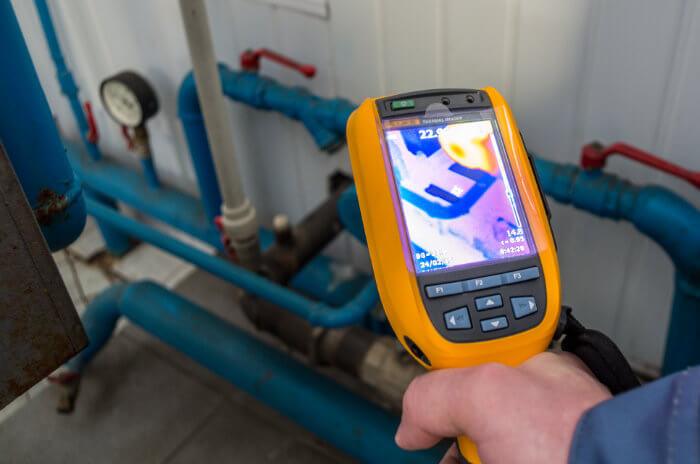
An underground supply-pipe leak is traced non-destructively before any digging, using acoustic ground microphones and leak-noise correlators, sometimes with tracer gas or thermal imaging to pinpoint the exact spot. Typical UK trade cost-guide ranges run about £250 to £600. Thames Water may repair a first leak on your boundary or external supply pipe free under its subsidy scheme.
Underground supply-pipe leak detection costs
| Job | Typical cost | Time |
|---|---|---|
| Acoustic ground microphone survey | £250 – £450 | 1 – 2 hours |
| Leak-noise correlator pinpointing | £300 – £600 | 2 – 3 hours |
| Tracer gas detection (hydrogen) | £350 – £650 | 2 – 4 hours |
| Thermal imaging survey add-on | £150 – £350 | 1 – 2 hours |
| Excavation to expose leak (per point) | £400 – £900 | half – full day |
Typical UK trade cost-guide ranges, not a quote. Our detection is charged at a fixed hourly rate quoted at booking, under no find, no fee.
We locate underground leaks before a spade touches the ground. Acoustic correlators and ground microphones follow the leak noise along the buried route; where the ground or pipe material defeats sound, tracer gas rises through the soil to give the position away.
The result is a marked point, a small targeted excavation, and a repair, instead of a trench across the garden.
Detection charged by the hour at a fixed rate quoted up front; excavation and repair at the same hourly rate once the leak is marked. No find, no fee.
What you get
- Water main leak detection on private supply pipes and buried mains
- Acoustic correlation across buried pipe runs
- Tracer gas surveys through soil, paving and driveways
- Pipe route tracing where no records exist
- Water main leak detection after a water company high-usage letter
- Excavation and repair arranged after location
How it works
Finding a buried pipe without digging first
01
Prove the loss
A meter test with everything off confirms the underground escape and its rate.
02
Trace the route
We map where the buried pipe actually runs, often not where anyone assumed.
03
Correlate the noise
Sensors along the route triangulate the leak position beneath the surface.
04
Mark and open
One small, precise excavation exposes the leak for repair.
Before you book anyone
Six things to know before you book underground water leak detection in London
01
Do the free stopcock test before you pay anyone
Ten minutes of your time can confirm the leak is genuinely underground. Turn off the internal stopcock, run no water, and watch the meter at the boundary. If the dials keep turning with the stopcock closed, water is escaping between the meter and your house - the classic buried supply pipe leak. If the meter stops, the problem is inside and a standard survey applies instead. Water companies flag continuous flow on smart meters (one Thames Water letter cited 48 litres per hour, roughly ten times normal household usage), so this test also tells you whether their letter is accurate before the four-week repair clock starts running.
02
Uncapped rates are where underground jobs get expensive
Trade platforms quote leak detection at £95-£145 per hour, which sounds cheap next to a fixed survey fee. But underground supply pipe leaks are rarely a one-hour job: the pipe must be isolated, pressure tested, charged with tracer gas and traced along its full run, often under driveways or extensions. Day rates for complex traces run £595-£1,500, and hidden-leak investigations typically land between £425 and £695. An open-ended hourly clock means you carry all the risk of a slow trace. A fixed hourly rate agreed before the visit caps that risk at booking: our mains and supply pipe traces are £180 an hour, typically £360–£540 in total for a London home.
03
Read the no-find-no-fee small print - underground leaks are often excluded
Many firms advertising no find, no fee quietly exclude exactly the leak you have. Common carve-outs in published terms: the guarantee applies to internal hot and cold pipework only, with incoming mains and underground supply pipes excluded; "found" is defined as narrowing the leak to a 5m x 5m area rather than a dig-here point; and the guarantee is void unless the same firm carries out the access work. Before booking, ask three questions in writing: does no-find-no-fee cover the external supply pipe, how precisely will the leak be marked, and is the guarantee conditional on you buying the repair from them?
04
Ask what equipment actually arrives on the van
Buried supply pipes cannot be reliably traced with a thermal camera alone - soil masks temperature differences, and plastic MDPE pipe transmits sound poorly, which defeats basic listening sticks too. A proper underground trace needs tracer gas (the industry-standard 5% hydrogen, 95% nitrogen mix, non-toxic and non-flammable) pushed through the isolated pipe so escaping gas can be detected at the surface, backed by acoustic correlators and a pressure test to confirm the circuit. Done properly, this pinpoints leaks to within centimetres. If a company cannot list the methods they will bring, you are paying survey money for a guess.
05
Never accept a dig-first quote - excavation is the expensive part
Speculative digging is the most common way London homeowners overpay. Trenching costs roughly £100-£200 per metre once reinstatement of drives and paving is included, moling runs £150-£200 per metre, and a full supply pipe replacement averages around £3,200 (£1,200-£4,400+ depending on length and access). Forum threads are full of invoices for exploratory holes dug in the wrong place - one repair bill for an underground lead pipe came in at over £1,600. Pinpointing the leak before anyone lifts a slab means one targeted excavation, or the cheaper decision to mole a new pipe instead of patching an old one repeatedly.
06
Mind the four-week deadline - and get a report your insurer and water company will accept
Most water companies, including Thames Water, only credit a leak allowance for water lost through a supply pipe leak if it is fixed within about four weeks of notification - miss it and you can be billed for every litre, with metered leak bills reaching £4,000 in reported cases. Around 97% of UK buildings policies also include trace and access cover, typically £5,000-£10,000, but loss adjusters reject vague paperwork. Insist on a written report stating cause, origin, detection method, moisture readings and photographs. We issue trace and access reports structured for UK loss adjusters within 48 hours of the survey.
Compare like for like
Underground Water Leak Detection Across London
A hidden leak on your underground supply pipe can waste water, soak foundations and inflate your bills long before it surfaces. We trace the exact leak position with acoustic ground microphones and correlators before anyone lifts a slab, so any digging is small, targeted and only done where it is genuinely needed.
| What to check | A cheap hourly quote | A dig-and-hope firm | London Leak Specialist |
|---|---|---|---|
| Finding the leak first | Quotes a low hourly rate but often starts digging early, letting the clock and the trench run on with no clear leak position confirmed. | Relies mainly on excavation, opening the ground where the pipe is assumed to run rather than where the leak has actually been traced. | We trace the leak with acoustic ground microphones and correlators along the supply pipe route, pinpointing the position before any ground is opened. |
| Who is responsible | Rarely checks the water company boundary, so you may pay for a leak that is not legally yours to repair. | Focuses on digging, not on establishing whether the leak sits on your supply pipe or the company's main. | We help establish where the boundary falls and whether the leak is on your supply pipe or the water company's side before work proceeds. |
| Free repair schemes | Seldom mentions that many London water companies offer a first free repair on customer supply pipes under set conditions. | Tends to quote for full excavation without raising any subsidy you might be entitled to claim. | We flag whether your water company's first-leak repair subsidy may apply, so you can claim any free repair you qualify for. |
| How pricing works | An open hourly rate can climb quickly once unexpected digging, reinstatement and extra hours are added on the day. | Excavation-led pricing is hard to predict, as cost depends on how much ground is opened to find the pipe. | We quote clearly against typical UK trade cost-guide ranges for detection, so you understand the likely cost before we begin. |
| If nothing is found | You usually still pay the accrued hours even if no leak is located during the visit. | You may pay for excavation and reinstatement whether or not the leak is actually found where they dug. | We work on a no-find, no-fee basis for detection, so you are not charged for a survey that fails to locate the leak. |
| Amount of digging | Early or speculative digging can mean several trial holes across your garden, drive or floor before the leak is reached. | Dig-and-hope means opening larger stretches of ground on the chance of exposing the leaking section. | Because the position is traced first, any excavation is kept small and targeted to the confirmed leak point only. |
| Report for your insurer | Often provides little more than a verbal summary, which insurers may not accept for a claim. | Usually leaves you with a repair invoice but no evidence of how or where the leak was located. | We provide a written detection report with our findings and method, suitable for supporting a home insurance claim. |
Questions
Supply pipe leaks: who pays, and what it costs
The water company says I have a leak, what now?
Their meter test showed usage that does not match your household, usually a leak on the private supply pipe, which is the homeowner’s responsibility. We locate it precisely, and some water companies offer contribution schemes or reduced bills once you show the leak was found and repaired promptly. Our report supports that claim.
Can you find a leak under a concrete driveway?
Yes. Acoustic signals travel well through solid surfaces, and tracer gas rises through joints and porous material. The alternative, breaking the drive speculatively, is exactly what precise location avoids.
How deep can you detect?
Typical London supply pipes sit 450–900mm down, well within range of correlators and gas detection. Deeper commercial mains are also locatable; depth mainly affects how tightly we can bracket the position before opening up.
How much does underground water leak detection cost in London?
Mains and supply pipe detection is charged at a fixed £180 an hour, and a typical trace takes two to three hours, so £360–£540 in total. Across the trade: hourly-rate firms charge £95-£145 per hour, which on underground supply pipe traces commonly totals £425-£695, with complex day-rate jobs reaching £595-£1,500. Detection is priced separately from repair: excavation and pipe work run from a few hundred pounds for a single targeted dig to around £3,200 on average for full supply pipe replacement.
Who is responsible for an underground water leak between the meter and the house?
The homeowner. The water company owns the main and the communication pipe up to the boundary of your property (usually the external stop valve or meter). Everything from the boundary to your internal stopcock is your private supply pipe, and leaks on it are yours to repair - typically within about four weeks of the water company notifying you. Leaks on the public side, including under the pavement, are the water company's responsibility to fix at no charge.
Will my water company refund the water lost through a leak?
Usually yes, through a leak allowance - but only if you act quickly. Most companies, including Thames Water, credit water lost through a supply pipe leak provided you repair it within roughly four weeks of being notified. Supply pipe allowances can generally be claimed more than once; internal pipework leaks are typically allowed only once. You will need proof of repair, such as a detection report and plumber's invoice, so keep all paperwork.
How long does underground leak detection take?
A typical domestic underground trace takes two to four hours on site. The pipe is isolated and pressure tested first to confirm the leak is on that circuit, then tracer gas (5% hydrogen, 95% nitrogen) is introduced and traced at the surface alongside acoustic correlation - the gas stage alone can pinpoint a leak in under an hour. Larger properties, long pipe runs or leaks under extensions take longer. Written reports for insurers or the water company usually follow within 48 hours.
How accurate is underground water leak detection?
Very accurate when multiple methods are combined. Tracer gas surveys locate buried leaks to within centimetres, with industry sources citing success rates above 95%, and acoustic correlators cross-check the position along the pipe run. Beware looser definitions: some firms' terms class a leak as "found" once narrowed to a 5m x 5m area, which can still mean digging several exploratory holes. Ask any company how precisely they will mark the excavation point before you book.
Does home insurance cover underground leak detection?
Usually, via trace and access cover, which around 97% of UK buildings policies include with limits of £5,000-£10,000. It pays for locating the leak and accessing the pipe - excavating and reinstating floors or driveways - but not the pipe repair itself or pre-existing damage. Claims succeed on paperwork: insurers expect a report stating the cause, origin, detection methods used, moisture readings and photographs. Check your policy schedule before booking, and get the detection report before repairs start.
London-wide
Underground leak detection in every borough
Related services
Acoustic Detection
Acoustic leak detection in London: ground microphones and correlators pinpoint hidden water leaks under floors, in walls and underground, without digging.
Learn moreTracer Gas
Tracer gas leak detection in London finds the leaks acoustic and thermal methods cannot: deep, small or slow leaks under concrete floors and external grounds.
Learn moreLeak Repair
Water leak repair across London: burst pipes, pinhole leaks, failed joints and weeping valves, usually fixed on the same visit as the detection survey itself.
Learn moreMeter turning with every tap closed?
Tell us the symptoms and your postcode. We’ll confirm the visit, the fixed hourly rate, how long we expect to need and the arrival window before you commit to anything.
Book a detection visit