Burst Water Main: What to Do, and What to Check When the Water Comes Back
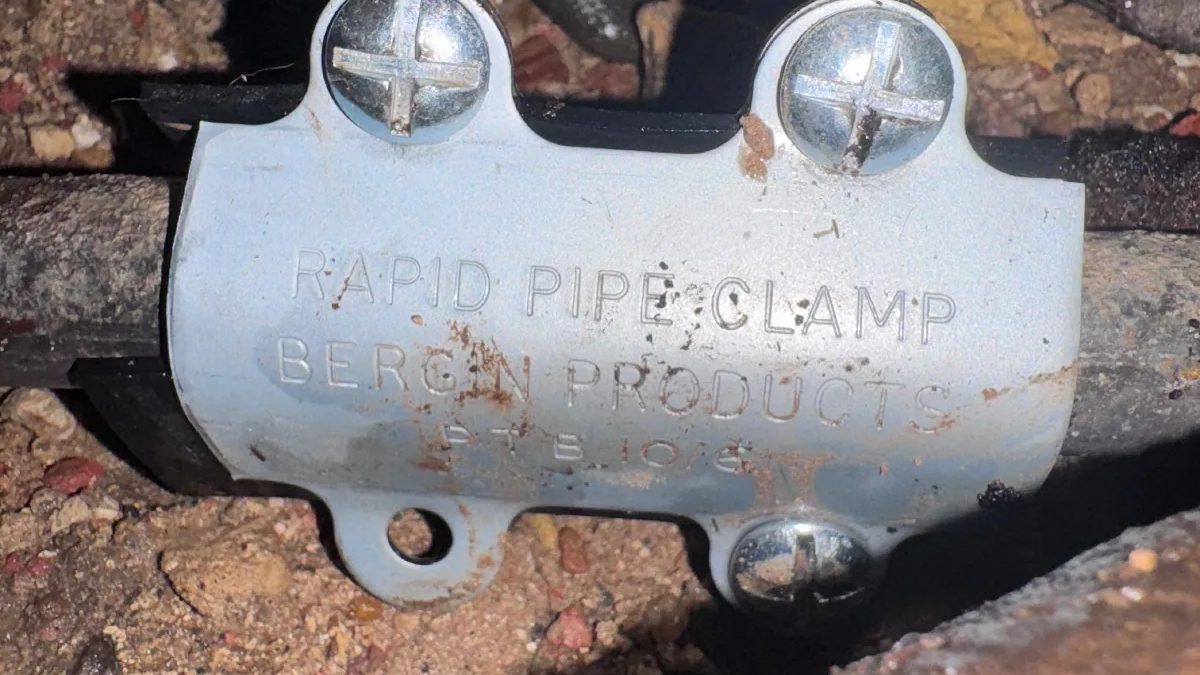
A rapid repair clamp on a leaking water pipe under a ground floor, from one of our jobs in Chiswick, W4.
When a trunk main bursts, thousands of homes lose water at once and get it back with a jolt. What to do while it is off, what is normal when it returns, and the one check worth running on your own pipes afterwards.
At about quarter past five on Monday 28 September, a large water main burst near Island Barn Reservoir in Molesey. By the time most of south-west London was awake, taps in up to 15,000 homes were dry or barely running. Schools in Esher, Surbiton, Thames Ditton and New Malden closed for the day, and Thames Water set up a bottled water station at Sandown Park.
Supply was rerouted by Monday afternoon and Thames Water said every affected property was back on by Tuesday. The permanent repair needs a specially fabricated section of pipe, so low pressure may come and go until that is fitted.
A burst main is Thames Water's problem to fix. Some of what follows it is yours, though, and that part is easy to miss. This guide covers what to do while the water is off, what is normal when it comes back, and the one check worth running on your own pipes once it has settled.
Who was affected by the Molesey burst
The outage reached five London boroughs, Kingston upon Thames, Merton, Richmond upon Thames, Sutton and Wandsworth, and two in Surrey, Elmbridge and Spelthorne. Postcodes reported as affected included KT1 to KT3, KT5 to KT8, KT10, KT12, SM4, SW16 to SW20, CR4, TW10 and TW16. The number of homes affected fell through the day as supply was rerouted, from about 15,000 at first light to around 6,000 by midday and about 5,500 by the evening.
If you are in one of those areas and your water is still behaving oddly this week, read on. Most of it is normal. Some of it is worth a closer look.
What a burst water main actually is
A water main is one of the large pipes under the road that carries treated water from a reservoir or treatment works to a whole district. Trunk mains, like the one in Molesey, can be more than a metre across. When one of them splits, the water company has to shut valves either side of the break, and everything downstream of those valves loses pressure at once. That is why a single burst can empty taps across several boroughs, and why homes miles from the burst are hit while the house next to it may not be.
Mains burst for ordinary reasons. Old cast iron gets brittle, ground movement stresses joints, pressure changes shock the pipe, and occasionally a digger finds one. Thames Water estimates that about 95% of the water it loses leaks from pipes hidden underground, most of it slowly rather than in a burst like this one. You can read Thames Water's own leakage update for the wider picture.
No water? Check whether it is the main or your house
Before assuming the worst about your own plumbing, take two minutes to work out whose problem it is.
- Ask a neighbour, or check the street. If the houses either side have no water either, it is almost certainly the network. If they are running normally and you are not, the problem is more likely on your side.
- Check with Thames Water. Its no water or low pressure page lets you check your postcode for known bursts and planned works.
- Check your own stop tap. It is usually under the kitchen sink. If someone has turned it off, or it has seized part-closed, that alone explains it. Our guide on how to find and turn off your stop tap shows where to look.
If the street has water and you do not, and the stop tap is fully open, you may have an airlock or a problem on your own supply pipe. That is the point at which to call a plumber, not before.
What to do while the water is off
- Turn off any tap you opened to test it. When the supply comes back, an open tap over a plugged sink is how a flood starts in an empty house.
- If you have a hot water cylinder and a cold tank in the loft, go easy on the hot water. Once the tank drains it will not refill until supply returns, and an immersion heater left on in a cylinder that has run low can be damaged.
- A combi boiler needs mains pressure to make hot water, so expect no hot water either. The heating side is a sealed system and should keep running. If the boiler shows a fault, reset it once the water is back.
- Do not run the washing machine or dishwasher on a timer overnight. They can start filling as soon as the supply returns and pull in whatever sediment the burst has stirred up.
- If someone vulnerable lives with you, make sure they are on your water company's Priority Services Register. During the Molesey burst, Thames Water delivered bottled water directly to people on it.
When the water comes back: cloudy, brown or spluttering
The supply rarely comes back clean and steady at once. Thames Water's guidance after an incident covers what to expect, and it matches what we see on callouts.
- Spluttering taps are air being pushed out of the pipes. Run the cold tap in the kitchen for a couple of minutes and it settles.
- Cloudy or white water is almost always tiny air bubbles. Fill a glass and watch it. If it clears from the bottom up within a minute or two, it is air and harmless. It usually clears from the whole system within two to three hours.
- Brown, orange or yellow water is sediment and iron deposits knocked off the inside of the mains by the change in flow. Run the kitchen cold tap until it runs clear. If it has not cleared after 20 minutes, or it keeps coming back, report it to the water company.
- Low pressure can take several hours to recover, and longer on higher ground. While the Molesey repair is temporary, Thames Water has said pressure may dip again.
If the pressure stays low for days after your neighbours' has recovered, the cause is probably in your own property. A partly closed stop tap, a blocked filter on a combi, or a leak on the supply pipe will all show up this way. Our guide to low water pressure in the house works through them in order.
The check worth doing once the water is back
This is the part most people skip. When a supply is cut and then restored, the pipes go from empty to full pressure quickly. On older pipework, a surge like that can find a weak compression joint, a corroded fitting or an old lead or galvanised section that was only just holding. It does not happen often, but it does happen, and a slow leak that starts this way can run unnoticed for months.
Once your pressure is back to normal, spend ten minutes on these:
- Look and feel. Check under the kitchen and bathroom sinks, around the boiler and its pipework, behind the WC, and at any exposed pipe runs. You are looking for drips, damp wood or a white crust on a joint.
- Run the meter test. Turn off every tap and appliance, read the water meter including the small dials, wait 30 minutes without using any water, and read it again. If it has moved, water is escaping somewhere. Our step-by-step guide to reading your water meter to check for a leak explains the dials.
- Split the test at the stop tap. If the meter moved, close the internal stop tap and repeat. If the meter still moves with the stop tap closed, the leak is on the buried supply pipe between the meter and your house. Our guide on a water leak between the meter and the house covers that case.
A meter that keeps turning when nothing is on is the clearest sign there is. If yours is doing it, our guide on why a water meter keeps spinning walks through what to check next.
Whose pipe is it? Water main vs supply pipe
This is where a burst main and a leak at your house stop being the same question. In broad terms, according to Thames Water's pipe responsibility guide:
- The water main under the road is the water company's.
- The communication pipe, the short branch from the main to your property boundary or the outside stop tap, is also the water company's.
- The supply pipe, from the boundary into your home, is yours. That includes any stretch that runs under a neighbour's garden or a shared path.
- A shared supply pipe serving several homes is usually the joint responsibility of the owners it serves. We cover that in sharing a water supply pipe with a neighbour.
So when a main bursts in the road, the repair, the traffic management and the tree felling are Thames Water's job. If the restored pressure opens up a leak on your supply pipe, finding and fixing it is yours. Thames Water expects a customer-side leak to be repaired within weeks of being told about it, and it can offer help with the bill under its leak allowance. For the full picture on liability, see who is responsible for an underground supply pipe leak.
Can you claim compensation for a burst main?
In England, the Guaranteed Standards Scheme sets minimum payments when a water company misses a service standard. For an emergency interruption like a burst, the company must restore supply within 12 hours of first becoming aware of it. If it does not, it owes each affected household £50, plus £50 for every further 12 hours the water stays off, up to twice your annual water supply charge. The payment is automatic, so you should not have to claim it. It should arrive within 20 working days. If it does not, you can claim a further £40 penalty payment within three months. The full rules are in Ofwat's summary of the guaranteed standards.
There is also a separate £50 payment for low pressure, if pressure in the pipe to your home falls below the minimum on two occasions of more than an hour within 28 days. That standard does not apply while necessary works are being carried out, which may rule out the dips while a main is being repaired.
Most homes in the Molesey burst were back on within hours, well inside the 12-hour standard, so most will not qualify. If your supply was off for longer, write down the times it went off and came back and contact Thames Water. If you are not happy with the answer, the Consumer Council for Water can take it up for free.
None of this covers damage inside your home. A leak that appears on your own pipes afterwards is a matter for your buildings insurance, not the water company, unless you can show the company's work caused it.
When it is worth getting the supply pipe surveyed
Most homes need nothing more than a flushed tap and a meter reading. It is worth getting your supply pipe traced if:
- the meter moves with the internal stop tap closed
- a patch of lawn, path or driveway between the boundary and the house stays wet when it has not rained
- your pressure stays low after the rest of the street has recovered
- Thames Water writes to say it has recorded unusually high use at your address
A buried supply pipe is found with ground microphones and tracer gas, without digging up the drive first. You can read how we do it on our underground water leak detection page. Mains and supply pipe work is £180 an hour and usually takes two to three hours, so a typical survey costs £360 to £540. The rate is agreed before anyone travels. If we attend a confirmed live leak and cannot find it, the detection time is not charged. Every rate is on our pricing page.
How we help with this
If the article describes a problem you actually have, these are the visits that deal with it.
- our full guide to leak detection
How each method works, what it costs and when it is the wrong tool.
- leak detection in London
Finding a hidden leak without opening the property up first.
- burst pipe repair
A split or burst pipe isolated and repaired, day or night.
Not sure which one applies? Describe the symptom on the phone and you will be told which survey it is, the hourly rate and roughly how long it takes, before anything is booked. 020 7123 8560
Frequently asked questions
What happens when a water main bursts?
The water company shuts the valves on either side of the break, which cuts or lowers the supply to every property fed from that section. It then reroutes water through other mains where it can, repairs or replaces the damaged length, and flushes the network. Supply usually returns within hours, often at low pressure and sometimes cloudy or discoloured at first.
Who is responsible for a burst water main?
The water company. The main under the road and the communication pipe up to your property boundary belong to it, so it pays for the repair and the reinstatement. The supply pipe from the boundary into your home is yours, so a leak on that section is your responsibility even if a nearby burst set it off.
Why have I suddenly got no water?
Most sudden losses of supply are a burst or emergency repair on the network. Check with a neighbour and on your water company's "in your area" map first. If the street has water and you do not, check that your internal stop tap is fully open, then suspect an airlock or a problem on your own supply pipe.
Why is my water cloudy or brown after the supply came back?
Cloudy or white water is trapped air and clears in a glass within a minute or two. Brown or orange water is sediment and iron deposits disturbed inside the mains. Run the kitchen cold tap until it clears. If it has not cleared after about 20 minutes, report it to the water company.
Can a burst main cause a leak in my house?
It can. When the supply is restored, the pipes go from empty to full pressure quickly, and on older pipework that can open up a weak joint or a corroded fitting. It is not common, but it is worth checking under sinks and around the boiler, then running a meter test once the pressure is back to normal.
Do I get compensation for a burst water main?
In England, an emergency interruption must be fixed within 12 hours of the water company becoming aware of it. If it is not, each affected household is owed £50 automatically, plus £50 for every further 12 hours, up to twice the annual water supply charge. Outages fixed within 12 hours do not qualify.
How much does it cost to find a leak on my water supply pipe?
We charge £180 an hour for mains and supply pipe tracing. Most domestic surveys take two to three hours, so a typical cost is £360 to £540, agreed before we travel. If we attend a confirmed live leak and cannot find it, the detection time is not charged.