Can a Thermal Camera Find a Water Leak? What Infrared Sees, and What It Cannot
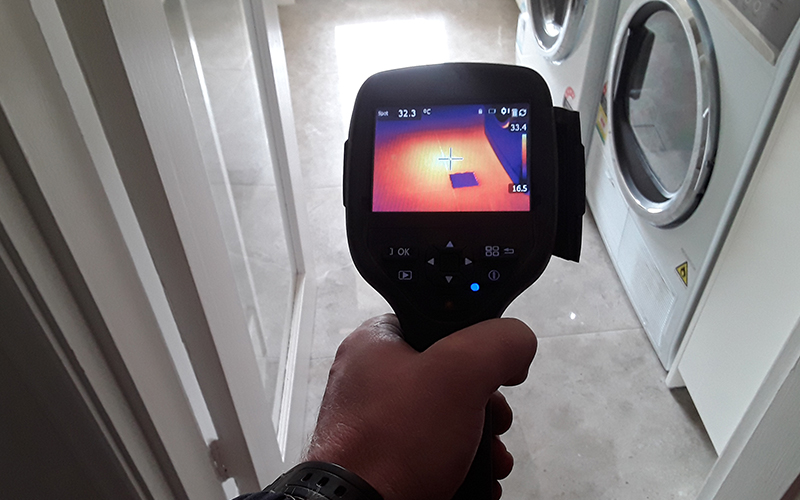
A thermal camera measures surface temperature, not moisture. Here is what that changes in a real leak survey, and where infrared quietly fails.
A thermal camera does not see water. It sees infrared radiation leaving the outermost few microns of a surface, and converts that into a picture of apparent temperature. Everything after that is inference. If water has not changed the temperature of a surface you can point a lens at, the water is invisible, however good the camera is.
That one sentence explains most of what follows: why infrared is excellent on a heating leak and close to useless on a slow cold-water weep under sealed vinyl, why a survey booked on the wrong day is worth very little, and why no competent engineer opens a floor on the strength of a thermal image alone.
What the camera actually measures
ASTM C1153, the standard practice for locating wet insulation in roofs by infrared imaging, defines a thermogram as an image that maps the apparent temperature pattern of a scene. The word apparent is doing real work. To turn radiation into a temperature, the camera has to be told how efficiently that particular surface emits, a value called emissivity, and it needs an allowance for the radiation the surface is simply reflecting from everything else in the room.
Those are not academic corrections. A study that measured building materials directly reported gypsum at 0.79 against a commonly quoted reference value of 0.90, ceramic tile at 0.87 against 0.92, and stainless steel at 0.16. Reading the same thermal data with the wrong emissivity produced surface temperatures that differed by up to 7°C. The same work found that emissivity rises with moisture content, with fluctuations greater than 10% through a drying cycle. That is an awkward irony: the thing you are hunting changes the constant you have to assume in order to hunt for it.
A thermal image is therefore a measurement on a settings-dependent scale, not a photograph. Two engineers can point identical cameras at the same wall and come away with different numbers.
The three ways water shows up at all
FLIR, one of the largest camera manufacturers, states it without spin: a thermal imaging camera cannot see moisture in walls, but it can detect the temperature differences water causes. There are three mechanisms, and each needs something to drive it.
Evaporation. Water leaving a damp surface carries latent heat away with it, so the wet area sits cooler than the dry material around it. This is the mechanism that finds cold-water leaks. It needs the water to reach a surface that can breathe.
Capacitance. Water stores far more heat per gram than the materials it soaks into, so a wet area responds more slowly to a change in air temperature than a dry one. ASTM C1153 is built entirely on this. A flat roof is scanned at night and the wet insulation reads warm, because it is still giving back the day's solar heat after the dry areas have cooled. It needs the temperature to be moving.
Conduction. Hot water escaping from a heating pipe or a hot feed warms the material above it. This is the strongest of the three signals, and the reason infrared is the right first tool on underfloor heating and the reason a warm patch on a floor is worth taking seriously. It needs the escaping water to be hot.
Notice what all three have in common. They need a thermal drive. Remove the drive and a soaking wet wall and a dry wall look identical.
Where infrared genuinely earns its place
It is the fastest way to read a heating circuit. Run the system, and a buried loop paints itself onto the floor in minutes. A leak shows as a bloom that spreads wider than the pipe line, or as a run that goes cold beyond a certain point.
It maps extent rather than source. If a ceiling is already wet, infrared shows how far the water has travelled through the plasterboard, which is what a drying contractor and a loss adjuster need. It is also the quickest way to answer whether a stain on a wall is a live wet area or an old dry mark.
It rules areas out, and half of any survey is elimination. A clean thermal sweep of three rooms in twenty minutes is elimination you would otherwise pay for by the hour. It also finds live pipe runs before anyone drills, which is the cheapest way there is to avoid putting a fixing through a pipe.
False negatives: when the camera sees nothing and the leak is real
These are the cases that matter, because a customer told "the camera found nothing" often hears "there is no leak".
Cold water under a sealed finish. Evaporative cooling only works if the water can evaporate. Sheet vinyl, a well-laid engineered wood floor, an intact damp-proof membrane under a screed, foil-backed plasterboard: all of them stop the moisture reaching a surface where it can lose heat. The leak under a concrete floor can be running for months with no thermal signature at the surface at all.
Depth. Heat spreads sideways as it travels up. A pipe 50mm into screed gives a readable stripe. The same pipe under 150mm of screed, insulation and a floor finish gives a smear that is wider, weaker and eventually smaller than the natural temperature variation of the floor itself. ASTM C1153 will not accept equipment with a minimum resolvable temperature difference worse than 0.3°C at 20°C, and a real anomaly has to clear the noise, not just exist.
Equilibrium. A leak that has been running steadily for a long time can wet an entire bay or an entire room evenly. Infrared works on contrast between wet and dry. If everything is wet, there is no edge to see.
Insulation in the wrong place. Anything thermally resistive between the water and the lens flattens the signal, and insulation sitting above a heating pipe is the usual indoor culprit.
There is a published figure for how often this bites. A 2017 study in the IEEE Journal of Selected Topics in Applied Earth Observations and Remote Sensing tested passive infrared thermography at 27 field sites with real leaks on buried reticulation pipes under soil and grass. It clearly identified 59% of the leaks. A further 22% of sites produced a notable but inconclusive thermal signature. That is outdoors, on ground that gets full solar loading and cools hard at night, which is about as favourable as passive thermography gets. Nobody should assume a plaster wall in a heated flat does better.
False positives are the more expensive failure
A missed leak costs you another visit. A confidently misread thermal image costs you a hole in the wrong floor.
Cool patches are produced by draughts, cold bridges, missing insulation, timber studs behind plasterboard, wall ties, a chimney breast, an external corner, and a sofa that was moved yesterday. Warm patches are produced by pipe runs that are not leaking, boxed cables, flues, downlighters, and a patch of wall the sun sat on three hours ago. Glass, gloss paint, mirrors, stainless splashbacks and polished stone have low emissivity and behave as infrared mirrors: what the camera reads there is the reflection of something else in the room.
FLIR's own guidance is blunt about this. Identifying a pattern that looks like moisture does not guarantee the presence of water, and a moisture meter should always be used to confirm what the thermal camera has found. ASTM C1153 goes further and requires infrared findings on a roof to be verified by invasive methods, either cores or a combination of cores and moisture meter probes. If the roofing standard will not accept the thermogram as proof, nobody should accept it as grounds for cutting your floor.
Conditions that ruin a survey
ASTM C1153 is written for flat roofs, but its required conditions describe the physics that governs any infrared moisture survey, and they are unusually specific. No appreciable precipitation in the 24 hours before the scan. Wind below 25km/h, because air movement drags every surface towards air temperature and flattens the contrast you are trying to read. No ponded water, ice, snow or debris on the surface. A delay after a day of heavy overcast, since cloud suppresses both the daytime solar gain and the night-time radiative cooling that create the signal. Dew and frost reduce the intensity of anomalies. On a roof ballasted with stone or pavers the outside air has to have been at least 18°C colder than the space below the deck for most of the previous 24 hours, and 23°C colder if there is insulation above the membrane.
Indoors, the same physics shows up as a shorter list. Heating that has been off for a week gives you nothing to see. A flat that has just been aired for an hour has no differential. Direct sun on an external wall in the morning will still be visible in the afternoon. A dehumidifier that has been running since the ceiling came down has already removed the contrast.
This is why the survey time matters more than the camera model. If the conditions are wrong, the correct move is to create a differential, usually by running the heating or the hot water, rather than to record a clean image and call the property dry.
Why it is nearly always paired with acoustic or tracer gas
Each method responds to a different side effect of escaping water, and each has a condition that switches it off.
Acoustic detection needs pressure and noise. It is strong on metal pipework and buried mains and weak on very small weeps, on plastic pipe, which damps the vibration, and on unpressurised waste pipes, which make no leak noise at all. Thermal needs temperature. Tracer gas needs neither: the pipe is drained and charged with a mixture of 5% hydrogen in 95% nitrogen, and the hydrogen leaves through the same defect the water did and rises to a surface detector that reads from 1ppm. A moisture meter is the only instrument in the bag that actually responds to water rather than to a proxy for it.
So the sequence, rather than the equipment list, is what decides whether a survey works. Isolate and pressure test to reduce the problem to one circuit. Thermal imaging to reduce it to an area. Acoustic to reduce it to a point. Tracer gas to confirm the point when the access cost justifies certainty. Moisture readings to prove that the anomaly is water. The honest test of any leak detection company is not which technology it owns, but what it does when the second method disagrees with the first. Our comparison of the three methods goes through the trade-offs in more detail.
What a survey costs, and what happens when the camera is silent
Across our last 400 leak detection surveys the cause of the leak was found in 95% of cases. In 2% the water was coming from a neighbouring property. In 3% it was not a plumbing leak at all: gutters, roofs and other structural defects letting water in. That last 3% is precisely the group a thermal image alone would misread. A cool bloom on a bedroom ceiling looks the same whether it came from a pipe or from a cracked parapet, and the difference is found by pressure testing, by weather correlation and by looking outside, not by turning up the camera's sensitivity.
Standard leak detection is charged at a fixed hourly rate of £160. Most domestic surveys take two to four hours, so a typical visit comes to £320 to £640 in total. Heating and trace and access work is £200 an hour, and mains and supply pipe work is £180 an hour. Where tracer gas is needed there is an £80 charge for the bottle. The rate is agreed before we travel and does not rise on the day, and it sits behind no find, no fee: if we attend a confirmed live leak and cannot locate it, the detection time is not charged. Thermal imaging is one of the tools on that visit, not a separate product.
If you have a damp patch and no explanation, call 020 7123 8560. Tell us what is wet, when it started and whether the heating is on, and we will tell you which method the property calls for before anyone travels. We cover London out to the M25.
What to ask before you book anyone
Four questions separate a survey from a photo shoot. What emissivity did you set, and for which surface? What temperature differential existed during the survey, and did you create it or wait for it? Which second method confirmed the anomaly before you marked it? Will you stand behind the mark before anything is opened?
A camera is a fast, non-contact way to narrow a search. It is not a moisture detector, it is not evidence on its own, and it will not work on a day when nothing in the building is changing temperature. Anyone who tells you otherwise is selling the picture rather than the answer. If you want the search narrowed properly rather than photographed, call 020 7123 8560 and describe the symptom.
How we help with this
If the article describes a problem you actually have, these are the visits that deal with it.
- thermal imaging surveys
Infrared showing where warm or cold water tracks behind a surface.
- leak detection in London
Finding a hidden leak without opening the property up first.
- our full guide to leak detection
How each method works, what it costs and when it is the wrong tool.
Not sure which one applies? Describe the symptom on the phone and you will be told which survey it is, the hourly rate and roughly how long it takes, before anything is booked. 020 7123 8560
Frequently asked questions
Can a thermal camera see through a wall or a floor?
No. It reads the surface it is pointed at, nothing behind it. What you are seeing is the temperature pattern that something buried has printed onto that surface. A warm pipe 20mm into plaster prints a sharp stripe. The same pipe 100mm down prints a wide, faint smear, because heat spreads sideways as fast as it travels up. Past a certain depth the pattern is weaker than the wall's own natural variation and the camera has nothing left to show.
Will thermal imaging find a cold water leak?
Sometimes. Cold water shows up through evaporative cooling, so the wet area reads slightly colder than the dry material around it. That only happens if the water can actually reach a surface and evaporate from it. Under sheet vinyl, a sealed engineered wood floor, an intact damp-proof membrane or foil-backed plasterboard, the moisture is trapped and the surface temperature never changes. Those are the cases where acoustic detection or tracer gas has to do the work instead.
The survey found nothing on the camera. Does that mean there is no leak?
No, and this is the single most common misunderstanding. A blank thermal image means there was no usable temperature contrast at the moment of the scan. That can be because the water is cold and sealed in, because the whole area is uniformly wet so there is no edge to see, because the heating had been off for days, or because the leak is too deep. The correct response is to create a differential, usually by running the heating or hot water, and then to move to pressure testing, acoustic listening or tracer gas. It is not to declare the property dry.
Is a thermal image enough evidence for an insurance claim?
It is supporting evidence, not proof. A thermogram shows a temperature anomaly; it does not show water. ASTM C1153, the roofing standard for infrared moisture surveys, requires infrared findings to be verified by invasive methods such as cores or moisture meter probes before they are treated as a result. A report that pairs thermal images with moisture meter readings and the method that confirmed the source is far harder to argue with than images alone.
Does thermal imaging work through tiles, carpet or engineered wood?
It depends on how thermally resistive the covering is and how strong the heat source underneath it is. A hot heating pipe under tile and a thin adhesive bed shows clearly. The same pipe under carpet and underlay, or under insulation, may show nothing, because the covering is doing exactly the job insulation is designed to do. As a rule of thumb, the more effective the floor is at keeping your feet warm, the worse it is for infrared.
Can I find the leak myself with a phone thermal attachment?
You can often see a heating loop or a hot pipe run, which is genuinely useful for knowing where not to drill. You will not diagnose a leak with it. Small clip-on sensors have coarser spatial resolution and worse thermal sensitivity than survey equipment, and neither they nor an expensive camera will tell you whether a cool patch is water, a draught, a stud or a cold bridge. If you do try it, take the image before the heating has been on all day, not after, or every pipe in the floor will read the same.
What time of day is best for a thermal leak survey?
For an internal survey, the best time is when something is changing. Scanning shortly after the heating or hot water has been brought on gives you a moving temperature and therefore contrast. Avoid scanning an external wall that has had direct sun on it in the previous few hours, because the stored solar heat will still be there and will drown any pattern you are looking for. If a dehumidifier has been running, expect the contrast to be reduced.
What does a survey cost, and do I pay if you cannot find it?
Standard leak detection is a fixed hourly rate of 160 pounds and most domestic surveys run two to four hours, so 320 to 640 pounds in total. Heating and trace and access work is 200 pounds an hour, mains and supply pipe work is 180 pounds an hour, and there is an 80 pound charge for the bottle if tracer gas is needed. The rate is agreed before we travel and does not rise on the day. No find, no fee sits behind it: if we attend a confirmed live leak and cannot locate it, the detection time is not charged.