Damp Patch on the Ceiling With No Leak Found: What It Actually Is
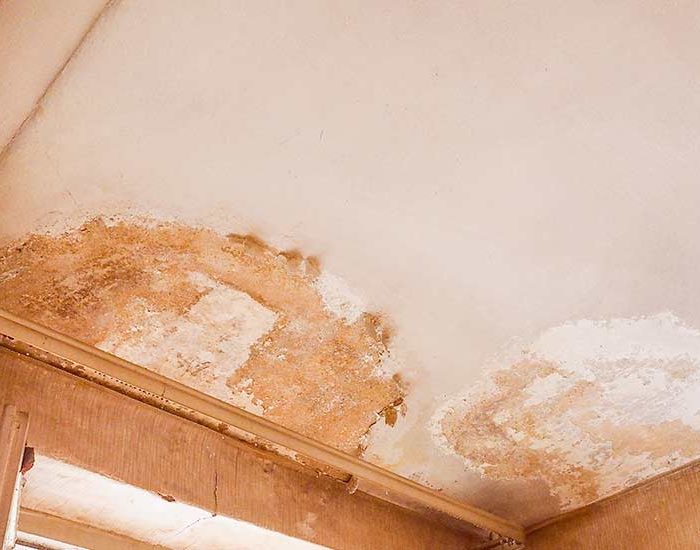
A plumber found nothing and the patch is still there. The real causes when plumbing is ruled out, and the measurable test that separates each one.
A plumber has been out. The water meter did not move. The boiler held its pressure overnight. Nothing was found, and the patch on your ceiling is still there.
That is a specific diagnostic position rather than a dead end. Either there is a plumbing leak and the checks that were run could not have found it, or water is reaching that ceiling by a route that has nothing to do with pipework. Those are not equally likely, and it is worth saying which way the odds run before going further.
What our own survey record says
Across our last 400 leak detection surveys we identified the cause in 95% of cases. In 2% the water was coming from a neighbouring property. In 3% it was not a plumbing leak at all: gutters, roofs and other structural defects letting water in.
The non-plumbing outcome is real and we do see it, but it is uncommon. When somebody tells you no leak was found, the balance of probability still sits with a plumbing leak the checks were not capable of detecting. Ruling plumbing out is a different job from failing to find it, and usually only the second thing has happened.
What "no leak found" usually did not test
Three checks get run before most people give up, and each has a narrow field of view. The water meter test only sees pressurised pipework downstream of the meter, and only if the loss is fast enough to move the dial in the time somebody stood watching it. It says nothing about the sealed heating circuit, waste pipes, a cold water storage tank or the flat above. Reading the meter properly means an isolation period of hours, not minutes.
The boiler pressure gauge only sees the sealed heating circuit in your own dwelling. A steady gauge rules out a heating leak and nothing else, and a dropping gauge is not automatically a leak either, since a failed expansion vessel or a weeping pressure relief valve does the same thing. That distinction matters if your boiler is losing pressure with no leak found.
Looking at the pipes proves least of all. Waste pipes are not pressurised. A cracked shower waste, a failed trap seal or a split soil branch only passes water while water is running through it, so by the time anyone lifts a floorboard the pipe is dry and looks perfect. The only way to test waste is to use it: run each fitting above the patch on its own for at least ten minutes, with a gap in between, taking a moisture reading at the same three marked points before and after each run. Soil stack and waste pipe leaks in flats are missed this way constantly.
If none of that was done, plumbing has not been excluded. It has been not-found, which is a weaker statement than it sounds.
The four kinds of damp, and which can reach a ceiling
The guidance published jointly by OHID, DLUHC and UKHSA sorts household damp into four types: condensation damp, where "moisture generated inside the home cools and condenses onto colder parts of the buildings"; penetrating damp, "water that gets into the building from outside due to defects in the walls, roofs, windows or floors"; rising damp; and traumatic damp, "caused by leaking water from waste and heating pipes, overflowing baths or sinks, burst pipes". A ceiling patch can be the first, the second or the last. It cannot be rising damp: ground moisture does not climb to a first floor ceiling, whatever anyone tells you.
Condensation, and the arithmetic that settles it in ten minutes
Condensation is not a vague accusation about how you live. It is a temperature calculation, and you can do it yourself with about twenty pounds of kit.
Cool a surface below the dew point of the air touching it and water comes out of the air onto that surface. Using the standard Magnus formula, air at 20°C and 60% relative humidity has a dew point of 12.0°C. At 50% it is 9.3°C, at 70% it is 14.4°C.
So buy a hygrometer and an infrared surface thermometer. Note the room temperature and humidity, work out the dew point, then take the surface temperature at the centre of the patch and half a metre away on clean plaster. If the patch is colder than the ceiling around it and at or below the dew point, you have your answer and no pipe is involved.
Appearance backs it up. Water that has passed through plasterboard, timber or eighty years of ceiling dust carries dissolved tannins and dries to a brown ring with a hard tide line. Condensation does not stain brown. It gives a diffuse grey or black speckled bloom, spreading rather than ringed, worse in winter, worse after showers and cooking, and concentrated in the coldest part of the room.
The fix is extraction and surface temperature. Approved Document F sets minimum intermittent extract rates of 15 l/s for a bathroom, 30 l/s for a kitchen with a cooker hood venting outside or 60 l/s without one, 30 l/s for a utility room and 6 l/s for a WC. A bathroom fan wired to the light switch that runs for twenty seconds after somebody leaves is not delivering that. And as the government guidance puts it, "simply removing surface mould will not prevent the damp and mould from reappearing".
Thermal bridging: when the stain is a drawing of the structure
This is the cause most often mistaken for a leak, because it produces a genuinely wet ceiling in one specific place. A thermal bridge is a part of the structure that conducts heat out faster than the fabric around it. The ceiling either side stays warm; that strip goes cold, drops below dew point and wets. The measure used in UK practice is the surface temperature factor, fRsi, set out in BRE IP1/06 and referenced by Approved Document L. For dwellings it should be at or above 0.75, meaning that with 20°C inside and 0°C outside the internal surface should not fall below 15°C.
Geometry is the tell. Straight parallel stripes at 400mm or 600mm centres are joists showing through. A band one hundred to three hundred millimetres wide following the wall and ceiling junction all round a top floor room is loft insulation stopping short of the eaves, leaving a cold perimeter. A single wet corner is two external walls meeting a cold roof. BS 5250 addresses this directly, alerting designers to minimise the risk of surface condensation on the ceilings of occupied spaces by keeping thermal insulation continuous.
Leaks do not draw straight lines, repeat at joist centres, or run round a room at a uniform width. If the shape of your patch describes the building, the building is the cause.
Roofs and gutters, and how to test rain without fooling yourself
The obvious test is whether the patch gets worse when it rains. The problem is that it rains a lot, and coincidence is cheap. Met Office 1991 to 2020 averages for Heathrow record 615mm of rain a year across 111.7 days with 1mm or more, so measurable rain falls on roughly three days in ten, and November alone averages 66.6mm across 11.2 rain days. One occasion where a wet ceiling followed a wet week tells you almost nothing.
What is worth something is three separately logged matches, and better still one clean mismatch: a heavy sustained downpour that produced no change at all. That single negative kills the roof theory faster than any number of positives confirm it. Watch the timing too: roof and gutter ingress lags rainfall by hours, peaks, then dries back between events, whereas a pressurised plumbing leak takes no interest in the weather and never dries back.
In London the offenders are predictable. Victorian and Edwardian terraces very often have parapet or valley gutters that discharge internally, and a blocked one does not drip, it floods over the internal side of the parapet straight into the top floor ceiling. Back-addition flat roofs sit directly over kitchens and bathrooms, which is exactly where people assume plumbing. Lead flashing at an abutment fails at the mortar chase long before it fails at the lead. The SPAB is blunt about neglected rainwater fittings: "concentrated and prolonged wetting is likely to cause damp patches and plaster mould on walls and ceilings, and the decay of timber skirting boards". If the wet ceiling sits under a flat roof, finding a flat roof leak is a different job from finding a pipe.
The flat above, and the conversation nobody wants
In a converted house or a purpose-built block, your ceiling is somebody else's floor. In 2% of our last 400 surveys the water was theirs, and in most of those the neighbour had no idea. If water is actively coming through from above, our page on water coming through the ceiling in a London flat covers what to do first.
Doing this properly needs access and a meter, not a chat. Take moisture readings at three marked points on your ceiling and write them down. Then have each fitting above run in sequence, ten minutes each, with somebody re-reading the same three points between runs. Eyes are useless here because the ceiling already looks wet; only the change in reading is evidence. Communal risers and shared soil stacks belong to neither of you, which changes who fixes it and who pays, a question our guide to who pays for a water leak in a flat goes into.
If you cannot get access, an independent survey and report is the normal route, because it gives a managing agent or an insurer something to act on. Standard leak detection runs at a fixed hourly rate of £160, and a typical survey takes two to four hours, so £320 to £640 in total. The rate is agreed before we travel and does not rise on the day. Call 020 7123 8560 and we will say on the phone whether a survey is likely to answer your question.
Historic staining, the answer nobody believes
Sometimes the leak was real, was fixed, and nobody ever repainted. The mark stays and every new occupant assumes it is live. The test is dull and conclusive. Draw a pencil line around the outer edge of the mark and write the date beside it. Take a moisture reading at the centre of the mark and at clean plaster a metre away. If those readings match, and the mark is still inside your pencil line a fortnight later having been through a wet spell, it is dry history and the treatment is stain block and paint. Old stains have a sharp tide line, an even mid-brown colour and no soft halo; active ones have a damp diffuse edge that moves. Telling a new leak from an old one is one of the more useful things a moisture meter settles cheaply.
Why the diagnosis decides who pays
Escape of water is an insured peril on most buildings policies. Condensation is not. Ageas, setting out standard buildings cover, lists among the usual exclusions "wear and tear, damage that happens slowly over time, like damp, condensation or rust", along with damage from lack of maintenance or neglect.
So the diagnosis is also the claim. A failed waste pipe is generally covered. Condensation on a cold perimeter, or a gutter last cleared six years ago, generally is not. That is why insurers want evidence of origin rather than an opinion, and why guessing and opening the ceiling is the expensive route.
What a survey does when plumbing looks clear
Each stage removes a category rather than chasing a hunch.
- Air temperature, humidity and surface temperatures, to establish whether the ceiling is below dew point before anything else is considered.
- Comparative moisture mapping on a marked grid, so the shape and gradient of the wet area is recorded rather than described.
- Thermal imaging under a deliberate temperature differential, which separates an evaporatively cooled wet area from a structurally cold one.
- Use-testing every fitting above the patch in sequence, with readings between runs.
- Static pressure testing on the mains, then the heating circuit isolated and tested separately.
- Tracer gas only once a pressurised loss is confirmed but not localised.
- External inspection of roof coverings, flashings and rainwater goods if every internal stage is negative.
Standard leak detection is £160 an hour. Heating and trace and access work is £200 an hour, and mains and supply pipe work is £180 an hour. Moisture mapping starts at £175 an hour and emergency attendance from £220 an hour; the full list is on our pricing page. Behind that sits no find, no fee: if we attend a confirmed live leak and cannot locate it, the detection time is not charged.
One honest caveat, because it matters more here than anywhere. No find, no fee applies to live leaks. If the survey concludes your ceiling is condensation on a cold perimeter, or a blocked parapet gutter, that is a finding rather than a failure to find, and the time is chargeable. You get a diagnosis and a report you can act on.
We cover London out to the M25, all 32 boroughs. If you have a damp patch, a plumber who found nothing and no idea what to do next, call 020 7123 8560 and describe the shape of the mark. Half the time that narrows it on the phone.
How we help with this
If the article describes a problem you actually have, these are the visits that deal with it.
- damp and moisture surveys
Moisture mapping that separates a leak from condensation or damp.
- our full guide to leak detection
How each method works, what it costs and when it is the wrong tool.
- thermal imaging surveys
Infrared showing where warm or cold water tracks behind a surface.
Not sure which one applies? Describe the symptom on the phone and you will be told which survey it is, the hourly rate and roughly how long it takes, before anything is booked. 020 7123 8560
Frequently asked questions
My plumber found no leak. Can I just repaint the ceiling?
Only if you can show the ceiling is dry, and a moisture meter is the only thing that shows that. Take a reading at the centre of the mark and at clean plaster a metre away. If they match, and the mark has not grown past a dated pencil outline after a fortnight that included wet weather, stain block and paint is the right answer. If the readings differ, painting buys you a few weeks of looking better while the structure keeps soaking.
How do I tell condensation from a leak on a ceiling?
Measure it. Get the room air temperature and relative humidity from a hygrometer and work out the dew point: at 20°C and 60% humidity it is 12.0°C. Then take the ceiling surface temperature at the patch and half a metre away with an infrared thermometer. If the patch is the colder spot and is at or below the dew point, it is condensation. Colour helps too, because leak water carries tannins and dries to a brown ring, whereas condensation gives a diffuse grey or black bloom with no ring.
The patch is a straight line, or runs all the way round the room. What causes that?
The structure. Parallel stripes at 400mm or 600mm centres are joists conducting heat out faster than the ceiling around them. A uniform band along the wall and ceiling junction of a top floor room is loft insulation that stops short of the eaves and leaves a cold perimeter. Water leaks are governed by gravity and the fall of joists, so they do not produce repeating parallel stripes or a constant width all the way round a room.
It only seems to get worse after heavy rain. Does that prove it is the roof?
Not on its own. Met Office averages for Heathrow give measurable rain on about 112 days a year, so roughly three days in ten. A single match between a wet week and a wet ceiling is likely to be coincidence. Log at least three separate events, and pay more attention to a mismatch: one heavy sustained downpour that produced no change at all is stronger evidence against a roof defect than three matches are for it.
The flat above says they have no leak. What do I do next?
Test rather than debate. Mark three points on your ceiling, take moisture readings and write them down, then have each fitting above run for ten minutes in turn while somebody re-reads those same three points between runs. A rise in reading after one specific fitting is the evidence. Bear in mind the pipework may be communal, in which case it belongs to the freeholder or managing agent rather than either of you, and an independent report is usually what gets it acted on.
Will buildings insurance pay if the cause turns out not to be a leak?
Usually not. Escape of water is an insured peril on most policies, but insurers commonly exclude gradual damage. Ageas, for example, lists among the standard exclusions wear and tear, meaning damage that happens slowly over time such as damp, condensation or rust, along with damage from lack of maintenance. So a failed waste pipe is generally covered and a blocked gutter or a cold perimeter generally is not. That is exactly why the diagnosis, and the evidence behind it, is worth more than an opinion.
Do you charge if the survey finds it is not a plumbing leak?
Yes, and we would rather be straight about that. No find, no fee means that if we attend a confirmed live leak and cannot locate it, the detection time is not charged. Concluding that your ceiling is condensation on a cold perimeter, or a blocked parapet gutter, is a finding rather than a failure to find, so the time is chargeable at the rate agreed before we travel. Standard leak detection is £160 an hour and a typical survey takes two to four hours.