What Non-Invasive Leak Detection Actually Means
Nobody defines "non-invasive", so here is a definition you can hold a company to: which methods genuinely leave your building untouched, where the physics runs out, at what point access work becomes unavoidable, and why your insurer may not pay for the survey at all.
Almost every leak detection company in London advertises non-invasive detection. There is no standard behind the phrase, no register policing it and no test a company has to pass before using it. It has become a reassurance rather than a description. So here is a definition specific enough to hold someone to, including us.
A method is non-invasive if, when the engineer leaves, your building fabric is exactly as it was. No hole, no lifted board, no drilled sample, nothing to make good. That is the entire test. Notice what it does not cover: whether the leak was found, whether your water stayed on, whether a builder is needed next week, and whether anyone pays for it.
Three tiers, not one
The honest picture has three levels, and most companies advertise the first while quietly working in the second.
| Tier | What happens to the building | Typical work |
|---|---|---|
| Non-invasive | Nothing is opened or removed | Meter and flow tests, acoustic listening, thermal survey, moisture mapping, drain camera |
| Minimally invasive | Something small and repairable is opened | An 8 mm hole for a borescope, a drilled sample for a moisture test, cutting into a fitting to connect a gauge or inject tracer gas |
| Access work | Fabric is deliberately removed | Floor up, tiles off, ceiling down, screed broken out |
There is nothing wrong with tier two. It is often the fastest and least destructive route to an answer. It becomes a problem only when it is sold as tier one.
What is genuinely non-invasive to your building
Meter and flow testing
Isolating sections of the system and watching the water meter touches nothing at all and still produces a hard fact: the system either loses water or it does not. It is unglamorous, and it is where a competent survey starts.
Acoustic listening
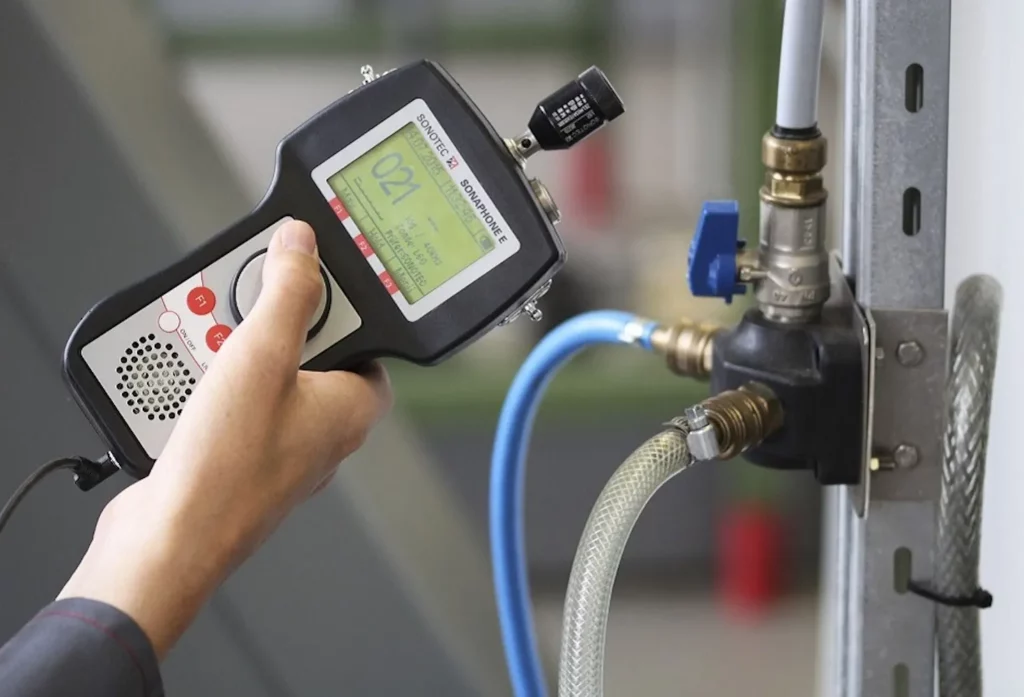
A ground microphone or contact microphone on pipework leaves nothing behind. The limit is physics, not manners. Leak noise carries badly in plastic pipe. Measurements on a buried plastic water pipe test rig published in Sensors found attenuation of roughly 1.6 dB per metre at 150 Hz, which works out at about 32 dB at 20 metres from the leak and 48 dB at 30 metres, and the authors state plainly that leak noise does not propagate as far in plastic pipes as it does in metal. Cast iron and copper carry the sound. Modern MDPE supply pipe and plastic push-fit do not. Acoustic work also needs the pipe under pressure and the building quiet, which rules out an unpressurised waste pipe and a Friday afternoon above a main road.
Thermal imaging
A thermal camera reads surface temperature. It does not see through a wall, a screed or a floor. What it sees is the temperature pattern a leak eventually creates at the surface once heat has conducted there, which means it needs a temperature difference to exist in the first place. A hot water or heating leak usually gives one. A cold mains leak under an unheated tiled floor in July often gives nothing. The relevant standard, BS EN ISO 6781-1:2023, which replaced BS EN 13187, describes infrared work on buildings as a method for detecting heat, air and moisture irregularities. Detecting irregularities is not the same as identifying their cause, and a thermal image on its own never proves a leak.
Moisture mapping
Pin and pinless meters measure electrical conductance and infer moisture from it. On plaster and masonry that inference is unreliable, and the British Standard says so: BS 5250 states that accurate measurements of the moisture content of brick or mortar cannot be obtained using electrical moisture meters, because salts increase the electrical conductance of the water and give falsely high readings. In a salt-contaminated Victorian wall, a high reading is a question, not an answer. The definitive measurement is gravimetric, weighing a drilled sample before and after oven drying, which is invasive by definition. Everything short of it is comparative: this area is wetter than that one, and the pattern points this way.
The methods that get called non-invasive but are not, quite
Tracer gas. This is the method that resolves the leaks nothing else has resolved, and it leaves your fabric untouched. It is not free of intrusion, though. The manufacturer instructions for the standard detectors are explicit: the system has to be emptied of its contents and sealed, so that gas can escape only at the leak. In practice that means draining the circuit, isolating it, and usually breaking into a fitting to connect the gas. The mixture is 5% hydrogen in 95% nitrogen, which at that concentration is non-flammable, non-toxic, non-corrosive and safe in drinking water pipework. Hydrogen is used because its molecules are small enough to permeate concrete, tarmac and grass and rise to the surface. On our published rates the gas bottle is £80 on top of the hourly rate, charged only when gas is actually used.
Pressure testing. Non-invasive to the fabric, definitely invasive to your day. The water goes off, the section is isolated and a gauge is fitted. It also has a trap in it. BS EN 806-4, the standard covering installation and commissioning of water systems inside buildings, sets out a different test procedure for plastic pipe than for copper and steel, because plastic is elastic and visco-elastic. It stretches under pressure, so the gauge falls in a system with no leak whatsoever. A five minute gauge check on a plastic system is not a pressure test, and a small pressure drop on plastic is not proof of anything.
Borescope inspection. An 8 to 10 mm hole, a camera and a filler repair afterwards. Next to lifting a floor it is nothing. It is still a hole in your wall and should be described as one.
What non-invasive does not promise
- It does not promise nothing gets opened later. Detection locates. Repair exposes. Nobody has ever fixed a pipe through an unbroken floor.
- It does not promise the water stays on. Most useful tests require isolation.
- It does not promise a pinpoint. An honest result is an area, a confidence level and the reasoning behind both. Anyone who marks an X on your floor without saying how sure they are is guessing in public.
- It does not promise anyone else pays. That one has more money in it than the other three combined, and it is covered below.
The point where opening up becomes unavoidable
Three triggers, in the order they arrive.
One: the evidence supports two answers. A warm patch in a screed can be a heating flow pipe or a hot water dead leg running alongside it. Thermal and moisture data narrow it; they do not always separate it. At that point a 10 mm inspection hole answers in ten minutes what another two hours of surface work will not.
Two: the construction blocks the signal. A suspended concrete slab, a thick sand and cement screed, an insulation layer, or the boarded and skimmed ceiling void of a converted flat all absorb or scatter what the equipment relies on. This is common in leaks under concrete floors, where the honest answer is that the concrete has to be broken somewhere. The purpose of the survey is to make that somewhere a patch instead of a room.
Three: the repair. This is the one that surprises people most. A survey ending in a precise location has done its whole job, and the pipe still has to be reached. Handled by the same team, that stage is trace and access work, priced separately and at a different rate.
What a survey can and cannot conclude without opening anything
A competent non-invasive survey can establish whether the system is losing water and which circuit is losing it, whether the loss is on the hot or cold side, a located area rather than a vague direction, whether moisture in a wall or ceiling is a live leak or the residue of an old one, and whether the water is coming from the plumbing at all.
That last point is not theoretical. Across our last 400 leak detection surveys the cause was found in 95% of cases. In 2% the water was arriving from a neighbouring property. In 3% it was not a plumbing leak at all: gutters, roofs and other structural defects letting water in. Those 3% are the strongest argument for surveying before anyone opens anything, because a ceiling taken down to chase a roof defect leaves you with the roof still leaking and a ceiling to rebuild.
What no survey can conclude without exposure: what the defect physically is, whether it is a pinhole, a failed compression joint or a nail through a pipe; the condition of the rest of that pipe run; a firm repair price; and that the building is now dry. Detection tells you where to look. It does not certify what you will find.
If you are at the stage of deciding whether to open something up, a survey first is almost always the cheaper order of operations. Call 020 7123 8560 and we will tell you on the phone whether the symptoms justify a survey or a plumber. We cover London out to the M25, all 32 boroughs, and the rate is agreed before anyone travels.
The insurance trap nobody puts in the advert
Trace and access cover is widely assumed to pay for the non-invasive survey. Often it does not, and the reason sits in a single conditional clause in the wording.
In a 2025 Financial Ombudsman Service decision, a policy read: "If the buildings are damaged we will pay the reasonable and necessary costs in locating the source of the damage up to £5,000 in addition to the policy excess, including making good any damage caused during the search." The customer's water authority had detected a leak inside her boundary. The ombudsman found that the policy "only engages if there's damage to the property caused by the escape of water. If there's no damage to the property, there's no cover for trace and access", and did not uphold the complaint. A leak caught early, before it has damaged anything, can therefore fall outside the cover that exists to find leaks.
A second decision, against Aviva in 2024, is worth reading if you are mid-claim. The insurer told the ombudsman that "non-invasive tracing isn't covered" and argued there had to be visible damage. The ombudsman rejected both points, noting there was no reference to visible damage in the wording and that "damage can be present without being able to see it". The customer's contractor used a pressure test, thermal imaging, moisture readings and a tracer gas test to find a leak under a kitchen floor. The invoices came to £11,333. The ombudsman counted 65 hours of labour to trace and access against 1.5 hours of actual repair, found the costs unreasonable even though the claim was valid, and ordered Aviva to refund half, £4,596.12.
Third, home emergency policies are a different product and frequently exclude the whole activity. In a further decision, a home emergency policy defined trace and access as "the process of identifying and locating the source of the emergency or gaining the necessary access to resolve the emergency" and simply did not cover it. The customer's plumber charged £1,190 to trace and locate a leak behind a tiled shower wall. She was not reimbursed.
The practical lesson is short. Before you assume a survey is covered, find the phrase "if the buildings are damaged" in your own wording, and find the trace and access limit, which in these cases ranged from nothing to £5,000. Do it before the visit, not after. We set out how the claim sequence normally runs in our guide to trace and access insurance cover, and the wider claims process on our insurance leak claims page.
What we charge, and what happens if we find nothing
Standard leak detection is a fixed hourly rate of £160. A typical domestic survey takes two to four hours, so £320 to £640 in total. Heating and trace and access work is £200 an hour, and mains and supply pipe work is £180 an hour. Moisture mapping starts at £175 an hour and emergency attendance at £220 an hour. The rate is agreed before we travel and it does not rise on the day.
Behind that sits no find, no fee: if we attend a confirmed live leak and cannot locate it, the detection time is not charged. That is a real constraint on us, and it is why the survey starts with the boring meter test rather than the impressive camera. There is more detail on how that guarantee works in practice in our explanation of no find, no fee leak detection, and a method by method breakdown in our leak detection technology guide and in how leak detection works.
If you have a rising bill, a damp patch or a letter from your water company and you want to know what can be established without touching your floor, call 020 7123 8560. We will give you the rate and a realistic view of what the survey can and cannot settle before you commit to anything.
How we help with this
If the article describes a problem you actually have, these are the visits that deal with it.
- leak detection in London
Finding a hidden leak without opening the property up first.
- our full guide to leak detection
How each method works, what it costs and when it is the wrong tool.
Not sure which one applies? Describe the symptom on the phone and you will be told which survey it is, the hourly rate and roughly how long it takes, before anything is booked. 020 7123 8560
Frequently asked questions
Is non-invasive leak detection genuinely damage free?
The detection stage usually is. Meter tests, acoustic listening, thermal imaging and moisture mapping leave the fabric exactly as they found it. Two things commonly move a job out of that category: an inspection hole of 8 to 10 mm to put a camera where the readings disagree, and the repair itself, which always requires exposure. Ask a company to tell you, before it arrives, which of the three tiers it expects to work in and what it will do if the first tier does not settle it.
Does non-invasive mean you will not lift my floor?
It means we will not lift it to look. It does not mean the floor never comes up. If the pipe runs in a screed or under a concrete slab, the pipe has to be reached to be repaired, and no equipment changes that. What the survey changes is the size of the opening. The difference between a surveyed job and an unsurveyed one is usually the difference between one patch and a whole room.
Will my water be off during the survey?
For part of it, yes. Pressure testing and circuit isolation are the tests that produce the hardest evidence, and both require the supply or the heating circuit to be shut down for a period. Tracer gas goes further: the system has to be drained and sealed before the gas goes in. Plan for the water being off intermittently across the visit rather than continuously.
Will my buildings insurance pay for a non-invasive survey?
Read the trigger clause before you assume it will. Trace and access cover in most policies begins with a condition such as "if the buildings are damaged". Where a leak has been found early and nothing is damaged yet, the Financial Ombudsman Service has upheld an insurer's refusal on exactly that basis. Home emergency policies are a separate product and frequently exclude trace and access outright. Check the wording and the limit, which is often a few thousand pounds, before the visit.
Can a thermal camera see through a wall or a floor?
No. It reads surface temperature only. It finds a leak by picking up the temperature pattern that leaking water creates at the surface once heat has conducted through the material, which is why it works well on hot water and heating leaks and much less well on cold mains leaks under an unheated floor. Anyone showing you a thermal image as proof of a leak, without a corroborating pressure or moisture result, is over-reading the picture.
How precise can a location be without opening anything?
On copper in an accessible void, often to within a few centimetres. On MDPE supply pipe buried in a garden, considerably less, because leak noise in plastic attenuates at roughly 1.6 dB per metre at 150 Hz and has largely died out by 20 to 30 metres from the source. A good report tells you the area, the method that produced it and how confident the engineer is. A single point marked with no stated confidence is a guess presented as a result.
What happens if the survey does not find the leak?
If we have attended a confirmed live leak and cannot locate it, the detection time is not charged. That is what no find, no fee means here. It also means the sequence starts with the cheap, boring tests that confirm a leak exists at all, because we carry the cost of a survey that goes nowhere.
Is a leak detection survey worth it if I already know roughly where the water is?
Often yes, because where water appears is frequently not where it enters. Across our last 400 surveys, 2% of cases turned out to be water arriving from a neighbouring property and 3% were not plumbing leaks at all but gutters, roofs and other structural defects. In those cases opening a ceiling or a floor first would have added a repair without fixing anything.