An active water leak needs stopping today, not next week. Here is how same-day emergency leak repair works in London: making safe, finding a hidden leak fast, the repair itself, and honest pricing, with no find, no fee on the detection.
An active water leak does not wait for a convenient appointment. Water tracks along joists, soaks into plaster, drops your mains pressure and runs up both the repair bill and the drying bill with every hour it continues. If you have water where it should not be, a meter that keeps ticking with every tap closed, or a damp patch that is visibly spreading, you need someone who can attend today, make the situation safe, find the source, and repair it, without tearing the house apart on a guess.
This guide explains how same-day emergency water leak repair works across London: the order we work in, how a hidden leak is found quickly, what the repair involves, and how it is priced. We cover all 32 boroughs and out to the M25, our detection is offered on a no find, no fee basis, and any repair is quoted and agreed before it starts, so there are no surprises once work is underway.
Stop first, then diagnose, then repair
In an emergency the correct order is stop, diagnose, repair. The first priority on arrival is to make the situation safe and stop water leaving the system, isolating a section, fitting a temporary clamp, or capping a damaged run. That halts the damage immediately and gives a controlled system to work on rather than a moving target. Only then does the emergency leak detection work happen properly, and only once the source is confirmed do we commit to a repair.
This order avoids the classic trap of opening up a ceiling or wall near the damp, finding nothing, and having to guess again. Every wrong opening is more mess, more cost and more time. Diagnosing before cutting is what keeps an emergency repair small and targeted rather than turning it into a demolition.
How is a hidden leak found fast?
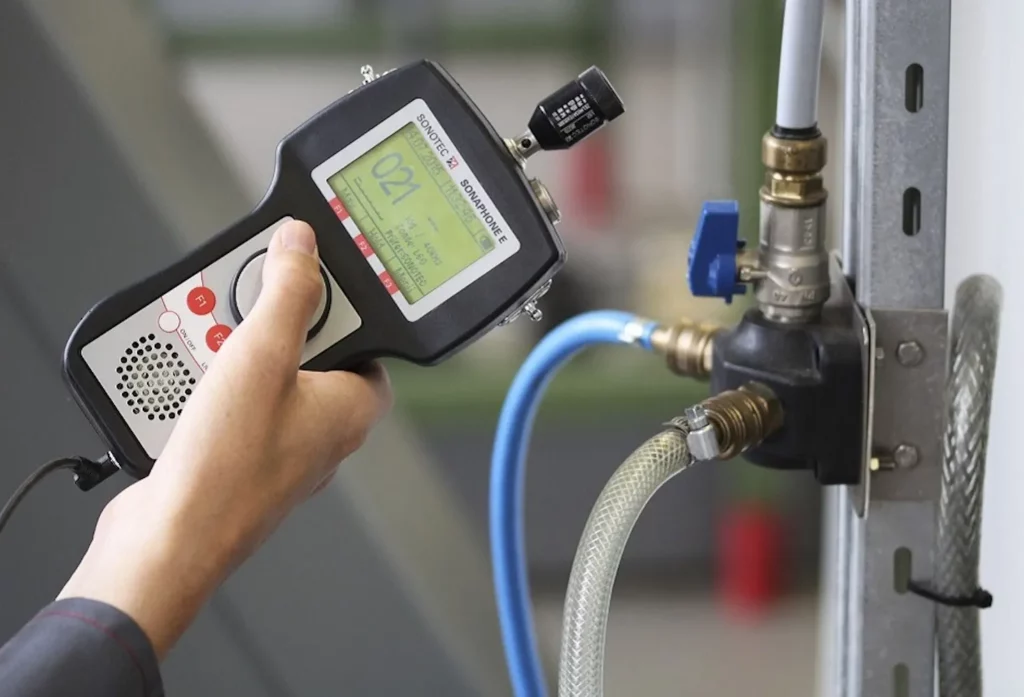
Speed in an emergency comes from ruling out where the leak is not, before spending time on where it is. We start with a pressure test, isolating sections of the system and watching how each holds, which tells us whether the problem is the mains supply, the hot or cold circuit, or the heating, and narrows a whole property down to one run of pipe. Ruling out the healthy parts of the system is what saves the floor and the plaster.
- Pressure testing to isolate the affected circuit and confirm a leak is live.
- Acoustic listening for the sound of water escaping under pressure.
- Thermal imaging to read the temperature difference a hot-water or heating leak leaves on a surface.
- Tracer gas introduced into a drained pipe to pinpoint the exact escape point.
- Moisture mapping to trace how far the water has already tracked.
Used together, these non-invasive methods locate most leaks to within a small area, so any access work is targeted rather than exploratory. You can read more about the techniques in our complete guide to leak detection.
What does the repair itself involve?
Once the source is confirmed and marked, the repair depends on what failed. Many common leaks, a split pipe, a failed compression joint, a weeping valve, a burst under a floor, can be repaired on the same visit, because our detection engineers are qualified plumbers carrying pipe and fittings. The aim is to make the repair through the smallest possible opening directly over the fault, then leave the affected area to dry before any redecoration.
Larger jobs, a failed underground supply pipe, an underfloor heating loop, or a leak requiring significant access, are quoted precisely once the source is exposed, so you know the cost before that work starts. Where a burst has already caused water damage, we document the leak and the damage in a written, insurer-ready report you can use to support a trace and access and escape of water claim. See our water leak repair and burst pipe repair service pages for specifics.
What can I do before you arrive?
The most useful thing is to stop the water. Close your internal stop tap, usually under the kitchen sink, in a downstairs cupboard, or where the mains enters, by turning it clockwise. For a heating or hot-water leak, closing the isolating valves at the appliance or radiator may be enough. With the water off, the leak largely stops adding to the damage, which is more valuable than any few minutes saved on arrival.
Then reduce risk and protect the space: keep clear of wet electrics and switch off the affected circuit at the fuse board if it is safe, move valuables out of the wet area, catch drips in buckets, and photograph everything before you clean up. If water is coming through a ceiling, keep from underneath a bulge and see our guide on water leaking through the ceiling.
How is emergency leak repair priced?
Emergency and out-of-hours work costs more than a routine daytime visit, and we would rather be straight about that. The callout is agreed with you before we travel, so you decide with the numbers in front of you rather than under pressure at the door. Our detection is offered on a no find, no fee basis, meaning if we cannot locate a confirmed live leak, you are not charged for the search. The repair is quoted and agreed separately once the source is confirmed.
Treat any figures you see online as typical UK trade cost-guide ranges rather than a fixed quote, because the real price depends on the property, the method needed, the time of day and how accessible the leak is. The honest headline is simple: you should always be able to see the detection fee and the callout cost before anyone sets off, and the repair cost before anyone starts cutting. For current figures see our pricing page. Handled that way, a same-day leak repair is a contained, predictable job rather than an open-ended bill.
How we help with this
If the article describes a problem you actually have, these are the visits that deal with it.
- water leak repair
Once the leak is found, the repair on the same visit where we can.
- leak detection in London
Finding a hidden leak without opening the property up first.
- burst pipe repair
A split or burst pipe isolated and repaired, day or night.
Not sure which one applies? Describe the symptom on the phone and you will be told which survey it is, the hourly rate and roughly how long it takes, before anything is booked. 020 7123 8560
Frequently asked questions
Can you repair a water leak the same day in London?
In most cases yes. For genuine emergencies across all 32 boroughs we aim to attend the same day, make the situation safe by stopping the water, then find and repair the leak. Many common failures, a split pipe, a failed joint, a burst under a floor, are repaired on the same visit, because our detection engineers are qualified plumbers carrying pipe and fittings. Larger jobs are quoted precisely once the source is exposed.
Do you find the leak before repairing it?
Yes, the order is stop, diagnose, repair. We make safe and stop the water first, then use pressure testing, acoustic listening, thermal imaging and tracer gas to pinpoint the source before committing to any repair. This avoids opening a ceiling or wall on a guess, finding nothing, and having to try again. Diagnosing before cutting keeps the repair small and targeted.
What should I do before the plumber arrives?
Stop the water by closing the internal stop tap clockwise, usually under the kitchen sink or where the mains enters, or shut the isolating valves for a heating leak. Then keep clear of wet electrics and switch off the affected circuit if safe, move valuables out of the wet area, catch drips in buckets, and photograph the damage before cleaning up so you have evidence for your insurer.
How much does emergency leak repair cost?
Out-of-hours work carries an uplift over a routine daytime visit, which we agree with you before travelling. Detection is offered on a no find, no fee basis, so you are not charged for the search if a confirmed leak is not located, and the repair runs at the same hourly rate once the source is confirmed. Treat online figures as typical UK cost-guide ranges, not fixed quotes, and always get the total before work starts.
Will I get a report for my insurance?
Yes. Where a leak has caused damage, we document the leak, the detection method, the location and the damage in a written, insurer-ready report you can forward to support a trace and access and escape of water claim. Many buildings policies cover the cost of finding and reaching a hidden leak, so a clear report can help you recover both the detection fee and the repair.
What if the water is coming through the ceiling?
Stop using whatever is above, turn off the water, keep clear of any bulging area because a water-filled ceiling can collapse, and isolate nearby electrics if safe. A saturated plasterboard ceiling can fail within hours, so treat it as urgent. We find whether it is a supply pipe, a waste, or a shower-tray seal before opening the ceiling, see our dedicated guide on water leaking through the ceiling for the full steps.