Leak Detection Before Buying or Selling a Home in London
Damp patches, staining, a high water bill or a survey that flags moisture can stall a house sale in London. Here is why a focused leak and moisture survey helps buyers negotiate, helps sellers fix problems early, and gives everyone a clear report to move on.
Few things unsettle a London property transaction like the word damp. It appears on a mortgage valuation, a homebuyer report or a full building survey, and suddenly a sale that felt settled starts to wobble. Buyers worry about what is hidden behind the plaster. Sellers worry the price is about to drop. Estate agents watch a chain slow down while everyone waits for answers nobody has yet.
The frustrating part is that the word damp on its own tells you almost nothing. It does not say whether you are looking at a slow plumbing leak under a floor, rain getting in through a tired roof, condensation from poor ventilation, or nothing more than a historic stain that dried out years ago. Those are wildly different problems with wildly different costs, and a transaction cannot sensibly proceed until someone works out which one you actually have.
That is where a focused leak and moisture survey earns its place. It is not the same as the survey your surveyor already did, and it is not meant to replace it. It is the follow-up that turns a vague red flag into a specific, evidenced answer both sides can act on. This article explains why that matters at the point of sale, what a survey checks, how it differs from a full building survey, and how a clear report keeps a deal moving rather than letting it drift.
Why moisture problems derail London sales
Older housing stock, converted flats, basement extensions and years of patch repairs mean London homes carry more than their fair share of moisture history. A transaction brings all of it to the surface at once, usually at the worst possible moment. There are a handful of recurring scenarios that cause the most trouble.
The undisclosed leak
A seller may genuinely not know about a leak, or may have assumed a stain that stopped growing was dealt with. Under a slow leak from a heating pipe, a waste connection or a hidden joint, water can track for months without an obvious pool of water. By the time it shows on a ceiling or a skirting board, the source can be a room away. If a buyer discovers this after completion, it becomes an expensive and stressful dispute. Finding it before contracts are exchanged is far easier for everyone.
Damp flagged on a survey
Most homebuyer reports and building surveys record elevated moisture readings somewhere. Surveyors are cautious by design, so they note the reading and recommend further investigation by a specialist. That recommendation is sensible, but it also hands the buyer an open question and no answer. Without a specialist follow-up, the buyer is left guessing at cost and the seller is left defending a problem that may not even exist.
Staining, tide marks and blown plaster
Brown tide marks, bubbling paint, salts on the wall or a patch of plaster that has blown all point to moisture at some stage. What they do not reveal is whether the cause is live or historic. A survey that can distinguish an active leak from an old, dried problem changes the negotiation entirely.
A water bill that does not add up
A steadily rising water bill, or a meter that keeps ticking over when nothing is running, is one of the clearest signs of a leak on the supply side. It is easy to ignore while you live somewhere, but at the point of sale it becomes a question a buyer is entitled to ask. Tracing that loss to a specific pipe run gives a definite answer instead of a worry.
What a leak and moisture survey actually checks
The purpose of a survey is diagnosis. It works out whether moisture is present, where it is coming from, and whether the source is active or historic, using non-invasive equipment first so that nothing is opened up unnecessarily. A typical scope covers the following.
- Moisture mapping. Calibrated moisture meters and comparison readings across walls, floors and ceilings build a picture of where readings are elevated and where they are normal, so the affected area is defined rather than guessed.
- Thermal imaging. A thermal camera highlights temperature differences that often accompany water tracking through a structure, a warm pipe run under a floor, or a cold spot where evaporation is happening. It is a way of seeing patterns behind surfaces without touching them.
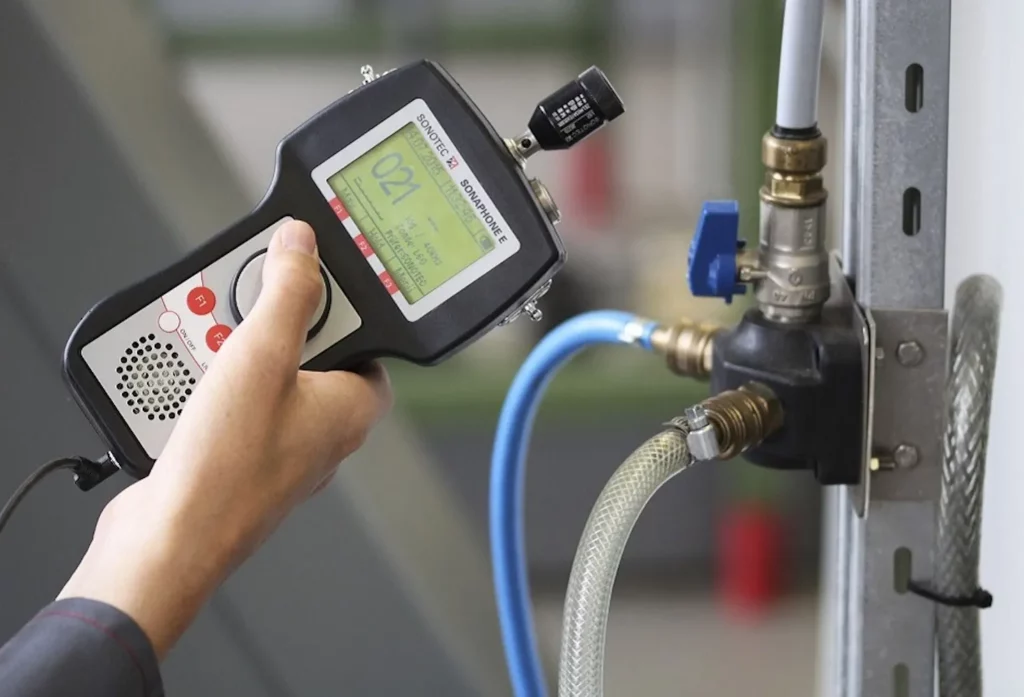
- Acoustic and tracer methods. On pressurised pipework, acoustic listening equipment and tracing techniques help pinpoint the source of a supply or heating leak to a specific location rather than a general area.
- Plumbing and appliance checks. Behaviour at the meter, pressure observations and inspection of likely culprits such as shower trays, waste connections, heating pipes and appliance feeds help separate a plumbing leak from other causes.
- Roof, rainwater and external checks. Where relevant, points where rain can enter, blocked or leaking gutters, and failed seals are considered, since not all internal damp originates inside.
- Condensation and ventilation assessment. Because so much apparent damp is condensation, a survey weighs up airflow, humidity and cold spots to rule that in or out rather than treating every reading as a leak.
The point of leading with non-invasive methods is that the home stays intact. Only when the evidence points clearly to one location would opening up be recommended, and by then it is targeted rather than exploratory.
How this differs from a full building survey
This is the distinction that causes the most confusion, so it is worth being precise. A full building survey, sometimes called a level three survey, is a broad assessment of the whole property. A qualified surveyor looks at the structure, roof, walls, services, drainage and general condition, and produces a report covering the building as a whole. It is broad by design, and moisture is only one of many things it touches on.
A leak and moisture survey is narrow and deep. It exists to answer one question in detail: is there moisture, where is it coming from, and is it live. It is the specialist follow-up that a building surveyor often recommends precisely because a general survey cannot, and is not meant to, trace a leak to its source.
| Aspect | Full building survey | Leak and moisture survey |
|---|---|---|
| Scope | Whole property condition | Moisture source and cause only |
| Question answered | What is the overall condition | What is causing this moisture and is it active |
| Moisture detail | Notes readings, recommends specialist | Traces and evidences the source |
| Typical trigger | Standard part of buying | A flagged reading, stain, leak or high bill |
| Best used | Before making an offer | To resolve a specific moisture concern |
The two are complementary. The building survey identifies that there might be an issue. The moisture survey establishes what the issue is. Trying to make one do the other job is where transactions go wrong, either overreacting to a cautious note or underestimating a real leak.
Who benefits, and how
A clear diagnosis helps everyone in the chain, but for different reasons. The table below sets out who gains what.
| Who | How a survey helps them |
|---|---|
| Buyers | Turn a vague damp warning into a known cause and scope, so they can negotiate on real figures or plan repairs with confidence rather than fear the unknown. |
| Sellers | Find and address a problem before it stalls a sale, or prove that a flagged reading is historic and not a live leak, protecting the asking price. |
| Estate agents | Keep a chain moving by replacing speculation with evidence, so both sides make decisions on facts rather than worst-case assumptions. |
| Landlords and investors | Understand a property's true condition before committing, and budget accurately for any works rather than discovering them later. |
For buyers
A survey converts anxiety into arithmetic. If a leak is confirmed, you know its source and rough remedial scope, which gives you a defensible basis to renegotiate or to ask the seller to fix it before completion. If the moisture turns out to be historic or condensation-related, you can proceed without overpaying for a fear that has no substance. Either way, you are making a decision with your eyes open.
For sellers
Getting ahead of the problem is almost always cheaper than reacting to it. If a buyer's survey flags moisture and you have no answer, you lose control of the narrative and the price. If you commission a survey first, you either fix a genuine issue on your own timeline and at your own choice of contractor, or you hold a clear report showing the reading is nothing to worry about. That report is a powerful reassurance to a nervous buyer.
For estate agents
Agents lose commission when chains collapse over unresolved worries. A specialist report replaces days of back-and-forth guesswork with a single evidenced document that both solicitors and both parties can rely on. It is one of the simplest ways to stop a moisture concern from becoming a deal-breaker.
How a clear report reassures both sides
The value of a survey is not only in the detection, it is in the document that follows. A good report states plainly what was checked, what was found, whether the source is active, and what the sensible next step is. It distinguishes a live leak that needs fixing from a historic mark that does not. That clarity is what lets a buyer and seller stop negotiating against their imaginations and start negotiating against facts.
Crucially, an independent diagnosis carries more weight than an assurance from either party. A seller saying there is no leak is understandably discounted by a cautious buyer. A survey report saying the readings are consistent with a resolved historic issue, with the evidence to support it, is something both sides can accept and move on from.
Typical scope and what it costs
Scope depends on the property and the concern. A single-room investigation triggered by one stain is smaller than a whole-flat survey prompted by a high water bill and readings in several places. As a general guide, non-invasive leak detection and moisture surveys sit within typical UK trade cost-guide ranges of roughly £250 to £600 for a focused domestic investigation, with larger, more complex properties or those needing extensive tracing costing more. These are cost-guide ranges to help you plan, not a quote, and your actual price depends on the property.
Our own positioning is deliberately straightforward. Detection is non-invasive wherever possible, so your home is not opened up on a hunch. The hourly rate is fixed and agreed at the point of booking, so there are no surprises on the day. We work on a no find, no fee basis for leak detection, which means the incentive is to give you a genuine answer rather than a reason to sell you something. And you receive a clear written report you can hand to a buyer, a seller, an agent or a solicitor.
If you want to understand the service in more detail, our leak detection in London page explains the equipment and approach. Where a confirmed leak needs a small, controlled opening to reach and repair it, our trace and access service covers that targeted work. And if you are still unsure whether you are dealing with a leak at all, the guide on how to tell the difference between damp and a leak is a sensible place to start.
When to book, and in what order
Timing matters in a transaction. As a seller, the strongest position is to survey before you list, or at least before a buyer's survey does it for you, so that any issue is on your terms. As a buyer, the moment to act is as soon as a report flags moisture or you notice staining, a musty smell or a suspicious water bill during viewings. Booking early keeps the specialist survey off the critical path and stops it from becoming the reason a completion date slips.
Whatever side of the deal you are on, the principle is the same. Do not let an unanswered moisture question sit in the middle of a sale. It only grows in people's minds. A focused, non-invasive survey answers it quickly, and a clear report lets everyone get back to moving house.
How we help with this
If the article describes a problem you actually have, these are the visits that deal with it.
- leak detection in London
Finding a hidden leak without opening the property up first.
- home leak detection
Flats and houses, at £160 an hour agreed before we travel.
Not sure which one applies? Describe the symptom on the phone and you will be told which survey it is, the hourly rate and roughly how long it takes, before anything is booked. 020 7123 8560
Frequently asked questions
Is a leak survey the same as the building survey I already paid for?
No. A building survey assesses the whole property and will often note a moisture reading and recommend a specialist look further. A leak and moisture survey is that specialist follow-up. It focuses only on finding the source of moisture and confirming whether it is active, which a general survey is not designed to do.
My homebuyer report flagged damp. Does that mean the sale is in trouble?
Not necessarily. A flagged reading is a prompt to investigate, not a verdict. Many turn out to be condensation or historic marks rather than live leaks. A focused survey establishes the actual cause so you can decide whether it affects the price or the timeline, rather than assuming the worst.
Will you have to open up walls or lift floors to find a leak?
We lead with non-invasive methods such as moisture mapping, thermal imaging and acoustic tracing, so in most cases nothing is opened up during detection. If the evidence points clearly to one spot and access is needed to reach or repair it, that becomes a small, targeted opening rather than exploratory damage.
As a seller, is it worth surveying before I even list?
Often yes. Surveying early means you either fix a genuine issue on your own timeline and choice of contractor, or you hold a clear report showing a reading is historic. Either outcome protects your asking price and stops a buyer's survey from taking control of the conversation later.
How much does a leak and moisture survey cost?
As a general guide, non-invasive domestic surveys fall within typical UK trade cost-guide ranges of roughly £250 to £600 for a focused investigation, with larger or more complex properties costing more. We agree a fixed hourly rate at the point of booking and work on a no find, no fee basis for leak detection, so the figure is clear before we start.
What do I actually receive at the end?
A clear written report setting out what was checked, what was found, whether any source is active, and the sensible next step. It is designed to be handed to a buyer, seller, estate agent or solicitor so both sides can act on evidence rather than guesswork.