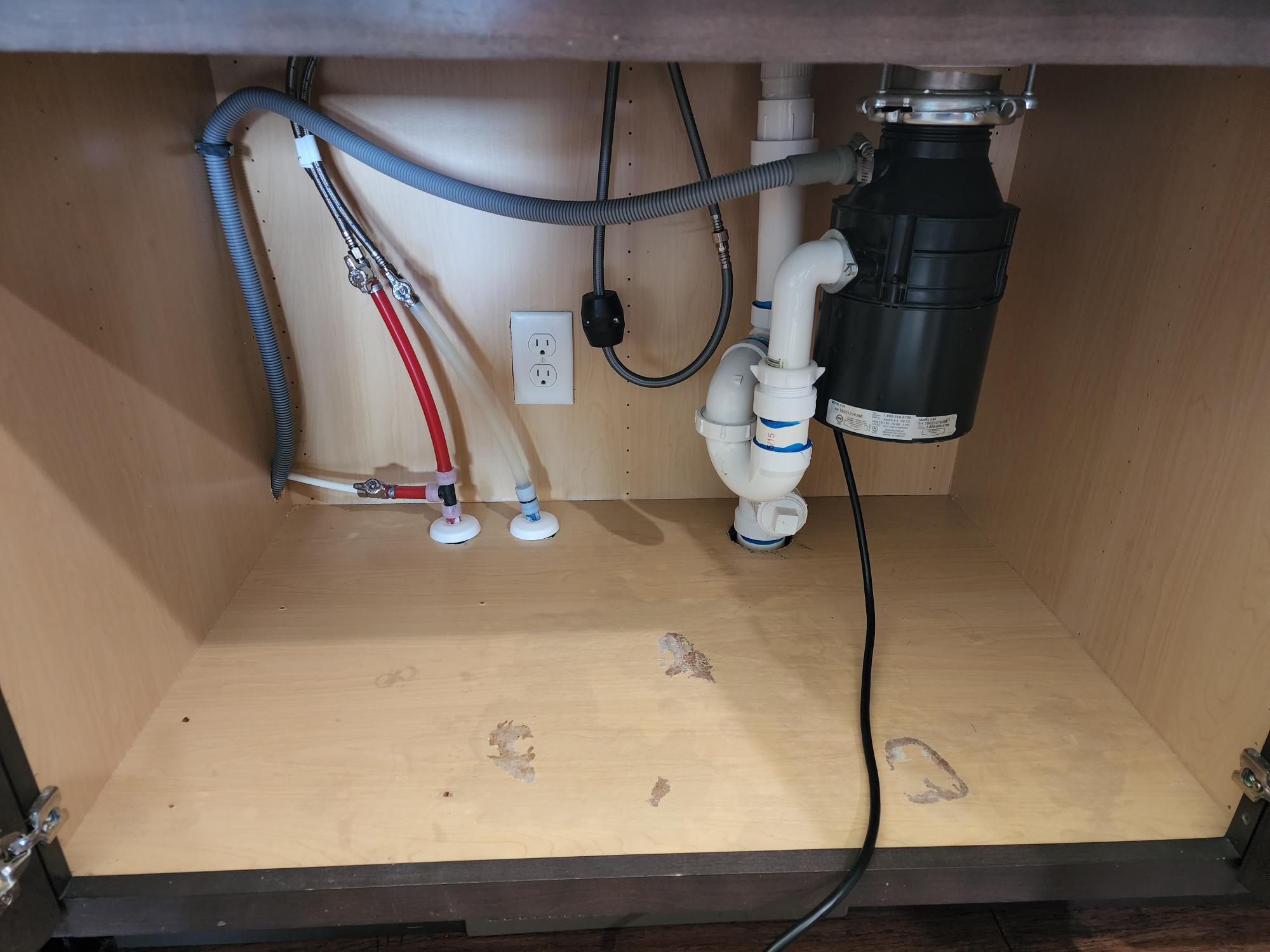
The cupboard under your kitchen sink is a tangle of pipes, traps and hoses, so a small puddle can come from any one of half a dozen places. Here is how to work out which, what you can safely do yourself, and when a leak points to something that needs a plumber before it floods the kitchen.
You open the cupboard under the kitchen sink to grab the washing-up liquid and your hand comes back wet. There is a puddle on the base board, the cardboard box of dishwasher tablets has gone soft, and you have no idea where the water is coming from. It is one of the most common calls we get in London homes, and the good news is that most under-sink leaks are slow, local and fixable. The bad news is that a few of them are not, and telling the difference quickly is what keeps a damp cupboard from becoming a flooded kitchen.
This guide walks through the usual culprits, a simple drying-and-watching method to pinpoint exactly which one is leaking, temporary fixes that buy you time, and the warning signs that mean you should stop and call someone out. It is written for a normal person with a torch and a roll of kitchen paper, not a time-served plumber, so nothing here asks you to solder anything or cut into a wall.
First, work out what kind of leak you have
Before you touch anything, take thirty seconds to understand the space. Everything under a kitchen sink falls into one of two categories, and they behave very differently.
Waste water is everything that drains away after you use the sink. It only carries water when the tap is running or the sink is emptying, and it sits at no pressure. Waste leaks are the traps, the U-bend, the plughole seal and the pipes that carry dirty water off to the wall. These leaks are annoying but rarely dramatic, because water only appears when you actually use the sink.
Supply water is the clean water feeding the taps, and behind it sits the full pressure of the mains or a storage tank. It leaks whether you are using the sink or not, twenty-four hours a day, and a supply leak that lets go completely can put out an alarming amount of water very fast. The tap tails, the flexible hoses, the isolation valves and the copper or plastic pipes climbing up to the taps are all supply.
The single most useful thing you can do is decide which of these you are dealing with, because a waste leak can usually wait until the weekend, while a supply leak that is getting worse cannot. If you are ever unsure, or the water is arriving faster than you can mop it, turn off your supply at the stop tap. Our guide on how to turn off your water stop tap shows you where to find it and which way to turn it.
The usual culprits
Under a typical London kitchen sink you are looking at a surprisingly busy little cupboard. Here are the parts that leak, roughly in order of how often we find them at fault.
The waste trap and U-bend
The trap is the curved section of pipe directly below the plughole, usually white plastic, that holds a plug of water to stop drain smells coming back up. It is the most common source of a slow under-sink leak because it has several push-fit or screwed joints, each with a rubber washer, and those washers perish, shift or clog with grease over time. A trap leak typically shows up as a slow drip that only appears a few seconds after you empty the bowl, and the water is often slightly grey or smells faintly of food.
Compression fittings on the waste and supply pipes
Where rigid pipes join, you often find compression fittings: a nut that tightens down onto an olive or a washer to make the seal. On the waste side these are usually hand-tightened plastic; on the supply side they can be brass. They leak when the nut has worked loose, when the olive was never seated properly, or when someone has over-tightened and cracked the fitting. A compression leak tends to weep steadily from one specific joint rather than drip from a general area.
Tap tails and flexible hoses
Modern mixer taps are connected to the supply with flexible braided hoses, often called flexi-hoses or tap tails. They are quick to fit, which is exactly why they are everywhere, and they are also one of the most reliable causes of serious kitchen and bathroom flooding in UK homes. The braid is a woven metal sleeve over a rubber inner tube. Over the years the rubber degrades and the braid corrodes, and when a flexi finally fails it can split or burst rather than weep, releasing mains-pressure water continuously. This is the one under-sink component that turns a nuisance into an emergency, and it is worth taking seriously. More on that below.
The sink seal around the plughole
Where the plughole waste fitting passes through the bottom of the sink, it is sealed with a rubber gasket and sometimes a bead of silicone. If that seal fails, water escapes around the plughole every time the bowl drains and runs down the outside of the waste pipe, which makes it easy to mistake for a trap leak. The tell-tale sign is water tracking down the top of the waste pipe from where it meets the sink, rather than from a joint lower down.
Waste-disposal and appliance connections
If you have a washing machine, dishwasher or waste-disposal unit, their hoses usually connect under the sink too, often teed into the waste pipe or fed from the isolation valves. Appliance drain hoses can slip off their spigots, and the jubilee clips that hold them can loosen. A leak that only appears when the dishwasher or washing machine is mid-cycle points straight at these connections rather than the sink itself.
Isolation valves
Isolation valves are the small in-line taps on the supply pipes, usually with a slotted screw you turn a quarter-turn with a flathead screwdriver. They let you shut off water to one tap or appliance without killing the whole house. They are handy, but they also add two more potential leak points, and the little spindle they turn on can weep over time, especially if the valve has not been touched in years and is then operated.
How to pinpoint which one it is
Guessing wastes time and often means you tighten the wrong thing. Instead, use a simple dry-and-watch method that isolates the source in a few minutes.
- Clear the cupboard and dry everything. Take everything out, then wipe every pipe, joint, hose and valve completely dry with kitchen paper. You cannot trace a leak across a cupboard that is already wet everywhere.
- Lay down dry paper as a detector. Put fresh, dry kitchen roll or a sheet of newspaper across the base of the cupboard and, if you can, wrap a single dry sheet loosely around each joint. Wet paper shows you the exact spot the first drop lands.
- Watch with the sink unused first. Leave it for ten to fifteen minutes without running any water. If paper gets wet during this dry period, you have a supply leak, because only supply water flows when nothing is being used. Check the flexi-hoses, isolation valves and supply-pipe fittings.
- Now run the cold tap and watch again. Fill the bowl and let it drain. Fresh wet paper that only appears now, a few seconds after draining, points to the waste side: the trap, the plughole seal or a waste compression joint.
- Run the hot tap separately. A leak that appears with hot but not cold narrows it to the hot supply tail or the hot side of the mixer.
- Run each appliance. If the paper only gets wet during a dishwasher or washing-machine cycle, the appliance hose or its connection is the culprit, not the sink.
- Feel upward from the wet spot. Water runs downhill, so the wet patch is always below the leak, never above it. Run a dry finger up each pipe from the puddle until you find the highest wet point. That is your source.
By the end of this you should be able to say something specific, such as "it only leaks when I empty the sink and the water is tracking down from the plughole," which tells you it is the sink seal, not the trap. That specificity is exactly what saves time whether you fix it yourself or call us.
Leak point, likely cause and fix at a glance
| Leak point | Likely cause | Typical fix |
|---|---|---|
| Waste trap / U-bend | Perished or displaced washer, grease build-up, loose connector | Hand-tighten connectors; clean and reseat or replace washer; renew trap |
| Compression fitting (waste) | Loose nut or badly seated washer | Nip up the nut a quarter-turn; replace washer if it still weeps |
| Compression fitting (supply) | Loose nut, poor olive, over-tightened crack | Careful quarter-turn on the nut; olive or fitting renewal by a plumber |
| Tap tail / flexi-hose | Aged rubber inner, corroded braid, loose connector | Isolate supply and replace the hose; do not patch a split braid |
| Sink plughole seal | Failed gasket or dried-out silicone | Re-seat waste fitting with new gasket and fresh silicone |
| Appliance / waste-disposal connection | Slipped hose, loose jubilee clip | Refit hose and tighten clip; renew perished hose |
| Isolation valve | Weeping spindle, worn internal seal | Tighten gland nut; replace valve if it keeps weeping |
Temporary fixes that buy you time
These are stop-gaps to control the water and protect your kitchen until a proper repair, not permanent solutions. Anything involving mains-pressure supply water should be treated with more caution than a slow waste drip.
- Isolate before anything else. If the leak is on a supply pipe, tap tail or flexi, turn the nearest isolation valve a quarter-turn to off, or shut the whole house down at the stop tap. Removing the pressure is the single most effective temporary fix there is.
- Nip up a loose nut, gently. A trap connector or compression nut that is finger-loose can often be hand-tightened, or given a light quarter-turn with a wrench, to stop a weep. Do not force it: over-tightening plastic cracks it, and over-tightening brass distorts the olive and can make the leak far worse.
- Clean and reseat a trap. Waste-trap leaks are frequently just grease and grit under the washer. Unscrew the trap over a bucket, rinse the washer and the seat, make sure the washer is sitting flat, and screw it back up hand-tight.
- Bucket and towel discipline. Put a bucket or washing-up bowl directly under a slow drip and lay old towels across the cupboard base. Check and empty them regularly. This will not fix anything but it protects the units and floor while you arrange a repair.
- Self-amalgamating or repair tape on a weeping joint. Silicone repair tape wrapped tightly around a lightly weeping fitting can slow it noticeably as a very short-term measure. It is not a fix for a split flexi-hose or a burst, and it should never be trusted to hold back mains pressure for long.
- Turn off the water to a leaking appliance. If the leak is on a dishwasher or washing-machine feed, isolate that appliance at its valve and stop using it until the hose or connection is sorted.
When the leak points to a supply-pipe problem
Most of what we have covered, you can reasonably investigate and often fix yourself. Some findings, though, point to a supply-pipe issue that is better handled by a professional, both because it is under pressure and because getting it wrong can flood the room.
Call a plumber rather than pressing on if any of the following is true:
- Water appears when the sink is not being used at all, and it is not coming from a hose or valve you can isolate. That usually means the rigid supply pipe or a soldered joint, which is not a hand-tighten job.
- You have turned off the isolation valve but the leak carries on, suggesting the valve is not sealing or the leak is upstream of it.
- There is a hiss, a fine spray, or you can hear water running inside the cupboard or wall when everything is off.
- The wet patch is spreading beyond the cupboard, the base units are swelling, or water is tracking under the floor or into an adjoining room.
- You have tightened and reseated the obvious joints and it still leaks, or a compression fitting weeps again after you have nipped it up.
- The pipework is corroded, the fittings are seized, or you simply are not confident, in which case forcing anything risks turning a drip into a flood.
A persistent leak on the clean-water side, especially one that runs when the house is quiet, is the kind of thing our water leak repair London team traces and fixes properly, rather than chasing the wet patch around the cupboard. Tracing a supply leak back to its source often needs the pressure managed and the joint remade correctly, and that is worth doing once, well.
What a repair typically costs
Costs vary with access, what has failed and how long the water has been getting out, so treat these as typical UK trade cost-guide ranges rather than a fixed quote. A straightforward job such as replacing a flexi-hose, renewing a waste trap or reseating a plughole is usually at the lower end of a call-out. Remaking a supply compression joint, replacing an isolation valve or tracing a supply leak sits higher because of the pressure work and the time to test it properly. Where water has been leaking long enough to damage units or flooring, the plumbing repair is often the smaller part of the total.
We think the honest way to handle this is to agree the price with you before we travel, so there is no awkward doorstep surprise, and to give you a realistic arrival window rather than a vague "sometime today." If we cannot get to you quickly, we would rather tell you that and let you keep the water isolated than have you sitting with a bucket wondering. When you call, the more specific you can be about what you found with the dry-and-watch method, the more accurately we can price and prioritise the visit.
The short version
A leak under the kitchen sink is usually a waste trap, a tired flexi-hose, a compression fitting, the plughole seal, an appliance connection or an isolation valve. Dry everything, lay down paper, and watch first with the sink unused and then while running each tap and appliance to find the exact source. Isolate the water and apply a temporary fix to protect the kitchen, tackle the simple waste-side jobs yourself if you are confident, and take flexi-hoses seriously because they are a recurring cause of real flooding. If the leak runs when nothing is being used, spreads beyond the cupboard, or survives the obvious fixes, it is pointing at the supply side and it is time to bring someone in before a damp cupboard becomes a flooded room.
How we help with this
If the article describes a problem you actually have, these are the visits that deal with it.
- our full guide to leak detection
How each method works, what it costs and when it is the wrong tool.
- leak detection in London
Finding a hidden leak without opening the property up first.
- water leak repair
Once the leak is found, the repair on the same visit where we can.
Not sure which one applies? Describe the symptom on the phone and you will be told which survey it is, the hourly rate and roughly how long it takes, before anything is booked. 020 7123 8560
Frequently asked questions
Why is water only appearing under my sink when I use it?
That pattern almost always points to the waste side rather than the supply side. Waste pipes and the trap only carry water when the sink is draining, so a leak that appears a few seconds after you empty the bowl and then stops is typically the trap, a waste compression joint or the plughole seal. Dry everything, run the tap, and watch which joint gets wet first.
Is a leaking flexi-hose an emergency?
A hose that has burst or is spraying is an emergency because it sits on the pressurised supply and will keep releasing water until someone shuts it off. Turn off the nearest isolation valve or the main stop tap straight away. A hose that is only lightly weeping is less urgent but still needs replacing soon, as flexi-hoses tend to fail suddenly rather than gradually.
Can I fix an under-sink leak myself?
Often, yes, for the simple waste-side jobs. Hand-tightening a loose trap connector, cleaning and reseating a washer, or refitting a slipped appliance hose are all reasonable for a confident DIYer. Supply-side work under mains pressure, remaking compression joints and anything on rigid pipe is better left to a plumber, because getting it wrong can turn a drip into a flood.
How do I tell a supply leak from a waste leak?
Dry the whole cupboard, lay down kitchen paper, and leave the sink completely unused for ten to fifteen minutes. If the paper gets wet during that period, it is a supply leak because only clean supply water flows when nothing is being used. If it stays dry until you run the tap or empty the sink, it is a waste leak.
I have tightened the joint and it still leaks. What now?
Stop tightening, because forcing plastic cracks it and forcing brass distorts the olive and makes things worse. A joint that still weeps after a gentle nip-up usually needs the washer or olive renewed, or the fitting remade properly. If it is on the supply side or you are not confident, isolate the water and call a plumber rather than risk a bigger leak.
How much does fixing a kitchen sink leak cost in London?
It depends on what has failed and how much water has escaped, so we quote against typical UK trade cost-guide ranges rather than a flat fee. Simple jobs like a new flexi-hose or a renewed trap sit at the lower end, while remaking a supply joint, replacing a valve or tracing a supply leak costs more because of the pressure work and testing. We agree the price before we travel so there are no surprises.