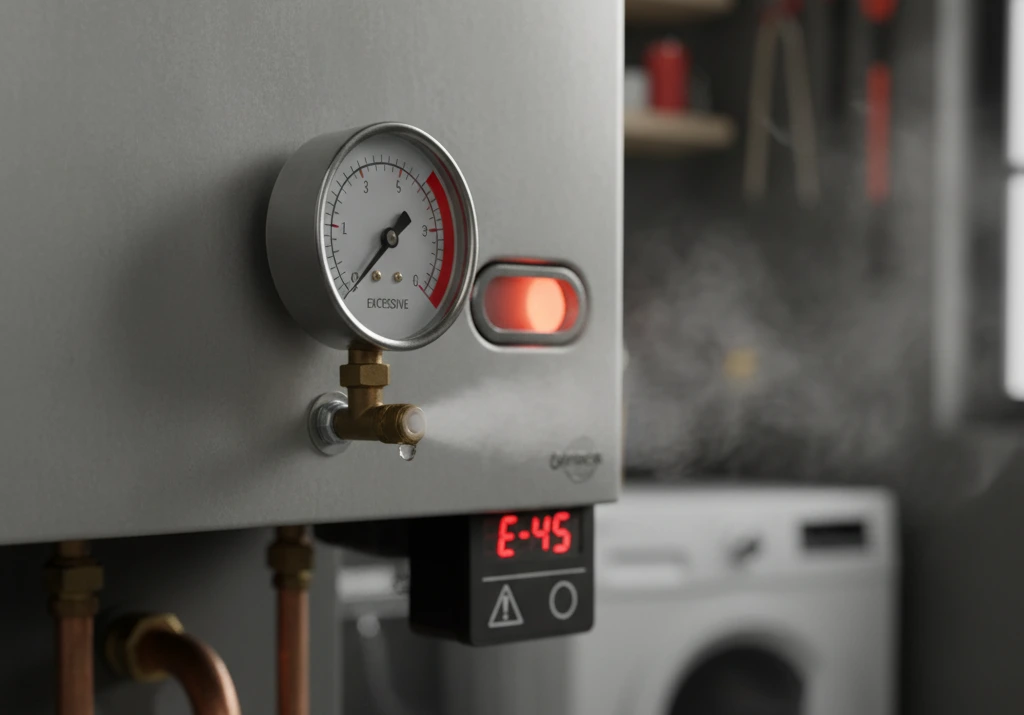
A boiler leaking water is never something to leave. Here is what causes a boiler to leak, the steps to take right now, and how to tell a quick DIY check from a job that needs a Gas Safe engineer.
A boiler leaking water, pooling underneath, or a steady drip running down the casing, is unsettling. A boiler is a sealed pressurised appliance, so water appearing where it should not is always a sign that something has gone wrong. The good news is that many boiler leaks are slow, undramatic, and give you time to react sensibly rather than panic. The important thing is to understand what you are looking at, take a few safe steps to limit any damage, and know which problems you can investigate yourself and which ones legally and practically need a Gas Safe registered engineer.
This guide walks through the common reasons a boiler leaks water, what each one usually points to, and exactly what to do in the first few minutes. It also explains why a leaking boiler is not something to ride out for weeks, and how a leak ties directly into the pressure problems many households in London run into during the colder months.
Is the boiler leaking water, or is something else?
Before assuming the boiler itself has failed, it is worth confirming where the water is genuinely coming from. Water travels. A drip that lands under the boiler may have started higher up or to one side, running along a pipe before it falls. A surprising number of "boiler leaks" turn out to be a weeping joint on the pipework nearby, a leaking radiator valve in the same room, or condensation from a nearby surface.
Dry the area completely with a towel, then watch where the first new drops appear. If water is emerging from within the boiler casing, from the pressure relief pipe, or from the pipes immediately connected to the unit, then you are dealing with a boiler-related leak. If it is coming from a joint a metre away, the fix is different, and often simpler.
Why is my boiler leaking water? The common causes
Boiler leaks tend to fall into a handful of categories. Some are minor and cheap to put right; others point to internal component failure or corrosion that needs proper attention. Here are the ones we see most often across London homes.
1. Loose or corroded internal connections
Inside the boiler, water is carried through a network of joints, unions and fittings. Over years of heating and cooling, these expand and contract, and a joint that was once watertight can loosen very slightly. The result is a slow weep that shows up as a damp patch or a thin trickle inside the casing. In older systems, connections can also corrode, especially where different metals meet or where system water has not been properly inhibited. A tightened or replaced fitting usually resolves this, but the casing must be opened by a Gas Safe engineer, so it is not a job to attempt yourself.
2. A pressure relief valve discharging
Every sealed boiler has a pressure relief valve, sometimes called the PRV or safety valve. Its job is to release water if the system pressure climbs too high, protecting the boiler from damage. When it operates, water is pushed out through a copper pipe that usually runs to the outside of the property, terminating near an outside wall. If you find water dripping or running from a small pipe outside, close to where the boiler sits on the other side of the wall, the PRV is very likely discharging.
This can happen for two reasons. Either the system genuinely is over-pressurised and the valve is doing its job correctly, or the valve itself has failed and is leaking even at normal pressure, often because a tiny piece of debris is holding it slightly open. Both need looking at, because a discharging PRV is frequently the visible symptom of a wider pressure problem.
3. A failed pump seal
The circulation pump moves heated water around your radiators. It is sealed where the motor meets the water side, and that seal can wear out over time. When it does, water seeps from the pump body, often leaving a damp patch directly beneath the pump or a mineral crust around it. A failed pump seal is a clear internal component fault and needs an engineer to replace the seal or, more commonly, the pump.
4. A corroded heat exchanger
The heat exchanger is where the burner heats the water. It is one of the most expensive parts of a boiler, and if it corrodes or cracks, it can leak internally. This is more common in older boilers, in systems that have run for years without a corrosion inhibitor, or where sludge has built up. A leaking heat exchanger is a serious fault. Depending on the age and value of the boiler, repair can cost enough that replacing the boiler becomes the more sensible option. Only an engineer can diagnose this properly.
5. An over-pressurised system pushing water out
This is closely linked to the PRV point above but worth separating out, because the root cause is often something a homeowner has done without realising. If the system has been topped up too far using the filling loop, the pressure rises. When the boiler then fires and heats the water, that water expands and the pressure climbs higher still. Once it passes the safety threshold, the PRV opens and water is expelled. So the "leak" is actually the safety system responding to too much water in a sealed loop. A related cause is a waterlogged or failed expansion vessel, which can no longer absorb that expansion, so pressure spikes every time the boiler runs.
6. Condensate pipe leaks
Modern condensing boilers produce acidic condensate water as a normal part of running efficiently. This drains away through a plastic condensate pipe. If that pipe cracks, works loose at a joint, or becomes partially blocked, water can escape and appear beneath or beside the boiler. Condensate leaks are often mistaken for a more serious internal fault, when in reality the pipe simply needs re-sealing, re-securing or clearing. In winter, a frozen condensate pipe can also back water up, so this is a seasonal issue in colder London spells.
Leak source to likely cause to action
| Where the water appears | Likely cause | What to do |
|---|---|---|
| Small pipe outside an external wall, near the boiler | Pressure relief valve discharging (over-pressure or faulty valve) | Check the pressure gauge; note the reading; book a Gas Safe engineer |
| Damp patch inside the casing, around joints | Loose or corroded internal connection | Turn off, do not open the casing; call an engineer |
| Puddle directly under the pump body | Failed pump seal | Isolate and turn off; engineer to replace seal or pump |
| Water inside the unit with dropping pressure | Corroded or cracked heat exchanger | Turn off; engineer assessment; may need replacement |
| Clear water from a white plastic pipe | Condensate pipe leak or blockage | Check the pipe run for cracks or ice; engineer to re-seal or clear |
| Pressure gauge very high, water expelled when hot | Over-pressurised system or failed expansion vessel | Note the reading; do not keep topping up; call an engineer |
What to do right now: immediate steps
If you have confirmed the boiler is leaking, work through these steps calmly. None of them involve opening the boiler or touching gas components, so they are safe to do yourself.
- Turn off the boiler. Switch it off at the appliance or its fused spur. This stops it firing and heating more water, which limits both the leak and any pressure build-up.
- Isolate the water supply to the boiler. If you can see and reach the isolation valves on the pipes feeding the boiler, turn them off. If you are unsure which valves they are, turning off the main stopcock for the property is a safe fallback.
- Turn off the electrical supply if water is near wiring. If water is dripping onto the boiler's electrical connections or a nearby socket, switch off the power at the spur or consumer unit. Never touch a wet electrical fitting.
- Soak up the water. Place towels and a bowl or bucket under the leak to catch drips and protect flooring, cupboards and anything below. This also makes it easier to see whether the leak is ongoing or has stopped.
- Note the pressure reading. Look at the pressure gauge on the front of the boiler and write down the number. A reading well above the normal band, or one that has dropped noticeably, is useful information for the engineer and helps narrow the cause before anyone arrives.
- Do not keep topping up the pressure. If pressure is low because of the leak, repeatedly using the filling loop simply pushes more water through the leak and, if over-pressure is involved, out through the PRV. Leave it and let an engineer diagnose it.
- Take a photo. A quick picture of where the water is coming from and of the pressure gauge helps us understand the job before we travel, so we can bring the right parts.
DIY-checkable versus needs a Gas Safe engineer
There is a clear line here, and it matters. A boiler is a gas appliance, and internal work on it is restricted by law to Gas Safe registered engineers. Opening the casing, adjusting internal components, working on the heat exchanger, replacing valves or the pump, and anything touching the gas or combustion side are all off-limits to a homeowner. Attempting them is unsafe and can invalidate warranties and insurance.
What you can safely do yourself is limited to observation and containment. You can identify where the water appears, read the pressure gauge, check whether a visible condensate pipe is cracked or frozen, dry the area, turn things off, and isolate the water. That is roughly the boundary.
Safe for a homeowner to do
- Read and note the pressure gauge
- Look for where the first drops appear once dried
- Check a visible condensate pipe for obvious cracks, loose joints or ice
- Turn off the boiler, water and, if needed, the power
- Mop up and protect the surrounding area
Must be done by a Gas Safe engineer
- Opening the boiler casing for any reason
- Tightening or replacing internal connections
- Replacing a pressure relief valve or expansion vessel
- Replacing a pump or pump seal
- Diagnosing or replacing a heat exchanger
- Anything involving the gas supply or combustion
Why a boiler dripping water should not be ignored
It can be tempting to slide a bowl under a slow drip and carry on, especially if the boiler still seems to heat the house. That is a mistake, for several reasons.
A leak means water is escaping a sealed system that is meant to hold pressure. Over time, that lost water shows up as falling pressure, and a boiler that keeps dropping below its working range will eventually lock out and stop heating altogether, often at the worst possible moment. Continuous leaking also corrodes the boiler internally and damages surrounding components, turning what might have been a cheap fix into an expensive one. There is potential damage to your property too, from wet cupboards and flooring to staining and, in the worst cases, damage to ceilings below. And where water meets electrics, there is a genuine safety risk.
Finally, a leak is often a symptom rather than the whole story. A discharging PRV points to a pressure or expansion vessel fault. A corroding connection can point to a wider water quality problem across the system. Catching these early, and having an engineer look at the underlying cause, is far cheaper than waiting for the boiler to fail completely.
How a leak links to system pressure loss
This is the connection many people miss. A sealed heating system holds a set amount of water under pressure, typically shown on the gauge somewhere around the low end of the normal band when cold. If water is leaking out, whether from an internal joint, the pump, the heat exchanger or through a discharging PRV, the total volume in the system falls. As it falls, the pressure reading drops.
So a boiler that keeps losing pressure and a boiler that is leaking are frequently the same problem viewed from two angles. If you are topping up the pressure every few days and it keeps falling, there is almost certainly a leak somewhere, even if you cannot yet see it. Sometimes the leak is on the boiler itself; sometimes it is elsewhere on the pipework or a radiator. This is where proper central heating leak detection earns its place, because tracing a hidden leak under floors or behind walls is far more effective than repeatedly re-pressurising and hoping.
The reverse also happens. A system that is over-pressurised, often from over-topping the filling loop or a failed expansion vessel, forces water out through the PRV. So you can have a leak that is really a pressure fault, and a pressure fault that is really a leak. Untangling which is which is exactly the kind of diagnosis an engineer does on the day.
How we handle a leaking boiler in London
Our approach is straightforward and honest. When you contact us about a leak, we ask a few questions and, where you can, we like a photo of the leak and the pressure gauge so we understand the job before we set off. We give you an honest arrival window rather than a vague promise, and the price is agreed before we travel, so there are no surprises when we arrive.
Our engineers are qualified plumbers who also work as leak detection specialists, which matters when a leak is hidden or when it is not obvious whether the boiler or the wider system is at fault. That means we can both carry out the internal boiler work safely and trace a leak elsewhere in the system if that turns out to be the cause. Where a repair is not the sensible option, for example a badly corroded heat exchanger in an ageing boiler, we will tell you honestly rather than sell you a repair that will not last.
On cost, we quote against typical UK trade cost-guide ranges and agree the figure with you up front. Parts such as a pressure relief valve, a pump or an expansion vessel sit at very different price points, and the diagnosis on the day determines which applies, so a firm price follows the inspection rather than a guess over the phone.
The bottom line
Water leaking from a boiler always means something, but it is rarely a reason to panic. Confirm the boiler really is the source, take the safe immediate steps of turning off, isolating, soaking up and noting the pressure, and then get a Gas Safe engineer to deal with the internal fault. Resist the urge to keep topping up pressure or to open the casing yourself. Treat a leak as an early warning, especially where pressure keeps dropping, and you will usually catch the problem while it is still small and inexpensive to fix.
How we help with this
If the article describes a problem you actually have, these are the visits that deal with it.
- leak detection in London
Finding a hidden leak without opening the property up first.
- central heating leak detection
For a boiler losing pressure or a circuit that will not hold.
- an emergency plumber in London
Attendance when water is running and damage is still spreading.
Not sure which one applies? Describe the symptom on the phone and you will be told which survey it is, the hourly rate and roughly how long it takes, before anything is booked. 020 7123 8560
Frequently asked questions
Is it safe to keep using a boiler that is leaking water?
No. Even a small leak means water is escaping a sealed pressurised system, which leads to falling pressure, internal corrosion, possible property damage and, where water meets electrics, a safety risk. Turn the boiler off, contain the leak and have a Gas Safe engineer look at it rather than continuing to run it.
Why is water coming out of a pipe outside my house near the boiler?
That small outside pipe is almost always the pressure relief valve discharge. Water coming from it usually means the system pressure has risen too high, or the valve itself has failed and is passing water. Note the pressure gauge reading and book an engineer, as it points to a pressure or expansion vessel fault that needs proper diagnosis.
Can I fix a leaking boiler myself?
Only the safe, non-invasive parts. You can read the pressure gauge, find where the water appears, check a visible condensate pipe for cracks or ice, and turn things off and mop up. Anything inside the casing, including connections, valves, the pump and the heat exchanger, must be done by a Gas Safe registered engineer by law.
My boiler keeps losing pressure. Does that mean it is leaking?
Very often, yes. A sealed system that keeps dropping in pressure is losing water somewhere, whether from the boiler, the pipework or a radiator. If you are topping up every few days and it keeps falling, there is almost certainly a leak, and leak detection is a better route than repeatedly re-pressurising.
Should I keep topping up the pressure while I wait for an engineer?
No. If pressure is low because of a leak, topping up just pushes more water through the leak, and if the problem is over-pressure it forces water out through the safety valve. Leave the pressure alone, contain the leak and let the engineer diagnose the underlying cause.
How quickly can you come out to a leaking boiler in London?
We give an honest arrival window when you contact us rather than an unrealistic promise, and we agree the price before we travel. Sending a photo of the leak and the pressure gauge helps us bring the right parts. Our engineers are qualified plumbers who also work as leak detection specialists, so we can handle both the boiler and any hidden leak in the wider system.