Case Study: Damp Living Room Wall and a Suspected Mains Leak Under the Kitchen Floor in Streatham SW16
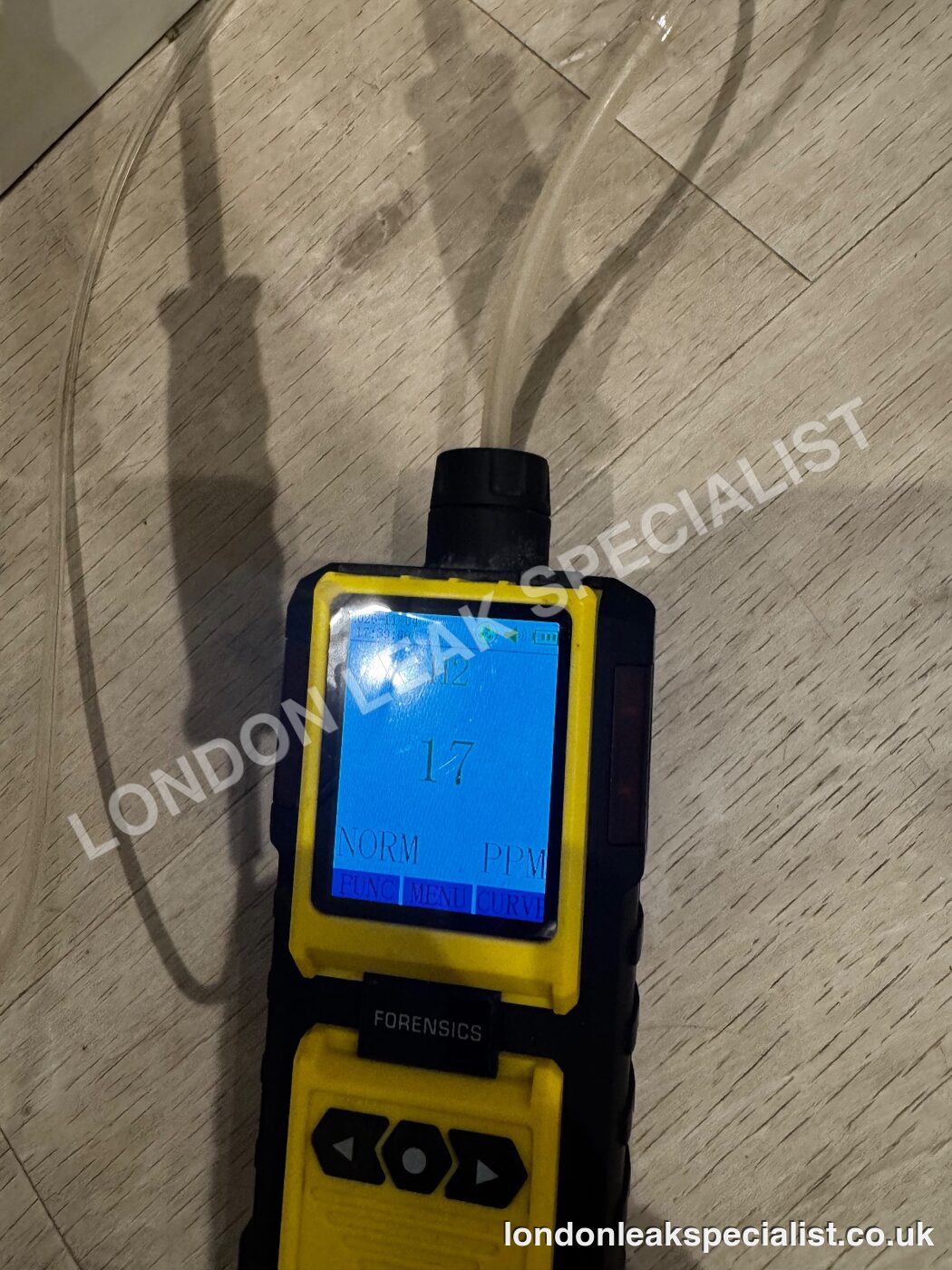
The tracer gas detector at work on a kitchen floor, from a job in Streatham, SW16.
Damp patches behind a sofa, a first visit that found no active plumbing leak, and later a Thames Water alert of about 6 litres an hour. Tracer gas pointed to the mains pipe under a kitchen floor in Streatham, SW16.
This job, in Streatham, SW16, took two visits and did not end in a neat "found it, fixed it". It is a better example of how leak detection works in practice for that reason. The first visit ruled a lot out and said honestly that the cause of the damp was unconfirmed. The second visit, after Thames Water flagged a leak on the property's supply, located a likely mains leak beneath the kitchen floor.
We have removed the client, the address and every contact detail. What is left is the method, the photos and the report, which you can download as a redacted PDF.
The brief: damp behind the sofa and a plumber's theory
The tenant had damp patches on a living room wall, behind the sofa and next to the kitchen. A plumber had already suggested there might be a leaking pipe behind the wall, but nobody knew whether it would be hot, cold or waste. That uncertainty is the whole brief. A wall next to a kitchen can have all three types of pipe in it, and opening it up to look is expensive and messy if you are guessing.
What we ruled out on the first visit, and how
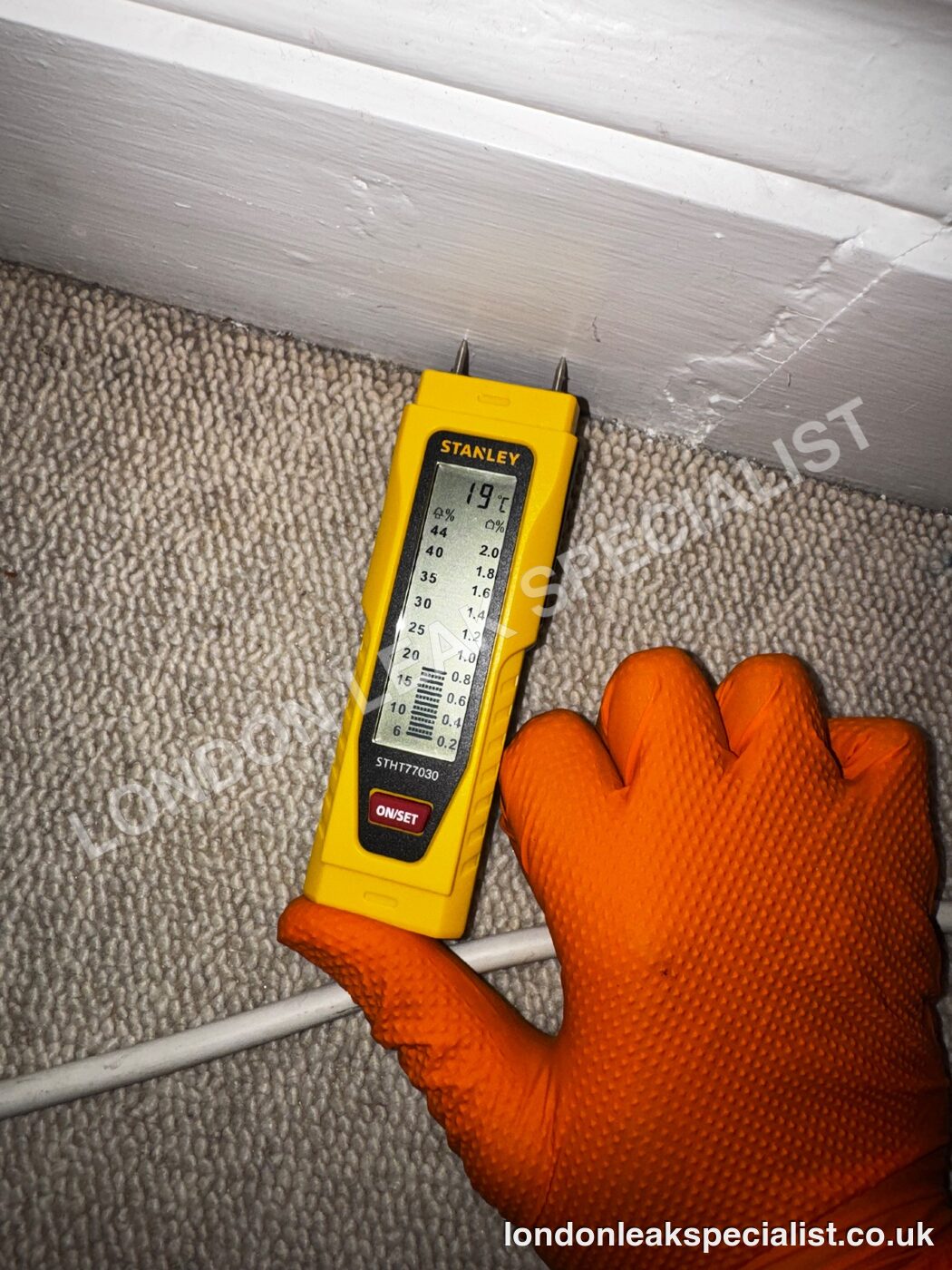
We started with the things that cost nothing and disturb nothing. The carpet and floor by the wall were dry. We checked the radiators, their valves and every visible connection. No leaks.
Next, the heating. We switched it on and used a thermal imaging camera to follow the heating pipes. They run beneath the floor and drop into the cellar, where they are accessible. Following the route matters because a hot pipe that is leaking shows as an odd warm area, and because you cannot clear a pipe you have not traced.
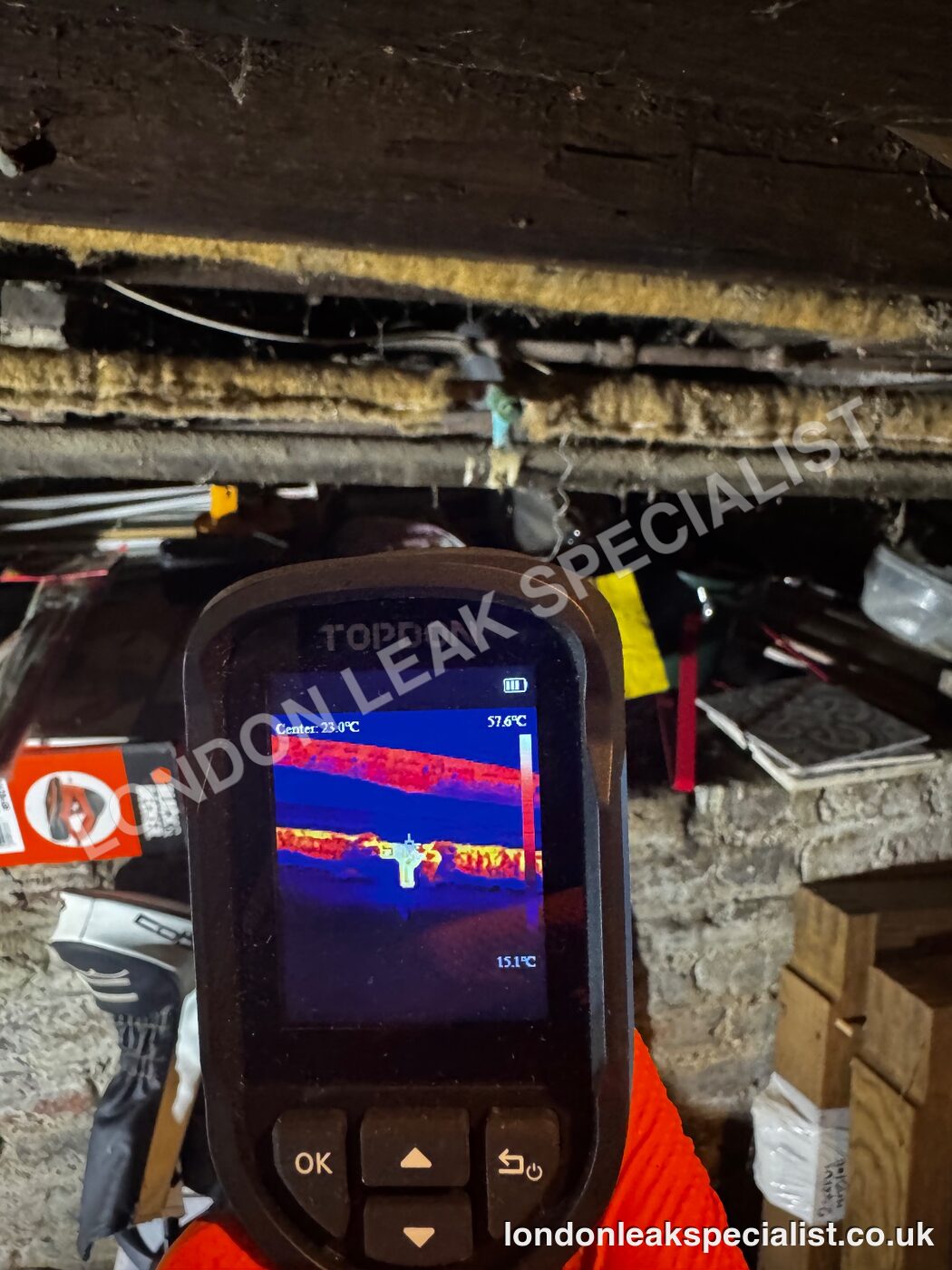
In the cellar we found a very small drip at a heating drain-off point. The tenant had never needed to top up the heating pressure, and the amount of water was tiny. On that evidence, we recorded it as unlikely to explain a damp wall in another room, but worth fixing.
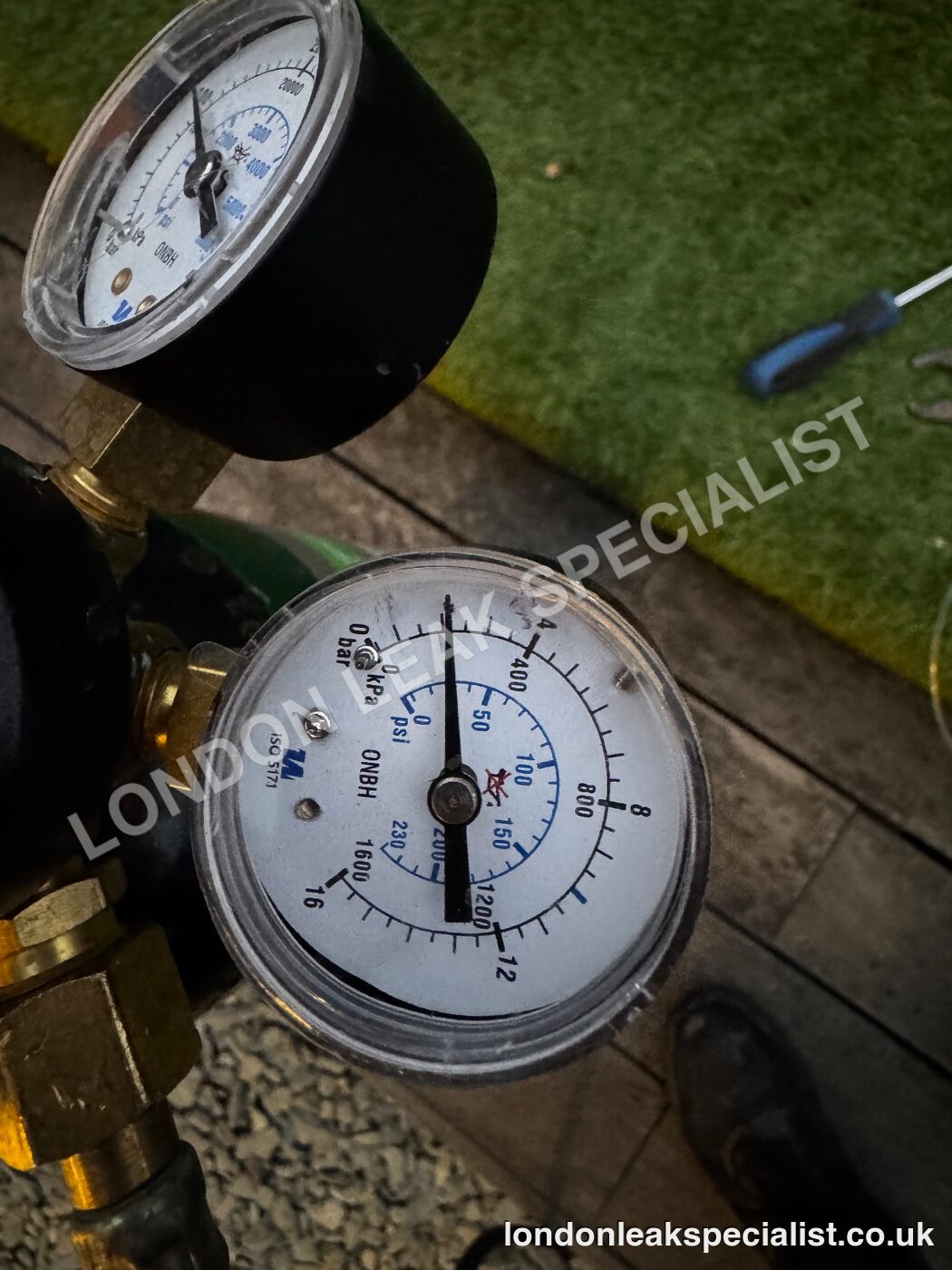
We then traced the incoming mains from where it enters from the street, through the cellar towards the kitchen. Nothing visible was leaking along the accessible sections. We pressure tested the cold mains: it held 2.5 bar for around 30 minutes with no drop. We also noted a limit on that test. The tenant flushed the toilet during it, so conditions were not perfectly still, and the report says the result should be read alongside the other findings and not as proof that no concealed or intermittent leak exists. The bathroom showed nothing that could link to the wall.
The report's conclusion was plain: no active plumbing leak found, cause of the damp unconfirmed. It listed other possibilities, including water collecting in the ground outside, and recommended a simple meter check: note the Thames Water meter reading, use no water, check again. If it moves, there is a leak somewhere on the supply. Many people skip this step, but it is free, and it settles the mains question better than a one-off pressure test.
The second visit: a Thames Water alert
Some time later Thames Water reported an ongoing leak on the property's supply, with an estimated loss of around 6 litres an hour. That was new information. It did not prove the earlier damp was connected, and we make no claim that it was. It did mean there was a real water loss to find.
We also used the visit to finish the heating repair, covered below.
The method: tracer gas, and why
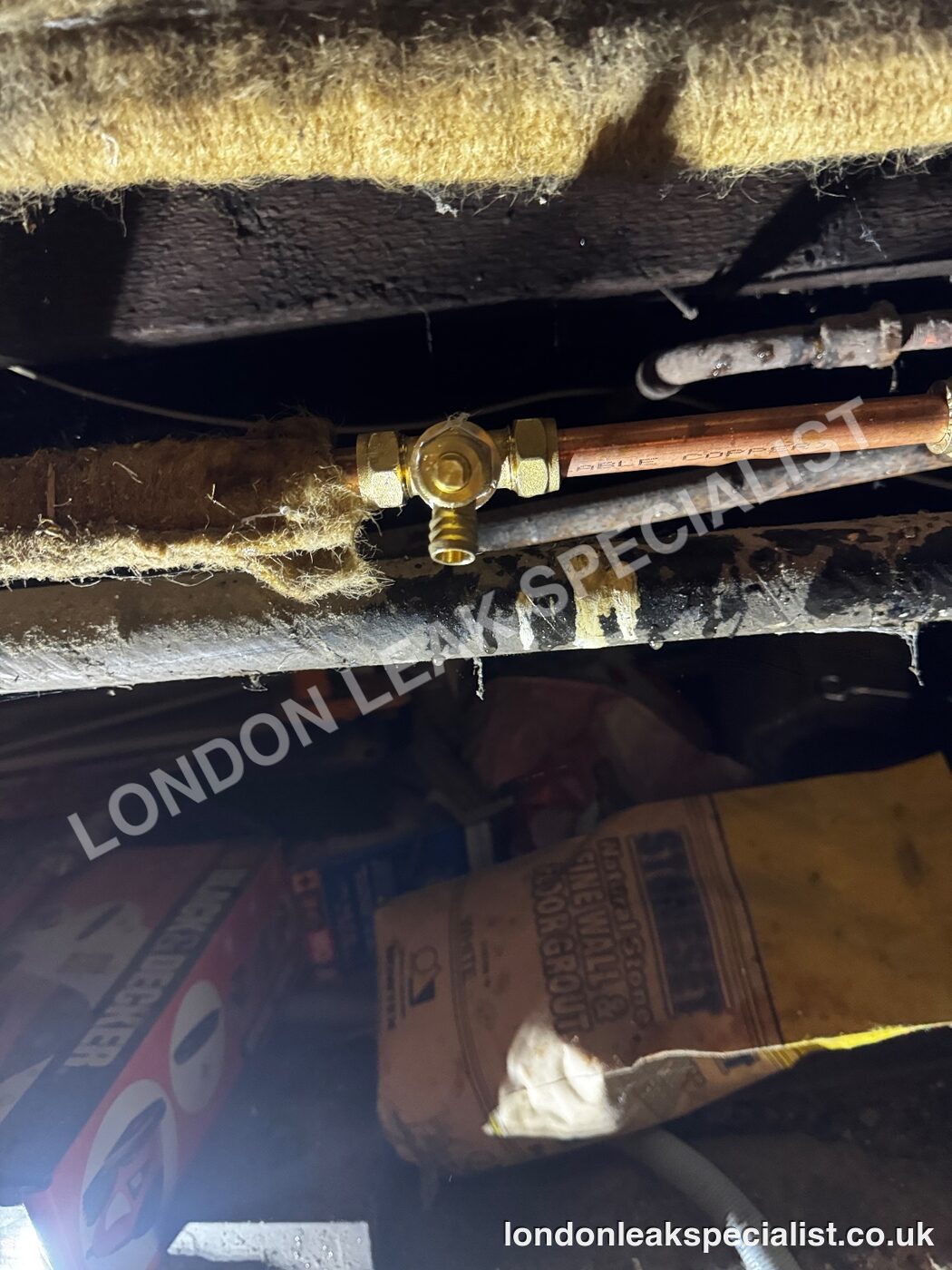
The suspect area was beneath the kitchen floor. The visible pipework was mostly older lead pipe transitioning to copper, which then disappears under the kitchen floor on the way to the boiler and kitchen tap. There was nothing to see on the accessible sections, and lifting a kitchen floor to look is the last thing you want to do on a guess.
So we drained down the mains system and charged it with tracer gas, a harmless mix that is lighter than air. If there is a hole in the pipe, the gas escapes through it and rises through the floor and fittings, where a sensitive detector can pick it up. It lets us look for the leak from above without breaking anything. Our guide on acoustic, thermal and tracer gas detection explains when each method fits.
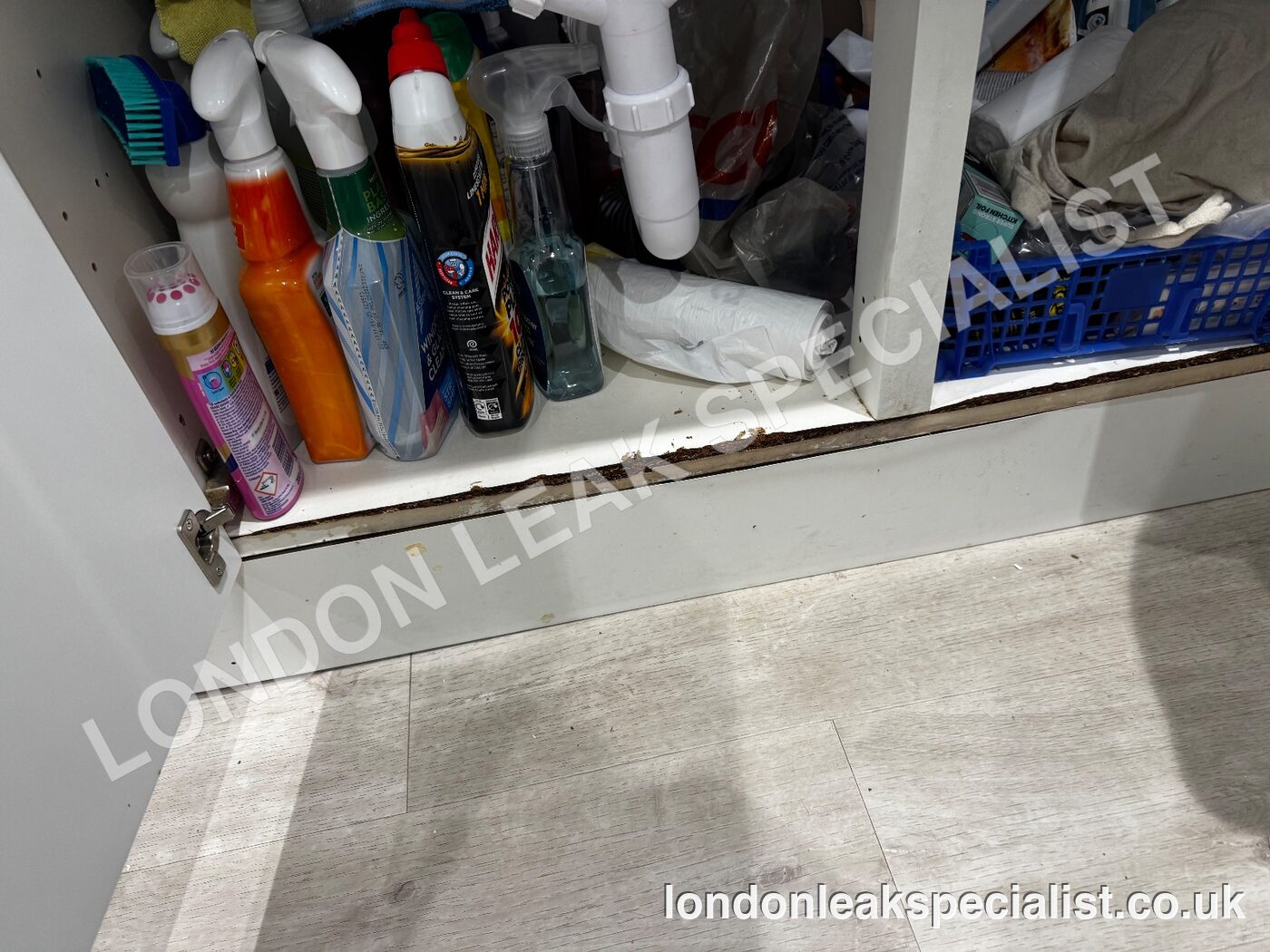
We checked the cellar first. No significant readings. We then scanned the kitchen floor: initial readings were minimal and gave no clear location. The next step was to put the detector wand beneath the kitchen units, where air movement is lower and gas can collect. There, we got a slight but detectable reading.
What we found, and what we could not say
The reading was low, but enough to establish a suspected leak on the concealed mains pipework beneath the kitchen floor. We want to be exact about the word "suspected". We detected escaping gas. We did not see the failed pipe, joint or valve, because it is hidden under the floor. The report says that in terms. A report that claimed more than the evidence would be worse than useless to an insurer or a water company.
What we did on the day
- Drained the heating system, cut out the section of pipe holding the leaking drain-off valve and fitted a new valve.
- Refilled the system, brought it back to normal pressure, bled it and checked every repaired connection. No further leaks from that section.
- Noticed that the boiler was discharging water through its pressure relief valve in operation. We did not touch it. It is a job for a Gas Safe registered engineer, and the report says so. We cover the same symptom in another case study.
- Charged and scanned the mains with tracer gas, as above, then turned the water back on.
What permanent repair and make-good is needed
The mains leak is still concealed, so the repair is not done yet. The report sets out two options, and we are quoting both:
- Localised access and repair. Lift a section of floorboard under the sink unit, find the failed pipe, joint or valve, cut it out and replace it, then pressure test.
- A new pipe route. Run a new supply from the cellar up into the kitchen, behind the units where practical, connect it to the original supply and abandon the defective section. This may avoid disturbing the kitchen floor.
Either way, we can quote the repair together with putting back anything we have to disturb, so the customer ends up with a finished job and not only a diagnosis. Rates are on the pricing page.
Why the method saved time and damage
Two obvious routes would have been worse. The first was to open the living room wall because a plumber thought there might be a pipe in it. The tests on the first visit gave no sign of an active leak there, so cutting into it would have been a guess. The second was to lift the kitchen floor on suspicion once Thames Water flagged a leak. Tracer gas narrowed the search to the area under the kitchen units first. Nobody has had to rip up flooring to find out where to look, and that is where the saving is: in not opening up the wrong place. We are not putting a figure on it, because no repair was done that we could compare with.
Leaks and damp in Streatham, SW16
Streatham sits in SW16, a postcode district that stretches across more than one borough. We do not name the council for this job because the record does not say which one it falls under. Older houses here often have lead supply pipe, cellars with boxed or lagged pipework and suspended timber floors, which makes leaks hard to see and slow to show. We cover leak detection across Lambeth and, a little further south in SW16, Norbury in Croydon.
The report, and what the insurer, agent or water company looks for
Who owns which pipe matters here. Thames Water says the homeowner is responsible for the supply pipe from the property boundary into the house, and it is responsible for the communication pipe that links to the main. A leak under a kitchen floor is therefore normally on the property side. If you want to understand how a leak affects the bill, see the Thames Water leak allowance and our guide to the water leak between meter and house.
On insurance, be careful. Trace and access cover, which pays to find a hidden leak and open up to reach it, is in many buildings policies but not all, and some exclude gradual wear such as corrosion. We cannot say what an insurer will decide. What we can do is give them what they need: the reason for the visit, every test and result including those that found nothing, what was confirmed and what was only suspected, photos and the options for repair. Our guide to insurance leak claims and the article on trace and access cover cover the detail. You can read the redacted report as a PDF.
What you can check yourself
- Do a meter check. Switch off everything that uses water, photograph the meter, wait, and photograph it again. Any movement means water is going somewhere. It works because it does not rely on seeing the leak. See why your water meter might be spinning.
- Check the cellar or the lowest accessible point. A torch on pipes and joints, and a dry paper towel wiped along them, will show weeping that your eyes miss.
- Look under the kitchen units. Mains pipes often enter the house near the sink. A damp base panel or staining on the cabinet floor is worth photographing, with dates.
- Do not rule out the ground outside. Standing water against walls and blocked drainage can cause damp that looks like a leak. This is why a dry result inside should not be treated as the end of the search.
- Keep the Thames Water letter and your meter photos. They date the problem and support a leak allowance or insurance discussion. See also what to do when your bill suddenly jumps.
A damp wall or a leak alert in Streatham, SW16, or anywhere in London, and no obvious source? We test in an order that avoids opening up more than necessary, repair simple faults on the day, and write the report so that agents, insurers and water companies can use it. We can also quote the permanent repair and make-good.
How we help with this
If the article describes a problem you actually have, these are the visits that deal with it.
- leak detection in London
Finding a hidden leak without opening the property up first.
- damp and moisture surveys
Moisture mapping that separates a leak from condensation or damp.
- underfloor heating leak detection
Loop by loop testing without lifting the whole floor.
Not sure which one applies? Describe the symptom on the phone and you will be told which survey it is, the hourly rate and roughly how long it takes, before anything is booked. 020 7123 8560
Frequently asked questions
How do you find a mains water leak under a kitchen floor?
We drain the mains, fill it with tracer gas and scan the floor and fittings with a detector. Any escaping gas shows where the pipe is leaking, without lifting the floor. In this Streatham, SW16 job, the strongest reading came from beneath the kitchen units.
Who repairs a leaking water supply pipe, me or Thames Water?
Thames Water says the homeowner is responsible for the supply pipe from the property boundary into the house, and that it is responsible for the communication pipe to the main. A leak inside the property, such as under a kitchen floor, is normally on the owner side. Check with Thames Water for your own situation.
Can lead pipes cause a leak, and should they be replaced?
Old lead pipe can fail at joints and where it connects to copper. In this job the visible supply was lead changing to copper before it ran under the floor. Replacing a failed section with a new route is one of the two options we quoted. A plumber can advise on replacing the rest.
My pressure test held but the water meter is moving. Why?
A short pressure test can miss a small or intermittent leak, and it is only as good as the conditions during the test. A meter check over a longer period, with all water off, is a more sensitive check. If the meter moves, there is a leak somewhere on the supply and it needs further investigation.
Do you do leak detection in Streatham and SW16?
Yes. We attend homes in Streatham, SW16 and the surrounding areas of south London. We find the source or show where it is not, repair simple faults on the day where safe, and can quote the permanent repair and make-good.