Copper carries water well and lasts for decades, yet it still springs pinholes, weeps at joints and splits after a freeze. Here is how the leak actually gets found on copper, and why cutting on a hunch is the wrong move.
Copper has been the default material for water pipes in London homes for generations, and for good reason. It resists corrosion better than the iron and lead that came before it, it tolerates heat, and a well-made copper system can run quietly for fifty years or more. Yet copper is not immune to failure. When it does leak, the escape of water is often slow, hidden behind plaster or beneath a floor, and maddeningly hard to place. The pipe that is dripping into your ceiling void may sit two metres away from the damp patch you can actually see.
This guide is about the practical business of finding a leak in a copper pipe: why copper fails in the first place, the signs that tell you something is wrong, and the detection methods that locate the exact point of loss before anyone lifts a floorboard. It is deliberately focused on copper rather than a general overview of every pinhole, because the detection approach for copper has particular strengths worth understanding. If you want the wider picture on pinholes specifically, our companion piece on pinhole leaks in copper pipes covers the metallurgy in more depth.
Why copper pipes leak
Copper does not simply wear out at random. When a copper pipe fails, there is almost always an identifiable mechanism behind it, and understanding which one is at work helps predict where the next problem might appear.
Pinhole corrosion from water chemistry
The most talked-about copper failure is the pinhole: a tiny perforation, often no wider than a pin, that lets water weep out under pressure. Pinholes are usually the end result of corrosion attacking the pipe wall from the inside. Certain water conditions accelerate this. Water that is slightly acidic, water with high chlorine or chloramine content, and water carrying fine grit or sediment can all pit the internal surface over time. In some homes, stray electrical currents finding their way to earth through the plumbing add electrolytic corrosion to the mix. The result is a slow thinning of the copper at a specific spot until the wall finally gives way.
Erosion-corrosion from flow
Where water changes direction sharply or moves too fast, it can physically scour the inside of the pipe. This is erosion-corrosion, and it tends to show up just after bends, at the outlet of pumps, or wherever a badly reamed fitting has left a burr that makes the water swirl. The tell-tale sign inside a failed section is a smooth, horseshoe-shaped groove pointing in the direction of flow. Undersized pipework carrying too much demand is a common culprit, which is why some London flats with later high-pressure showers pumped through original narrow pipe start to see failures.
Failed soldered and compression joints
A copper system is only as sound as its joints. Soldered capillary joints depend on the solder wetting the full ring between pipe and fitting; a cold joint, a poorly cleaned surface, or too little flux leaves a void that can weep for years before it becomes obvious. Compression joints rely on an olive being crushed evenly onto the pipe. Over-tightening, a scratched pipe surface, or slight movement in the run can all break that seal. Joints are the single most common leak point in copper, more so than the pipe wall itself.
Freeze damage
Water expands as it freezes, and a copper pipe running through an unheated loft, an external wall or an uninsulated void can split when a hard frost catches it. The split may be a hairline that only weeps when the ice thaws and the system comes back under pressure, which is why so many freeze leaks are discovered on the first mild day after a cold snap rather than during the frost itself.
Physical wear and installation stress
Copper is soft enough to chafe. A pipe rubbing against a joist with every heating cycle, a nail or screw driven through a pipe during earlier building work, vibration from a boiler, or a run that was bent too tightly on installation can all create a weak point that eventually fails. These mechanical causes are common in properties that have been altered, extended or re-floored over the years, which describes a great many London homes.
The signs that point to a hidden copper leak
Copper leaks rarely announce themselves with a burst and a flood. More often they are quiet, and the evidence is indirect. The signs worth watching for include:
- An unexplained rise in your water bill or a water meter that keeps creeping when every tap and appliance is off.
- Damp patches, staining or blistering paint on walls and ceilings, often some distance from the actual leak because water tracks along joists and pipe runs before it drops.
- A persistent musty smell in a cupboard, under a sink or in a particular room, which points to sustained moisture.
- Reduced water pressure at one or more outlets where water is being lost from the system before it reaches the tap.
- The sound of running water when nothing is in use, or a faint hiss near pipework.
- Warm patches on a floor where a heating or hot-water pipe is leaking, or unexpected cold damp where a mains-cold pipe is at fault.
- Green or blue-green staining and verdigris on exposed copper, which marks a spot where water has been escaping and reacting with the metal.
Any one of these on its own may be innocent. Two or three together are a strong signal that a pipe is losing water somewhere you cannot yet see.
Why acoustic detection excels on copper
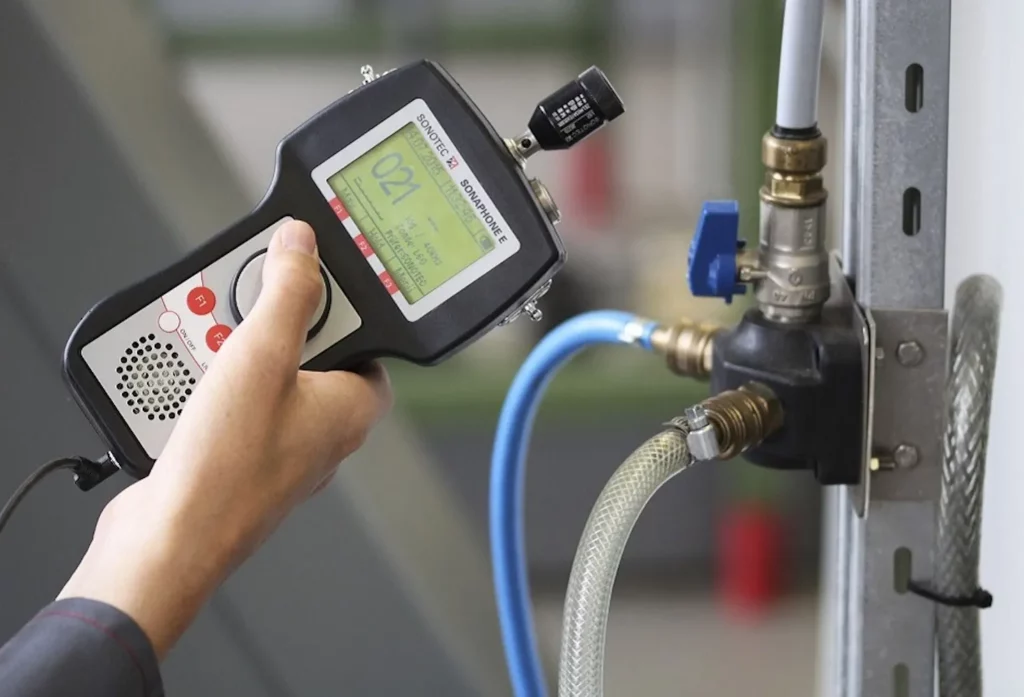
The single biggest advantage of copper when it comes to finding a leak is that it is metal, and metal carries sound extremely well. When water escapes from a pressurised copper pipe, it does not do so silently. The water forcing its way through a pinhole or past a failed joint generates a characteristic hiss, and the vibration of that escape travels along the rigid copper wall for a considerable distance. This is exactly what acoustic leak detection is built to exploit.
An acoustic technician uses highly sensitive ground microphones and contact sensors to listen to the structure. By placing sensors at different points along a run and comparing the strength and character of the sound, the leak can be triangulated to a surprisingly small area, often within a matter of centimetres, without removing a single tile. Copper's stiffness means the signal stays coherent over distance far better than it would on plastic pipe, which absorbs and deadens vibration. In practical terms, a leak that would be almost impossible to place on a modern plastic manifold system can often be pinned down cleanly on copper precisely because the pipe itself acts as a sound conductor.
Pressurised systems favour this method most, because the pressure is what drives the escaping water and creates the noise. On a mains-cold copper supply or a pressurised hot run, acoustic work is frequently the fastest route to an answer. Our dedicated overview of acoustic leak detection in London explains the equipment and the listening technique in more detail.
When thermal imaging and tracer gas are added
Acoustic detection is powerful, but no single method is right for every situation, which is why a proper survey is multi-method. Two techniques in particular complement acoustic work on copper.
Thermal imaging reads surface temperature differences. A hot-water or central-heating leak warms the material around it, while an escaping cold-mains supply cools it, and a thermal camera renders that contrast visible through wall and floor finishes. On copper heating circuits this is especially useful, because it can confirm which of several parallel runs is the wet one and show the direction water is tracking before anything is opened up. It does not see through walls, but it reads the thermal footprint the leak leaves on the surface.
Tracer gas is the method of last resort that rarely fails. A safe, inert mixture, typically hydrogen in nitrogen, is introduced into the drained pipe. Being the smallest molecule, hydrogen escapes through the exact point of failure and rises to the surface, where a gas-sensitive probe detects it. On a copper pinhole too small or too intermittent to make a reliable sound, or on a system that cannot be brought fully up to pressure, tracer gas will still find the breach. Used together, acoustic listening narrows the search, thermal confirms the affected run, and tracer gas nails the precise spot. That layering is what separates a confident locate from a guess.
Why speculative cutting is a mistake
The temptation, when a ceiling is staining and nerves are frayed, is to open up the most obvious spot and have a look. It is almost always the wrong move on copper. Water tracks. The point where a leak shows itself on a ceiling or wall can be well removed from the point where the pipe is actually failing, because water runs along joists, follows the pipe run, and pools at the lowest point it can reach before soaking through. Cutting into the visible damp patch frequently reveals sound pipe and dry timber, and now there is a second hole to make good on top of the original problem.
This is a recurring theme wherever DIY plumbers compare notes: the honest consensus is that chasing a damp mark by eye leads to repeated, needless holes and a much larger repair bill, while a proper locate finds the point first and cuts once. Non-invasive detection exists precisely to break that cycle. Find the leak accurately, then open up exactly where the pipe fails and nowhere else.
Repair options once the leak is found
Locating the leak is only half the job; the right repair depends on the cause and the condition of the surrounding pipe. There is a clear hierarchy of options on copper.
Remake the joint
Where a soldered or compression joint has failed and the pipe either side is sound, the fix is to remake the joint. A failed compression fitting can often be dismantled, fitted with a fresh olive and remade; a weeping soldered joint is cut out and a new capillary or push-fit connection made. This is the least disruptive repair and, on a genuine joint failure, the correct one.
Replace the affected section
Where the pipe wall itself has perforated, whether from a pinhole, erosion-corrosion or a freeze split, the failed length is cut out and a new section of copper spliced in with couplers. It is important that the replacement is properly sized and the pipe reamed clean, because fitting new copper into a system that caused the failure through turbulent flow will only invite a repeat. A single isolated pinhole in otherwise healthy pipe is usually a straightforward section replacement.
Repipe the run or the property
When pinholes start appearing at multiple points, it is a sign that the water chemistry or the original installation is attacking the whole system, and patching becomes a losing game. At that point replacing the run, or in older properties the whole supply, is the sounder long-term decision. This is a particular consideration in period London housing stock, where copper may sit alongside older lead or galvanised sections. Our guide to old pipes in London homes covers how mixed-material systems age and when wholesale replacement makes sense.
Typical UK trade cost ranges
As a rough guide, and in line with published UK trade cost guides rather than a fixed quotation, remaking a single accessible joint is generally a modest job at the lower end of the scale, while cutting in a new section of pipe sits a little higher once access and making good are accounted for. A full repipe of a run or a property is a substantial project priced by scope. Detection itself is a separate, upfront service, and the value of getting it right is that it keeps the repair small and targeted rather than exploratory. Actual figures vary with access, location within the property and the finishes involved, so treat any range as indicative until a survey is done.
How we approach a copper leak in London
Our position is deliberately straightforward. We locate copper leaks using acoustic detection as the primary tool, backed by thermal imaging and tracer gas where the situation calls for it, so the answer does not rest on a single method. The work is non-invasive: the aim is always to find the exact point before anything is opened up. Pricing is a fixed hourly rate agreed at the point of booking, so you know the rate before we arrive, and our approach is no find, no fee, which means the risk of the search sits with us rather than you.
If you suspect a copper pipe is leaking anywhere in a wall, floor or ceiling void, the right first step is an accurate locate rather than a hopeful hole. You can read more about our full service on the leak detection in London page, and the acoustic leak detection page explains why copper responds so well to a listening survey.
How we help with this
If the article describes a problem you actually have, these are the visits that deal with it.
- leak detection in London
Finding a hidden leak without opening the property up first.
- our full guide to leak detection
How each method works, what it costs and when it is the wrong tool.
Not sure which one applies? Describe the symptom on the phone and you will be told which survey it is, the hourly rate and roughly how long it takes, before anything is booked. 020 7123 8560
Frequently asked questions
Can I find a copper pipe leak myself before calling anyone?
You can gather useful clues. Check whether the water meter still creeps with every tap and appliance off, look for damp patches, staining, musty smells or green verdigris on exposed copper, and note any drop in pressure. These confirm a leak exists, but the actual point is usually hidden and tracks away from where the damp shows. Locating it precisely needs acoustic, thermal and tracer-gas equipment rather than the eye.
Why is acoustic detection so effective on copper specifically?
Copper is a rigid metal, and metal carries sound well. Water escaping from a pressurised copper pipe creates a hiss whose vibration travels along the pipe wall for a long way with little loss. Sensitive ground microphones and contact sensors pick that up and let a technician triangulate the leak to within centimetres. Plastic pipe deadens the same signal, so copper is one of the materials best suited to a listening survey.
Do you always need to cut into the wall to find the leak?
No. The whole point of non-invasive detection is to avoid that. Acoustic listening, thermal imaging and tracer gas locate the failure through intact wall and floor finishes, so the only opening made is the single, precise access needed for the repair itself. Cutting on a hunch usually reveals sound pipe, because water tracks along joists and shows itself away from the actual leak.
My copper pipe leaked right after a cold snap. Why then?
Freeze damage is a common copper failure. Water expands as it freezes and can split a pipe running through a loft, external wall or uninsulated void. Often the split is a hairline that only weeps once the ice thaws and the system comes back under pressure, which is why many freeze leaks are found on the first mild day after the frost rather than during it.
Is a pinhole leak a one-off, or will more appear?
It depends on the cause. A single pinhole in otherwise healthy pipe, perhaps from a stray nail or a local defect, can be a genuine one-off fixed with a section replacement. But pinholes driven by aggressive water chemistry or erosion-corrosion tend to recur across the system, and once several appear, patching becomes a losing game. That pattern is the signal to consider replacing the run rather than chasing individual holes.
How much does it cost to find and fix a copper leak?
Detection is charged as a fixed hourly rate agreed when you book, on a no find, no fee basis. Repair cost depends on the cause: remaking a single joint is a modest job, cutting in a new section sits a little higher once access and making good are counted, and a full repipe is priced by scope. These follow typical UK trade cost-guide ranges and vary with access and finishes, so treat them as indicative until a survey is done.