Case Study: Water Still Coming Through After the Flat Above Was Isolated, Marylebone NW1
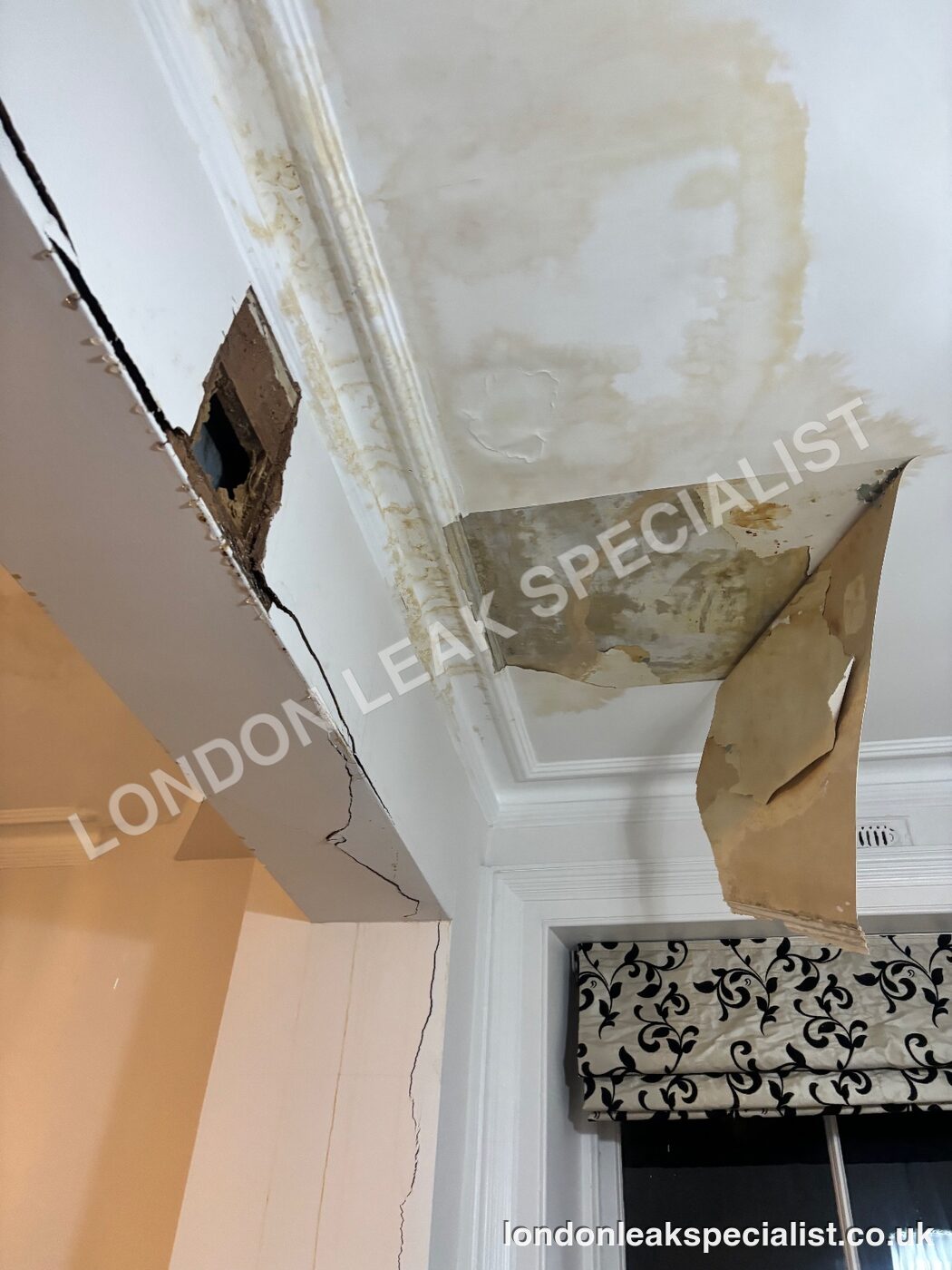
The ceiling opened up where water was coming through, with the boxed-in beam beside it, in a block in Marylebone, NW1.
In a mansion block in Marylebone, NW1, the water supply to the top-floor flat had been turned off, yet water was still coming through the ceilings below. Two visits, a pressure test, a dye test and a ceiling opened up later, here is what was ruled out, what was not, and why we stopped short of recommending a repair.
Switching off the water to the flat above is the first thing most managing agents try when a ceiling starts to drip. It is a sensible step. It is also not proof of anything, and this job, in a mansion block in Marylebone, NW1, in the City of Westminster, shows why. The supply to the top-floor flat had been isolated and water was still coming through the flats below.
This one does not end with a neat photograph of a split pipe, and we would rather say that plainly than dress it up. We removed the client, the building, the address and every contact detail. You can download the redacted report as a PDF.
The brief: a top-floor flat isolated and water still arriving below
A managing party asked us to look at an escape of water that had affected several flats in a purpose-built block. Earlier contractors had pointed at the top-floor flat. The landlord there had already stripped out most of the bathroom and kitchen fittings and the supply to that flat had been turned off. Even so, residents below were still seeing water at their ceilings.
That is the awkward bit. If the suspected source is switched off and the water continues, either the diagnosis was wrong or incomplete, or there is more than one route for the water. We attended twice, three days apart.
What we ruled out first, and how
On the first visit we went through the top-floor flat. Most fittings were gone and the remaining plumbing was pipe ends capped with isolation valves. The flooring where the basins, sink and toilet had been was heavily damp, which tells you a lot of water had escaped at some point. What it cannot tell you is where it came from, because the fittings were no longer there to inspect.
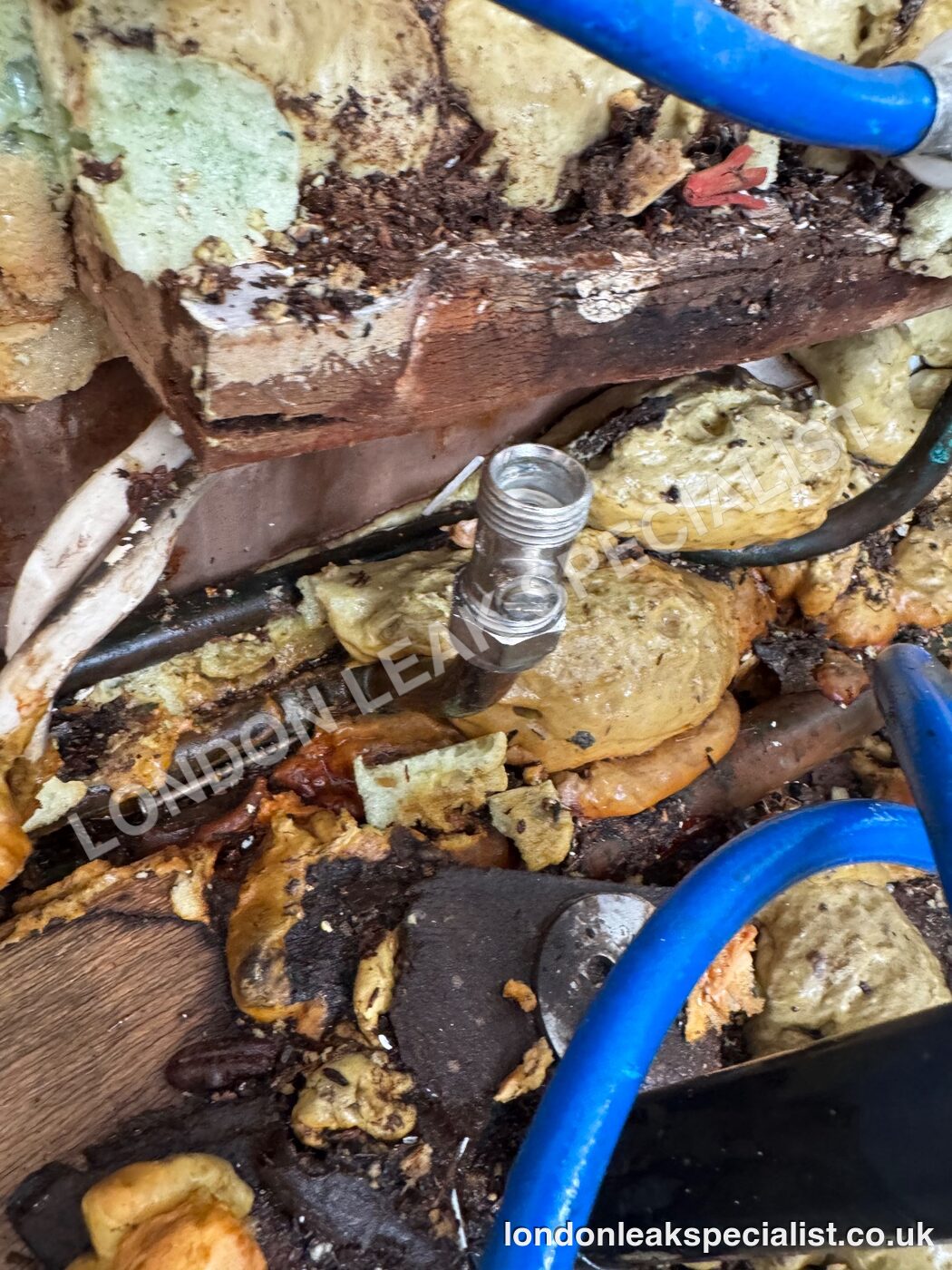
We then did two things to narrow it down.
- A pressure test. We pressurised the accessible supply pipework and watched the gauge. It only reached about 1 bar, most likely because the supply was isolated and the system was partly disconnected, but it held with no drop. We recorded that result with its limit: a low-pressure test on a half-dismantled system cannot prove the pipes are sound.
- A tracer dye test on the waste. We ran yellow dye into the accessible waste pipework and asked the residents below to watch for coloured water over 24 hours. Dye is a straightforward way to test whether a waste pipe is leaking, because coloured water turning up in a ceiling is hard to argue with.
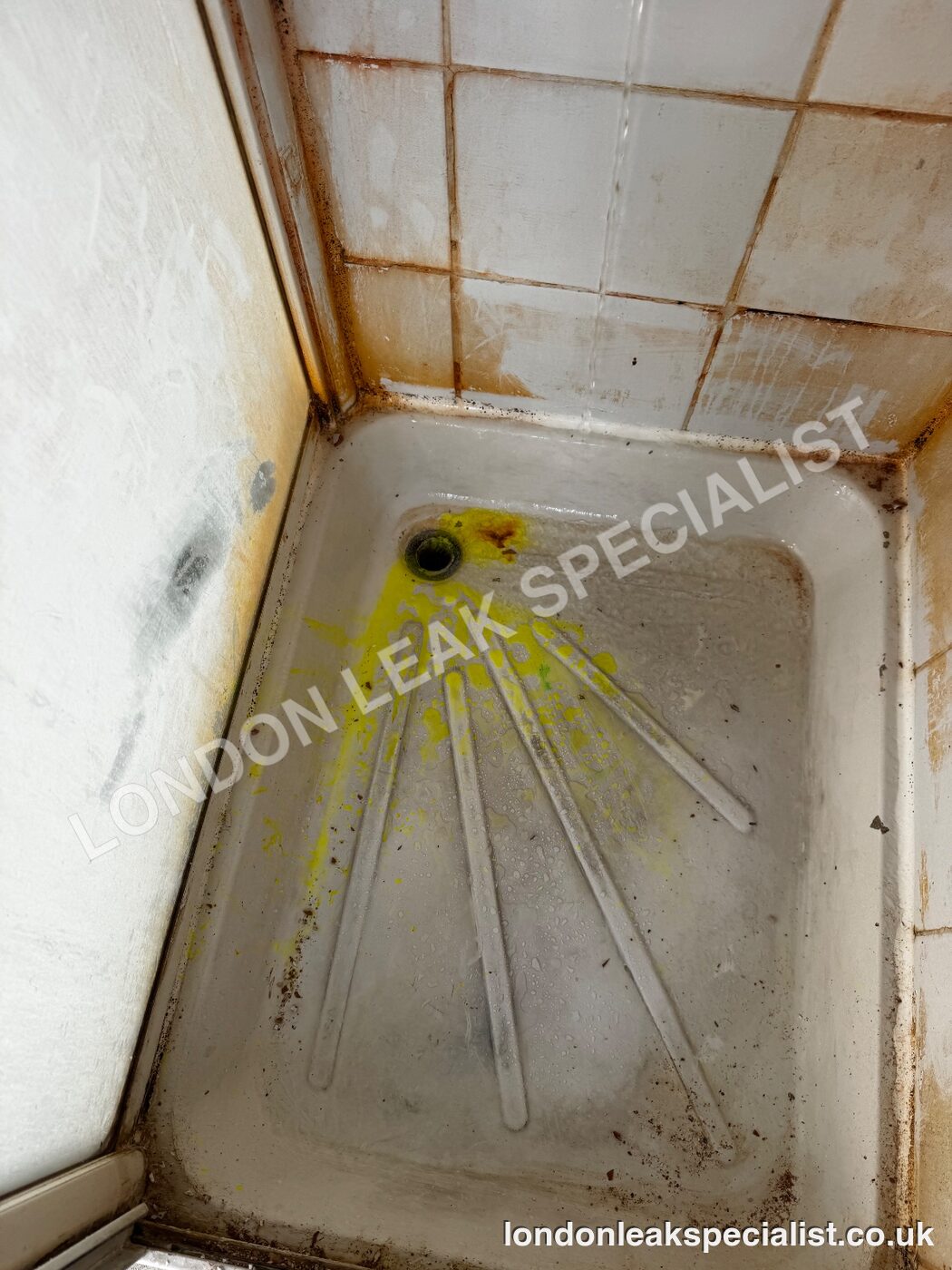
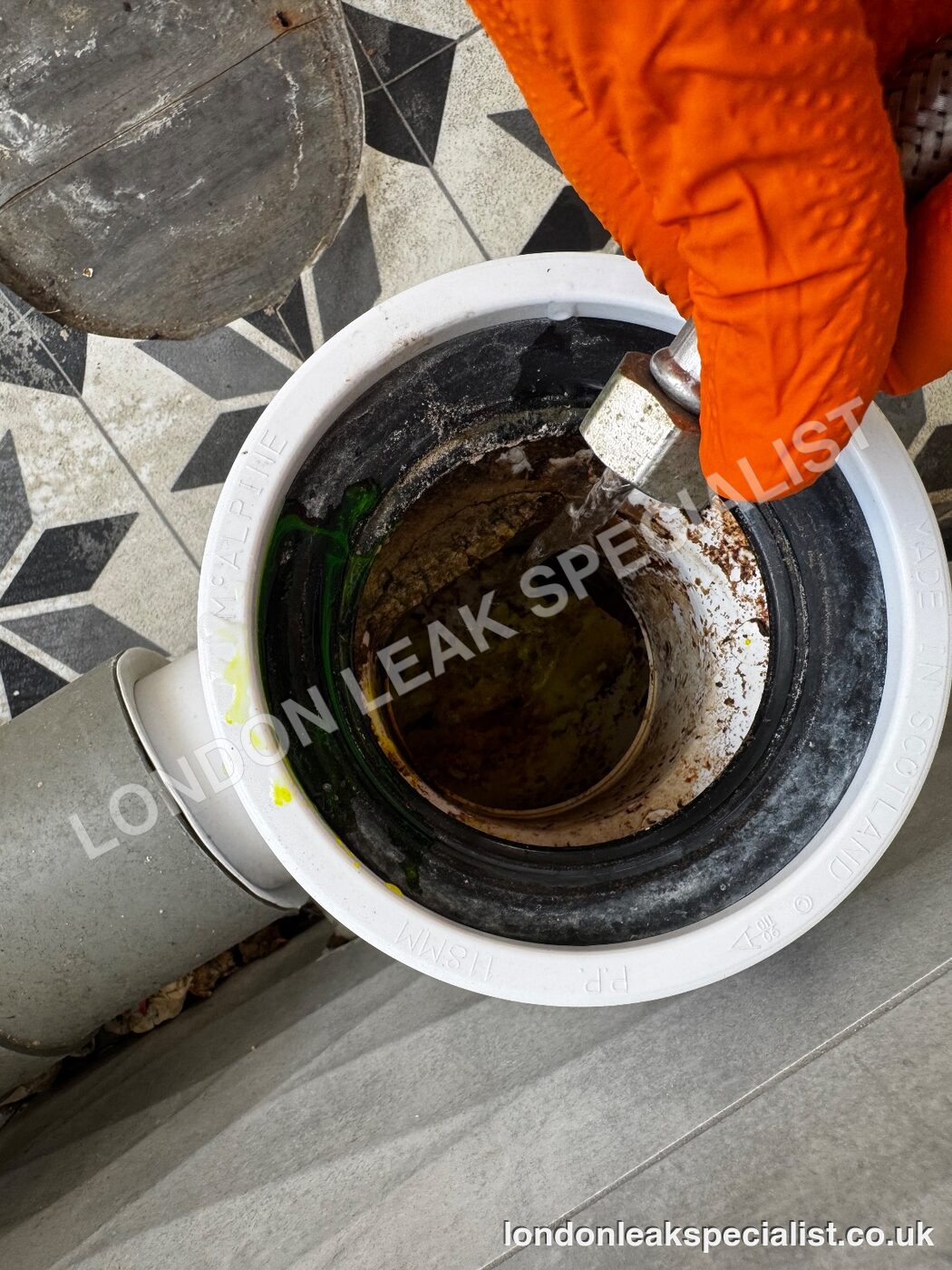
For background on choosing between dye, gas and listening methods, see our guide to acoustic, thermal and tracer gas leak detection. We also used dye on a different building in our NW10 soil stack case study.
The second visit: following the water down
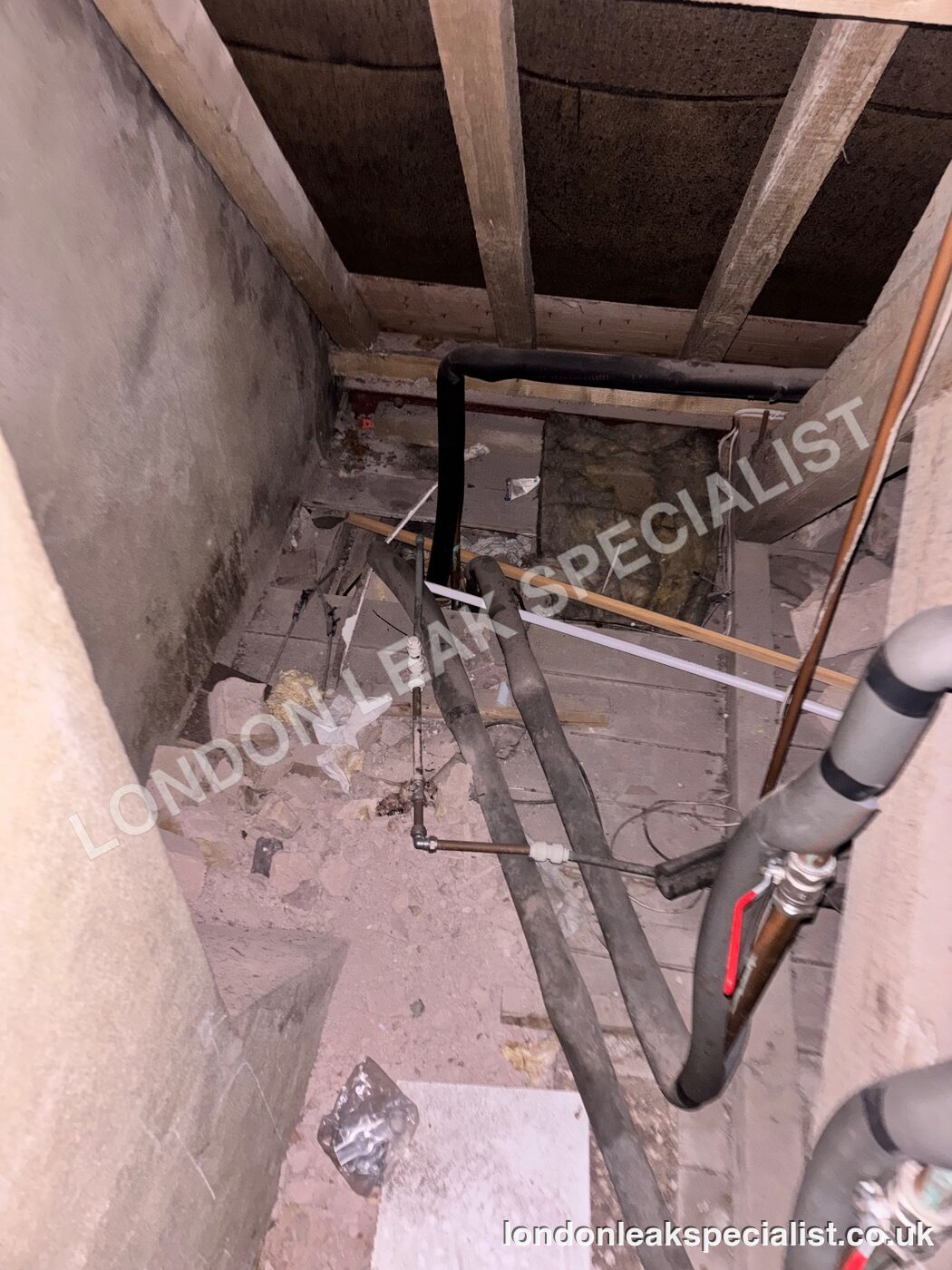
Because water was still arriving, the second visit started in the flat where it was showing most. We located the boiler and followed the pipework. The pipes there run beneath the concrete floor, not through the ceiling, so there was nothing at ceiling level to blame. That matters: it meant the water in that ceiling was arriving from somewhere else.
We opened the ceiling where the water was mainly coming through. There was no pipework in the void at all. The only significant item was a steel beam, boxed in and cracked along its casing.

We then went up to the flat directly above, which has a new bathroom. All of its pipework sits about four inches above the floor, so it is easy to inspect. We went over it and found no active leak. That is a useful result: a new, visible bathroom installation is exactly the sort of thing that would otherwise take the blame.
What we found, and what we did not
We did not find the source, and the report says so. What we established was this:
- The isolation of the top-floor flat had not stopped the escape, so the leak cannot be pinned on that flat alone.
- The pipework in the flat below is not in the ceiling, and the opened ceiling held no pipe.
- The accessible pipework in the new bathroom above had no active leak.
- Two flats, the top-floor flat and one other, could not be accessed on the second visit.
Our working assessment, recorded as unconfirmed, is that water may be travelling through the main structural wall before it enters the ceiling below. The room underneath is open plan, which would let the water spread over a wide area of ceiling and make the leak look bigger than its source. That is a hypothesis, not a finding, and the report treats it as one.
Marylebone, NW1 and the City of Westminster
The NW1 postcode district is split between the London Borough of Camden and the City of Westminster, and this job sits on the Westminster side, in the Marylebone and Lisson Grove area. Buildings like this are typically stacked mansion blocks where bathrooms and kitchens sit above one another, with communal risers, boxed-in beams and old structural walls. A leak can travel a long way inside that fabric before it shows. We cover the area on our leak detection in Marylebone page and the wider City of Westminster page. For more on staining that appears in one flat but starts in another, see our guide to damp patches on ceilings.
What we did on the day, and why we stopped where we did
On the two visits we inspected the top-floor flat and the two flats below it, pressure tested the accessible supply, ran the waste dye test, opened the ceiling void, and inspected the new bathroom pipework. We did not do a repair, and that was deliberate.
Without a confirmed failed pipe or entry point, any repair is a guess. The risk is simple: pay to replace a section of pipe or re-do a bathroom, then find the ceiling still wet. The report instead recommends getting access to the remaining flats and running a trace gas test in them. Tracer gas is a safe mixture pushed into a pipe system and detected on the surface above, so it can find a concealed pinhole without taking up a floor. It is the logical next step when pressure and dye have not given a clear answer and the pipes are not visible.
We also recommended putting a waterproof sheet over the kitchen floor in the flat below before anyone opens that ceiling further.
What permanent repair is needed
None can be specified yet, and we are not going to invent one. Once the source is located, the report says the defective section or connection should be repaired and the system tested under normal operating conditions to confirm the water has stopped. After that the ceilings, lining and decoration need to dry and then be made good. We can quote the repair and the make-good together, so the ceilings end up finished to like-new rather than patched while the cause still exists.
The order matters:
- Get access to every flat on the suspected route.
- Trace gas test the supply and heating pipework in those flats.
- Repair the confirmed failure and pressure test the repair.
- Monitor the ceilings below until they are dry, then redecorate.
Why this saved time, money and damage
We will not put a figure on it, because the job is not finished. The reasoning is still worth setting out.
- It avoided repairing the wrong flat. Earlier assumptions pointed at the top-floor flat. The isolation result showed that assumption was incomplete before anyone paid for pipework or a new bathroom there.
- It ruled out the flat above without opening it up. Inspecting the visible new bathroom pipework cleared it in a short time instead of leaving it as a standing suspect.
- It stopped more ceilings being cut open. The one ceiling we opened showed there was no pipe in it, which answers the question for the other ceilings in the same position.
- It gave the managing party a written list of what is still needed. That is access and a trace gas test, not another round of guessing.
What an insurer, agent or landlord looks for in a report like this
In a block with several owners and a managing party, the report is as much about responsibility as pipes. Who pays often depends on the leases and where the leak starts. Citizens Advice explains the general position, including that a tenant should tell the landlord and keep records, in its page on leaks from a neighbouring flat. A reader wants the tests listed, the readings, the limits, who was and was not accessible, and a clear opinion on what happens next.
On insurance, be careful. Trace and access cover is in many buildings policies but not all, and some exclude gradual wear. We cannot promise cover. Our trace and access cover explainer and our insurance leak claims page set out what insurers usually ask for. Our pricing page lists the public rate, which is £160 an hour. For a different flat-to-flat dispute with a clearer result, see our NW5 shower leak case study.
What you can check yourself
- Keep a dated log with photos. Note when water appears and how much. A pattern that follows rain suggests the outside of the building, while one that follows use of baths and toilets points to waste or supply. It works because the timing narrows the source.
- Check whether the water stops when the flat above is isolated. If it does not, treat the isolation as a clue that the source is elsewhere or that there is more than one route, not as a failed test.
- Put a shallow tray under any drip and note the colour. Clear water points to the supply or rain, brown staining to water that has travelled through plaster and dust, and dye to the waste you tested.
- Look at the water meter if you have one. With everything off, a meter that keeps moving means the loss is on the supply. It works because it ignores the ceiling and measures the supply directly.
- Protect the floor and the contents. A sheet and a bucket cost nothing and prevent a second claim.
Water coming through a ceiling in Marylebone, NW1, or anywhere in the City of Westminster and London? We find the source or show where it is not, and write the report an agent, landlord or insurer can act on. If we do not find your leak, you do not pay.
How we help with this
If the article describes a problem you actually have, these are the visits that deal with it.
- water coming through a ceiling
What to do first when it is coming through from above.
- leak detection in London
Finding a hidden leak without opening the property up first.
Not sure which one applies? Describe the symptom on the phone and you will be told which survey it is, the hourly rate and roughly how long it takes, before anything is booked. 020 7123 8560
Frequently asked questions
Why is water still coming through my ceiling after the flat above turned its water off?
Isolating one flat only removes that flat's supply. Water can still come from another flat, communal pipework, the waste system, heating pipes, or travel along a wall or beam before showing at the ceiling. Further testing, such as tracer gas, is needed to confirm the route.
How do you trace a leak between flats in a mansion block?
We work through the accessible plumbing in each flat, pressure test the supply, run dye through the waste, open the affected ceiling to check the void and then use tracer gas where the pipes are concealed. We record each result and its limits in a written report.
Who is responsible for a leak from the flat above in London?
It depends on the lease and where the leak starts. Pipes serving only one flat are usually that flat's responsibility and communal pipes the landlord or management company's, but check your lease. Citizens Advice has general guidance for tenants.
Do you need access to every flat to find the leak?
Often yes. On this job the investigation could not be completed because two flats were not accessible. We can only confirm a source in the pipework we can inspect or test, so arranging access early saves repeat visits.
Do you cover leak detection in Marylebone, NW1 and the City of Westminster?
Yes. We attend flats and mansion blocks in Marylebone, NW1 and across the City of Westminster. We find the source or show where it is not, write a report agents and insurers can use, and can quote the permanent repair and make-good.